This article, originally published in the Gujarati periodical Abhiyan in 1991, is reproduced here in translation solely for academic and research purposes, with the permission of its author, senior journalist Ms. Sheela Bhatt.
Credit and sincere thanks to Sheelaben, a founding member of Abhiyan magazine, for this article and for kindly granting permission to publish it in English and Hindi for the benefit of a wider readership.
The original Gujarati article is reproduced at the bottom of this page.
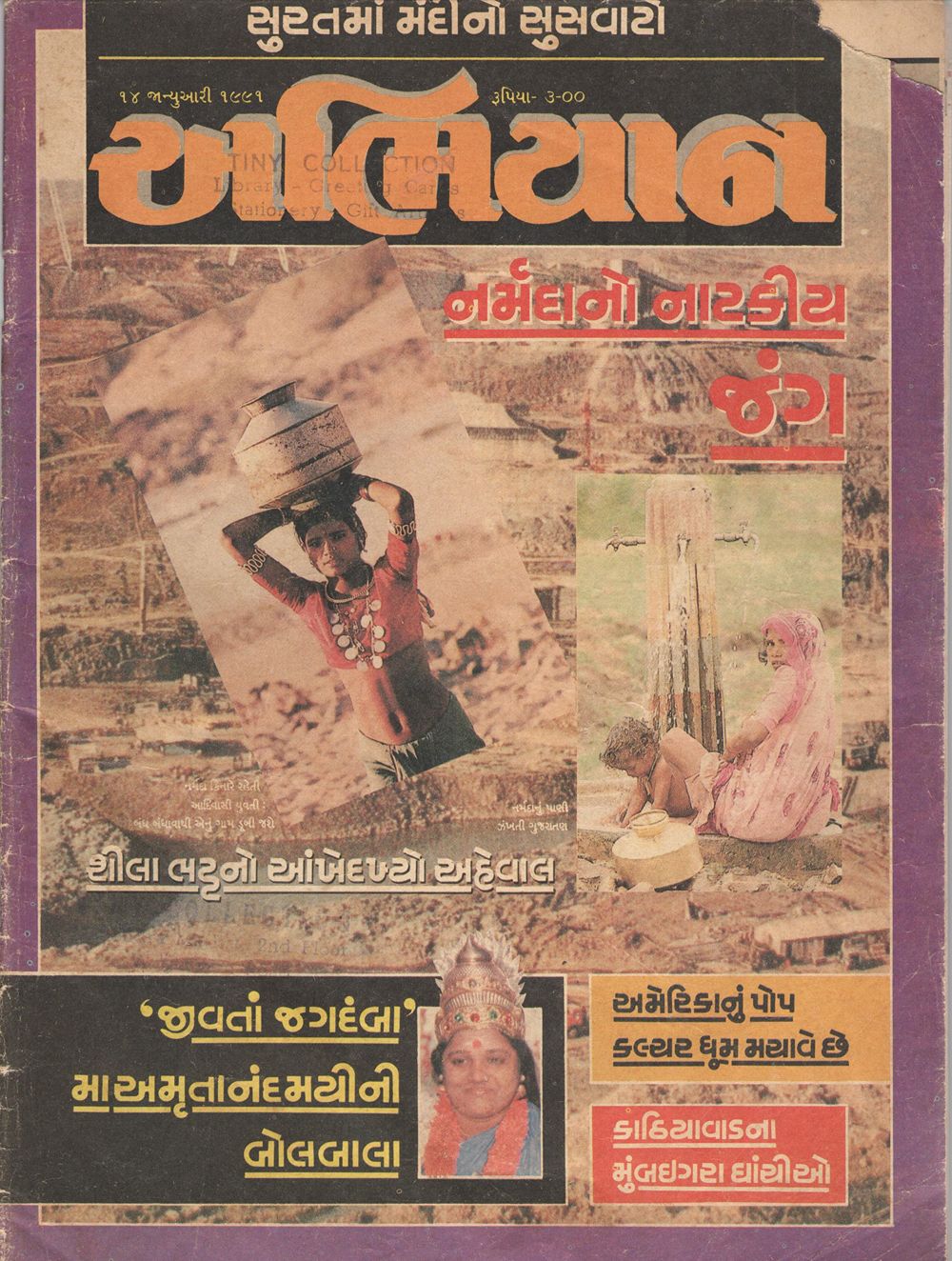
14 January 1991
Price: Rs. 3.00
Abhiyan
The Dramatic Battle over Narmada
An Eyewitness Report by Sheela Bhatt
Cover Story
In my twelve years of journalism, I had never experienced anything like what I witnessed on the first and second of January 1991 while reporting on the Narmada project and the movement opposing it. Never before have I seen or heard of a conspiracy on this scale to deceive the people of Gujarat and to prevent accurate information from reaching the Gujarati public. The Government of Gujarat, a large section of the people of Gujarat, and numerous voluntary organizations in the state are participating in a counter-movement against those opposing the Narmada project. Many Gujaratis, who are not in a position to study the Narmada project in depth, have not even realized the extent of the mafia-like tactics employed by those systematically spreading incomplete information—whether false or true—about the project.
On the third of January, while returning from Vadodara to Mumbai, I resolved that if I wrote about both the supporters of the Narmada project and those opposing it, I would write according to what I believed to be true. If I failed to write what I genuinely believed today, then twenty years from now I would regret having remained silent in 1991—through dishonesty, calculated caution, fear of displeasing the majority of readers, and in pursuit of the short-term interests of my weekly magazine.
Every day, in many Gujarati newspapers, by reading the information and articles supplied ready-made by the Gujarat government’s Information Department and the Narmada Nigam, many Gujarati readers, out of passionate love for Gujarat, have become supporters of the Narmada project. The love of all those people of Gujarat for Gujarat is genuine. Loving our homeland is one thing, and being misled into the propaganda carried out cunningly through biased, spicy information about the Narmada project is another.
Since starting Abhiyan, this is the first time I wish to address my readers directly. I urge you to reconsider the Narmada issue free from the overwhelming influence of politicians’ speeches and the government’s publicity machinery. I would even say that every reader of Abhiyan should not, even for a moment, abandon the belief that a dam should indeed be built across the Narmada River. But having accepted that premise, you should then seek to understand all aspects of the issue: the corporation constructing the dam; Chimanbhai Patel; Keshubhai Patel; Jayprakash Associates, which has secured a major contract for the project; the newspapers publishing articles and reports in support of the dam; Medha Patkar, Baba Amte, and the displaced people of Madhya Pradesh and Maharashtra who are opposing it; and whether there is any truth to the allegations that anti-national or foreign funds are playing a role behind the movement against the dam.
If you are devoted to Gujarat, then you should form your opinion on this vital issue for the state only after learning the true facts. You should not lose your judgment and simply become one sheep in a flock.
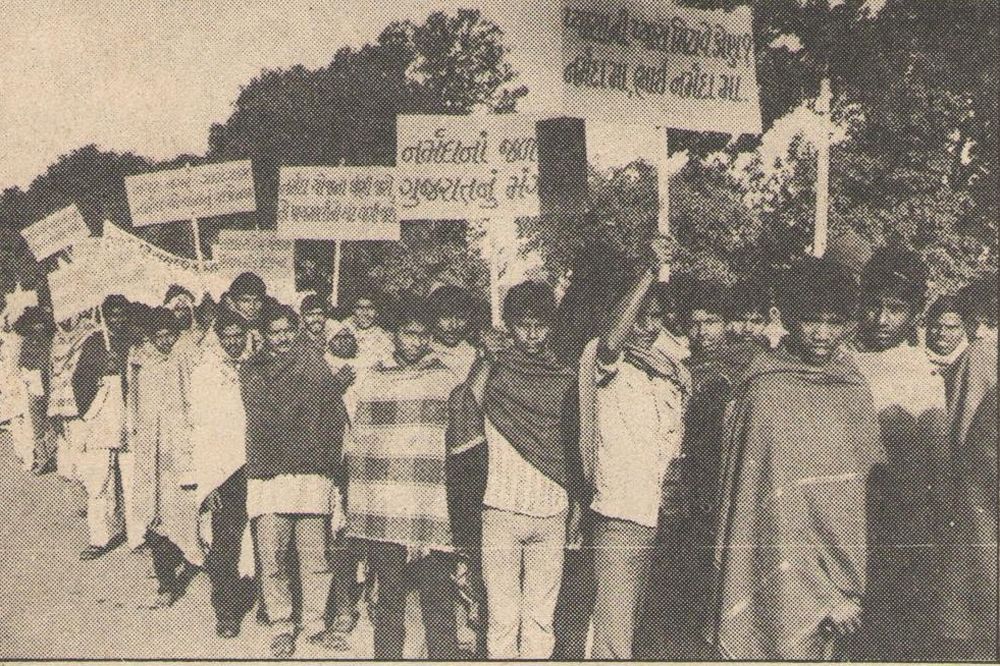
Since 29 December, two opposing groups have been facing each other at the border village of Ferkuwa, near Chhota Udepur on the Gujarat–Madhya Pradesh border. They raise slogans, shout at one another, and engage in loud exchanges. When tempers flare, fiery speeches are delivered. When they tire, the two sides sing garbas facing each other. Drums are beaten. Through loudspeakers, slogans are shouted with enough force to carry some 200 metres across to the other side.
On one side at Ferkuwa are the supporters of the massive dam being built across the Narmada River at Navagam—a structure planned to be 455 feet high and 4,000 feet long. They are backed by a camp of about 1,500 personnel from the Gujarat Police and the State Reserve Police. Two minutes further down the road, on Madhya Pradesh territory leading to the village of Chandpur, about 2,000 Adivasis have set up camp.
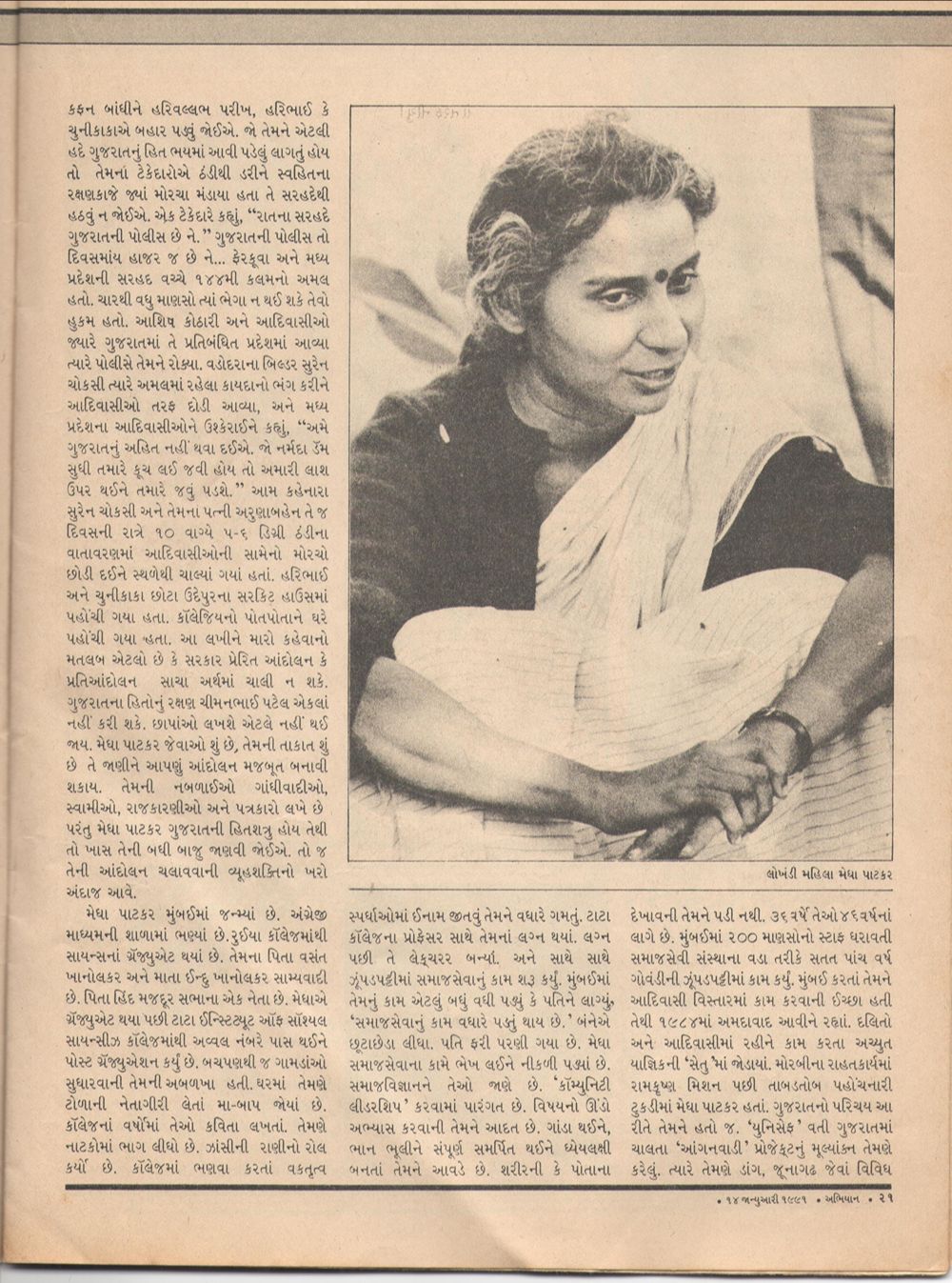
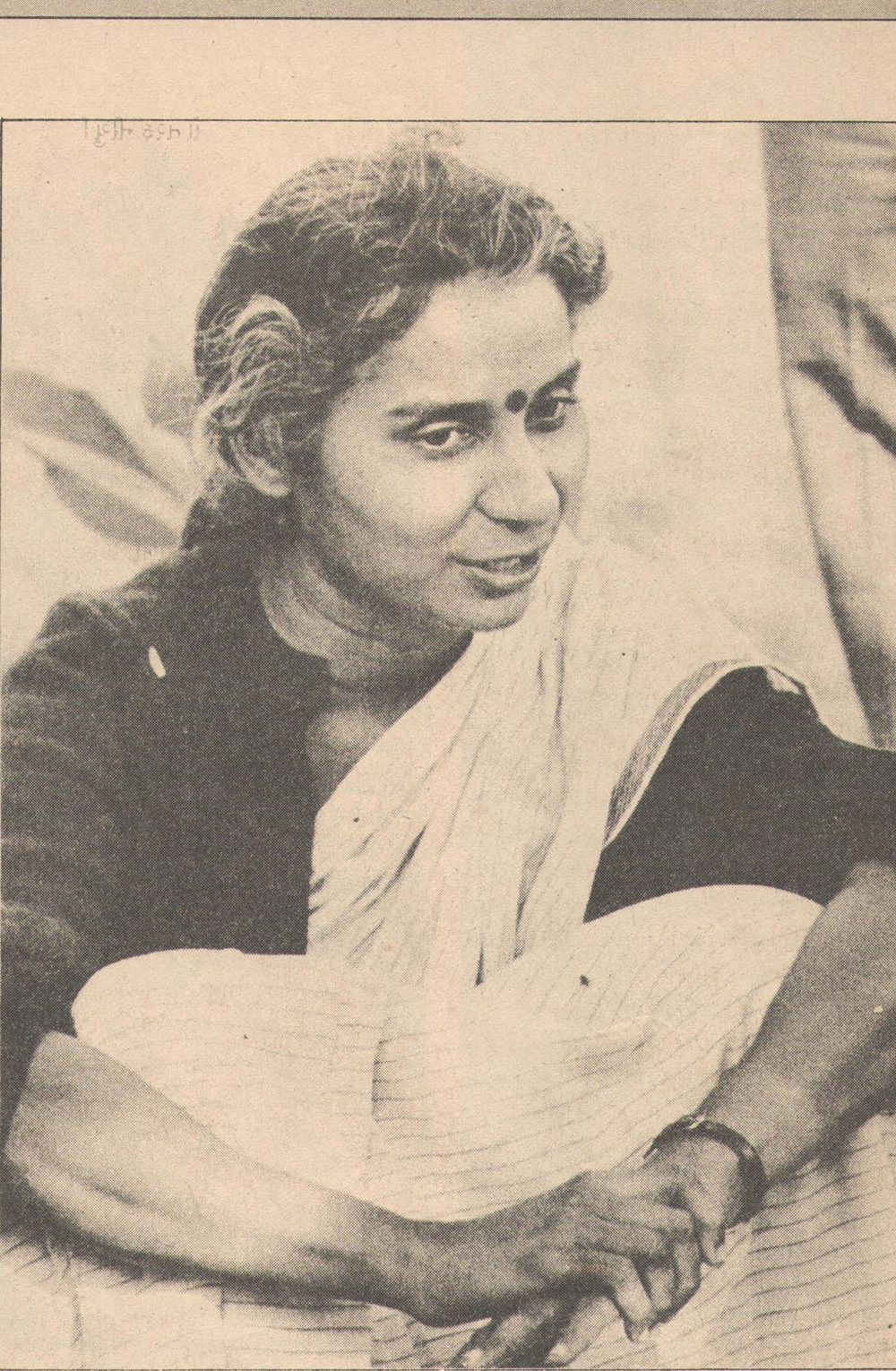
These Adivasi villages are among those that will be submerged when the Narmada dam is completed. They are expected to leave their ancestral homes and resettle in Gujarat, but they are not prepared to do so in the slightest. Present among them is Medha Patkar, the leader of this unprecedented movement, who taught them to fight for their rights. She too is here, wearing a simple inexpensive cotton sari and an ordinary sweater for warmth, hurrying about in the bitter cold. With a lean, almost fat-free frame and without ornaments such as bangles or earrings, she seems to live on the strength of sheer determination. Among the opponents of the Narmada dam, her stature is nothing less than that of a goddess. She is also receiving the support of Baba Amte.
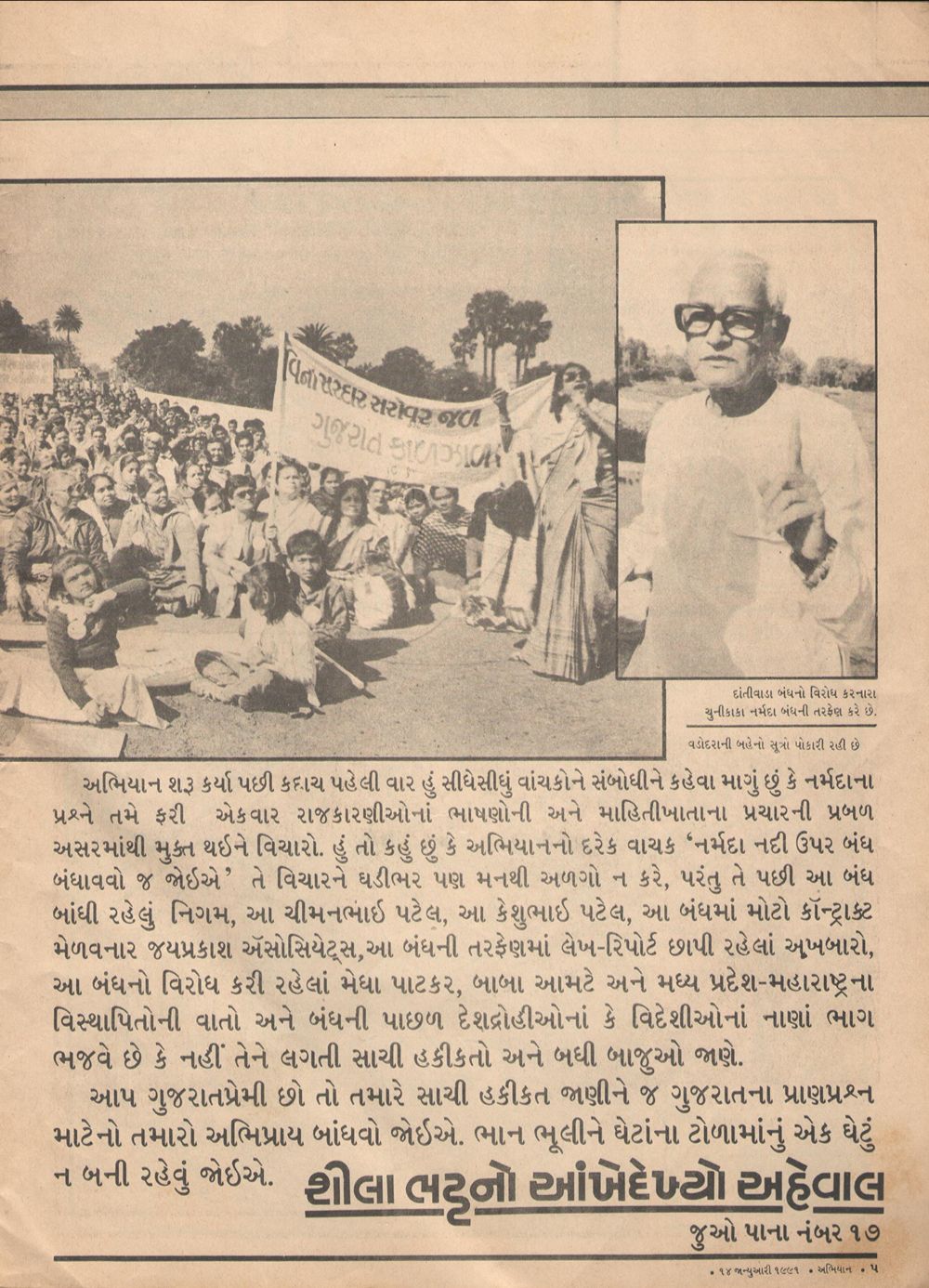
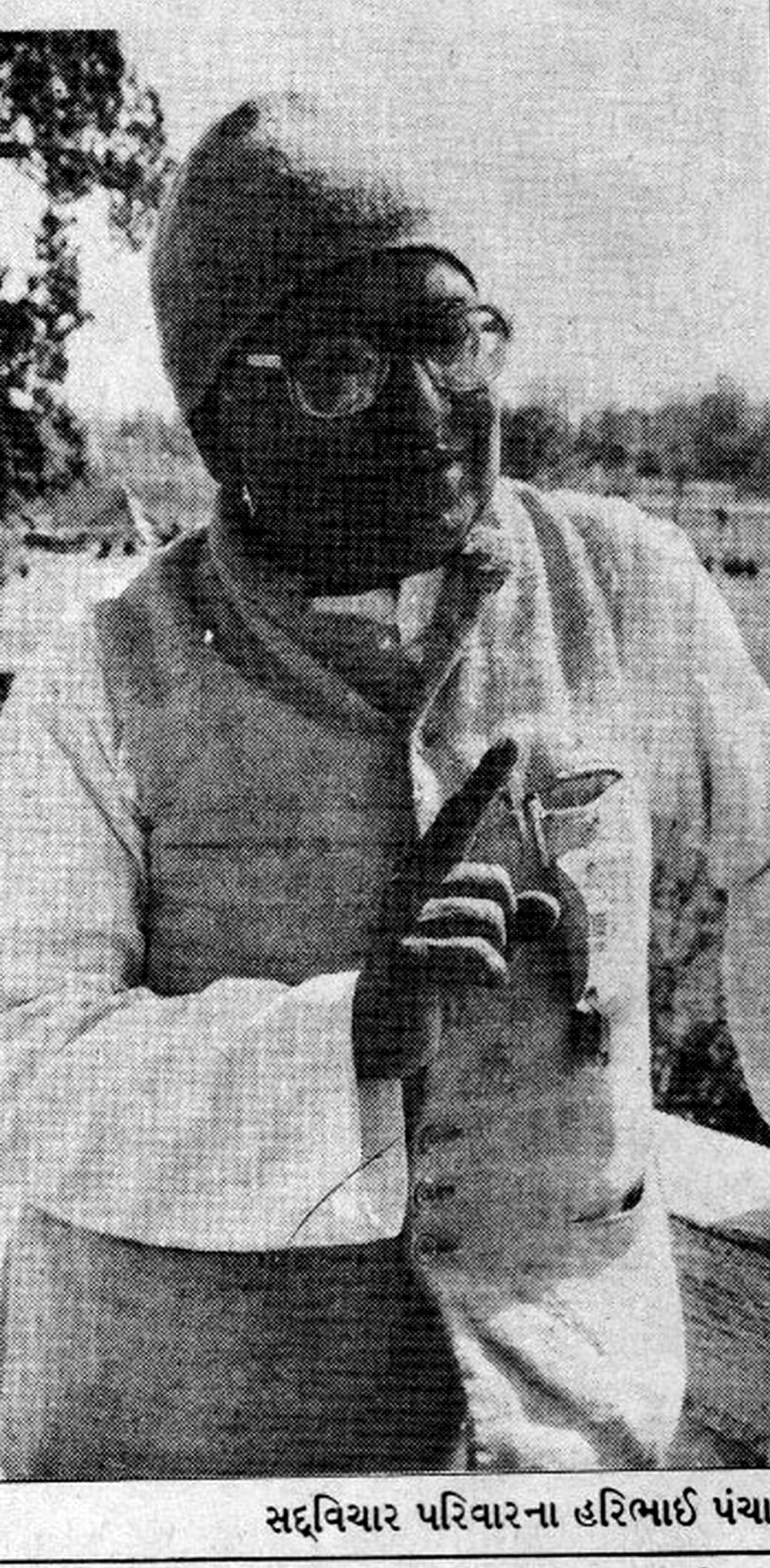
The visible leader of the pro-Narmada dam camp was Chief Minister Chimanbhai Patel. He occasionally arrives by helicopter at the site of this unusual, almost theatrical confrontation. During the day, however, those leading the demonstrations against Medha Patkar and Baba Amte were Sarvodaya leader Harivallabh Parikh of the Rangpur Ashram near Chhota Udepur, Gandhian Chunibhai Vaidya, and leaders such as Haribhai Raval and Krishnaprasad Patel of the Sadvichar Parivar. Chimanbhai Patel’s wife, Urmilaben Patel, is also present to encourage them all. Vadodara based builder Suren Choksi and his wife Aruna Choksi, accompanied by other women, also came to participate in the demonstrations. Students from the Chhota Udepur college and members of the Home Guards shouted slogans loudly against Medha Patkar and Baba Amte.
On one side, the slogans were:
“Struggle is our strength,
Struggle is our devotion.”
“What will Sardar Sarovar do?
It will destroy everyone.”
On the other side, the slogans rang out:
“Gujarat will never bow;
The dam will never stop.”
“The spirit of Gujarat is Gandhi and Sardar;
Baba Amte, beware! Beware!”
The atmosphere at Ferkuwa had become one of a battle between two opposing ideologies. The demonstrations by the Gujarat camp appeared considerably more aggressive in public. The college boys from Chhota Udepur laughed, chatted, and mingled casually. At the front sat a group of women from Vadodara, singing garbas in praise of the Narmada River. Haribhai had published 22,000 copies of a collection titled Narmada Garbavali. However, the copies had inadvertently been left behind, and before long they ran out of songs to sing.
Poets such as Pinakin Thakor and Madhav Ramanuj had composed special songs and garbas to support both the “Save the Narmada Dam” campaign and the Gujarat government’s efforts. Ever since Medha Patkar’s Narmada Bachao Abhiyan (“Save the Narmada” campaign—campaign to save the Narmada River from the dam) had gathered momentum, the Government of Gujarat had undertaken what could only be described as an unprecedented campaign to mobilize public opinion in favour of the dam. It had not merely sought support; it had deliberately intensified the movement. Every possible institution and prominent individual had been enlisted. Programmes of every kind were organized with the zeal of preparing for war. Rallies were held across the state.
In effect, Chimanbhai Patel had recast Medha Patkar’s movement for the rights of the displaced people of Madhya Pradesh and Maharashtra as though it were an invasion of Gujarat itself.
Haribhai Panchal gave me about five booklets. According to the information contained in them…
“…The time has come for the people of Gujarat to make a sacrificial commitment and plunge into action. Fortunately for Gujarat, all political parties are united on this issue, transcending party differences. Through the spontaneous people’s organization, Narmada Abhiyan, programmes have been planned to create public awareness and, should the need arise to face this ‘war’, to meet that challenge and resist it through non-violent means. These programmes include Narmada Melas, Narmada Conferences, Narmada Jal-Abhishek Yatras (water consecration processions), Narmada Public Meetings, Narmada Dayras (folk gatherings), Narmada Exhibitions, afforestation drives, and assistance in the rehabilitation of Narmada oustees. To implement these programmes, a Narmada Dal (Narmada Corps) is being formed. Narmada Abhiyan calls upon the people of every village in Gujarat to join this corps.”
This appeal was directed primarily at mobilizing people to participate in the “Shanti Yatra” (Peace March) scheduled to be held at Ferkuwa on 29 December. Medha Patkar had announced that, beginning on Christmas Day, she would lead a Sangharsh Yatra(March of Struggle) from Badwani in Madhya Pradesh with Adivasis, marching towards the Narmada dam. The Narmada Ahvaan Shanti Yatra was organized specifically to stop that march.
The rally on 29 December was an overwhelming success. However, the enthusiasm of Gujarat’s supporters of the Narmada dam slackened somewhat on the 30th and 31st. It had been expected that Medha Patkar and the Adivasis from Madhya Pradesh would reach Ferkuwa on 29–30 December, but their march on foot from Badwani to Chandpur took longer than anticipated. Meanwhile, supporters from Gujarat arrived at Ferkuwa free of cost in buses arranged by the government and voluntary organizations.
According to Darayash (Pranav) Nedhora, a Janata Dal worker from Vadodara:
“On the night of the 31st, those maintaining the front against the anti-dam protesters were freezing in the cold, and no arrangements had even been made for their meals. After that, nobody in Vadodara was willing to go to Ferkuwa for demonstrations. Then a message came from Chimanbhai in Gandhinagar that at least two busloads of people had to be sent to Ferkuwa. But people like Navnit Kaka and Kishore Rana all backed out. I finally drove there myself in my Maruti car.”
An unusual, government-sponsored agitation was underway at Ferkuwa. The zeal and fervour displayed by political workers, Gandhians, so-called Gandhians, and newspaper supporters of the dam were far greater than that shown by the people sitting in the crowds—or those who had been brought there to sit.
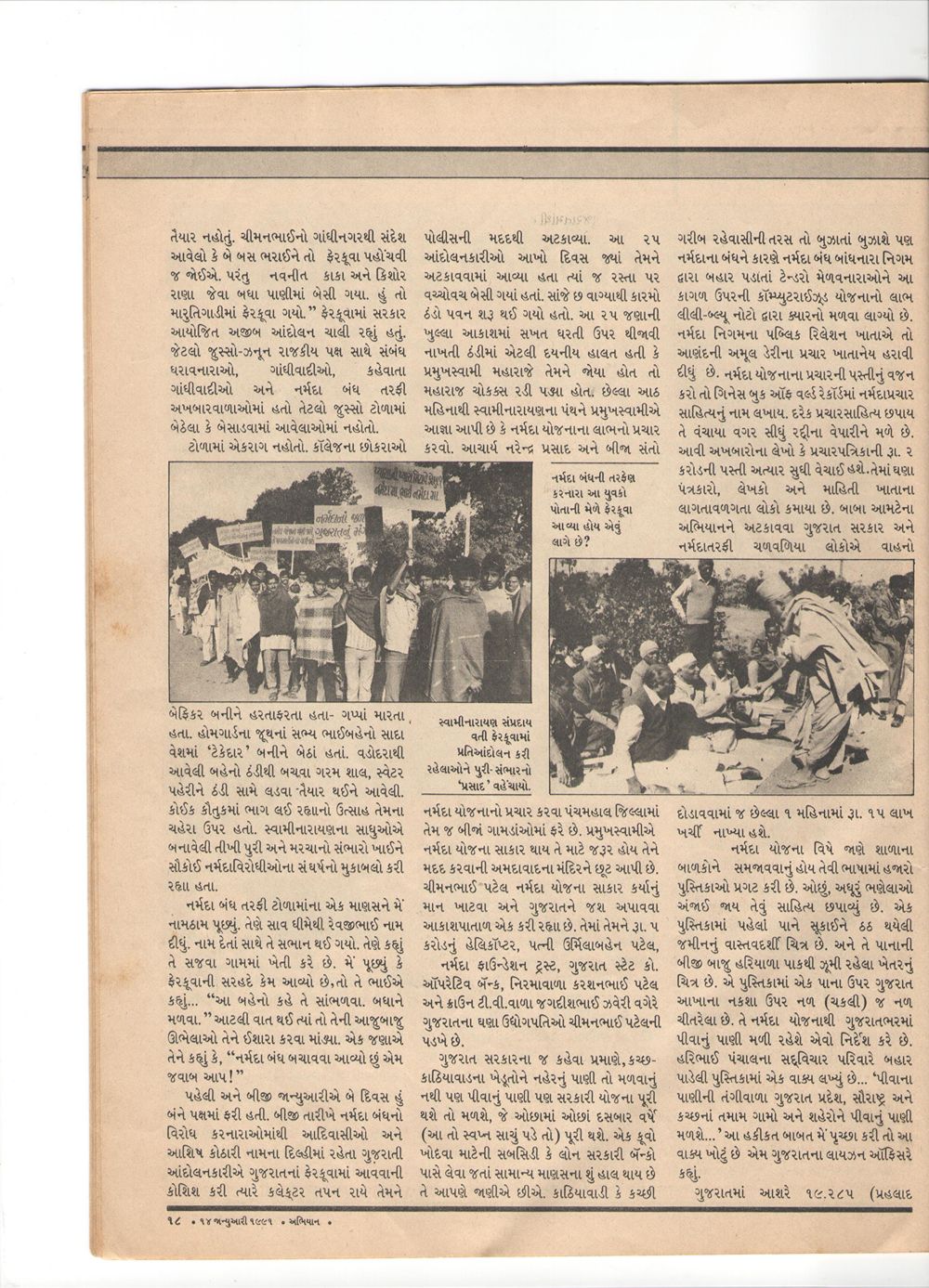
The crowd itself lacked any real sense of unity. The college boys wandered around carefree, laughing and chatting. Members of the Home Guards, dressed in ordinary clothes, sat among the crowd as volunteers and marshals. The women who had come from Vadodara were wrapped in warm shawls and sweaters, prepared to face the winter cold. Their faces reflected the excitement of taking part in what seemed to them a novel spectacle. Everyone fortified themselves with spicy puris and chilli relish prepared by Swaminarayan sadhus as they continued their vigil against the anti-dam protesters.
I asked one man in the pro-dam crowd his name and where he was from. Softly, he replied that his name was Revjibhai. But the moment he gave his name, he seemed to become self-conscious. He told me that he was a farmer from Sajwa village. I asked him why he had come to the Ferkuwa border. He replied:
“To listen to what these sisters have to say… and to meet everyone.”
No sooner had he said this than the people standing around him began signalling to him. One of them prompted him:
“Say you’ve come to save the Narmada dam!”
On the first and second of January, I spent two days moving between both camps. On the second, when a group of Adivasis opposing the Narmada dam, along with Ashish Kothari, a Gujarati activist based in Delhi, attempted to enter Ferkuwa in Gujarat, District Collector Tapan Ray stopped them with the help of the police. The twenty-five protesters sat down in the middle of the road at the very spot where they had been stopped and remained there throughout the day.
By six o’clock in the evening, an icy wind had begun to blow. The condition of these twenty-five people, sitting on the hard ground in the open under the freezing sky, was so pitiable that, had Pramukh Swami Maharaj seen them, he would surely have been moved to tears.
For the previous eight months, Pramukh Swami had instructed the Swaminarayan sect to publicize the benefits of the Narmada project. Acharya Narendra Prasad and other sadhus had been touring Panchmahals district and other villages campaigning in favour of the project. Pramukh Swami had also authorized the Ahmedabad temple to provide whatever assistance was necessary to help bring the Narmada project to fruition.
Chimanbhai Patel, determined to earn the credit for completing the Narmada project and to bring prestige to Gujarat, was sparing no effort. He had the support of a ₹5-crore helicopter, his wife Urmilaben Patel, the Narmada Foundation Trust, the Gujarat State Cooperative Bank, industrialists such as Karshanbhai Patel of Nirma, Jagdishbhai Zaveri of Crown TV, and many other prominent businessmen of Gujarat who stood firmly behind him.
According to the Gujarat government itself, farmers in Kutch and Saurashtra will not receive canal irrigation water. Even drinking water will reach them only if the government’s distribution scheme is completed—a task that will take at least another ten or twelve years, assuming everything goes according to plan.
We all know the ordeal an ordinary citizen faces in trying to obtain a government subsidy or bank loan simply to dig a well. The thirst of the poor residents of Kutch and Saurashtra may eventually be quenched, but those who have secured tenders issued by the Narmada Corporation for construction of the dam have already begun reaping the benefits of this computer-designed project in the form of bundles of green and blue currency notes.
The Public Relations Department of the Narmada Corporation has surpassed even the publicity machinery of Anand’s Amul Dairy. If one were to weigh all the publicity material produced for the Narmada project, it would deserve an entry in the Guinness Book of World Records. Most of this literature goes straight from the printing press to the scrap-paper dealer without ever being read. By now, nearly 2 crores worth of newspaper supplements and promotional pamphlets must have been sold as waste paper. Many journalists, writers, and people connected with the Information Department have profited from this exercise. To counter Baba Amte’s campaign alone, the Gujarat government and pro-dam activists must have spent nearly ₹15 lakhs during the past month merely on transportation.
Thousands of booklets explaining the Narmada project have been published in language so simple that it appears intended for schoolchildren. Literature has been produced in a style designed to impress people with little formal education. One booklet opens with a realistic picture of parched, cracked land; on the facing page is an image of lush green fields swaying with abundant crops. Another booklet carries a map of Gujarat covered with drawings of water taps, suggesting that the Narmada project will bring drinking water throughout the state.
One booklet published by Haribhai Panchal’s Sadvichar Parivar contains the following claim:
“All the villages and towns of Gujarat, Saurashtra, and Kutch that suffer from drinking water scarcity will receive drinking water.”
When I made inquiries about this claim, Gujarat’s liaison officer admitted that the statement was false.
According to Prahlad Patel’s booklet, Gujarat has approximately 19,285 villages. The government says that only 4,720 villages and 131 towns will receive drinking water from the project. Yet the publicity is conducted with such relentless exaggeration that one would think every household in Gujarat would enjoy running water twenty-four hours a day simply by turning on the tap. All sense of proportion has been lost.
The language used in Gujarat’s newspapers against the anti-dam movement portrays the Adivasis of Madhya Pradesh, Medha Patkar, and Baba Amte almost as though they were citizens of an enemy country. This is profoundly wrong. If the dam is in the interest of our state, then it should certainly be built, and Gujarat should not yield on that question. But that does not justify treating our neighbouring state as an adversary or launching this kind of counter-offensive against it.
Today, a kind of pro-dam mafia culture prevails in Gujarat. To oppose the Narmada dam is almost to be branded anti-Gujarat. Creating such an atmosphere reflects insecurity on the part of the dam’s supporters. If the Government of Gujarat and the people are genuinely confident in their determination to build the dam, why should they fear the internal opposition of a mere handful of people?
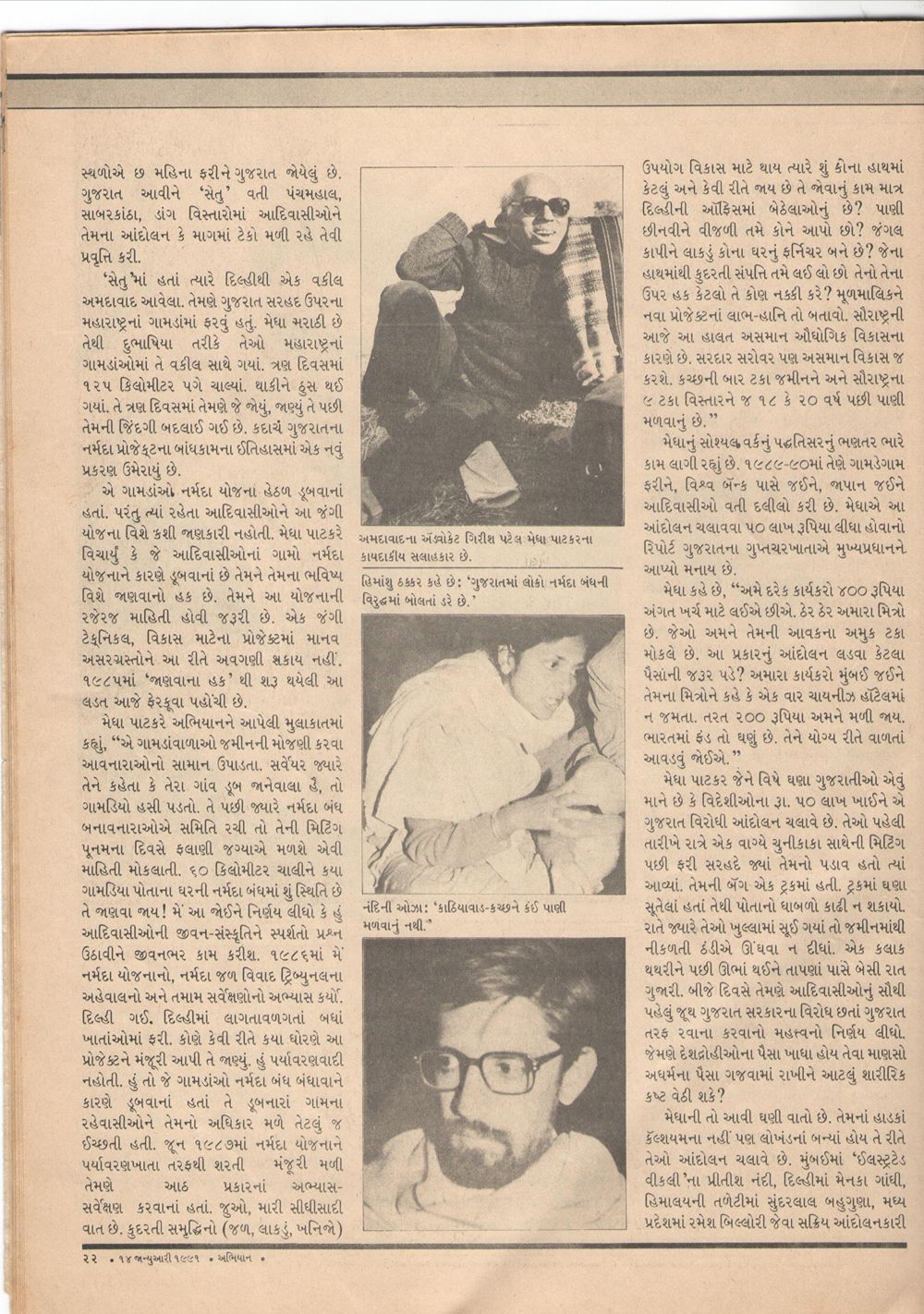
The newspapers of 3 January reported that an effigy of Ahmedabad advocate Girish Patel had been placed on a donkey, paraded through the streets, and burnt outside his residence in Naranpura. Girish Patel has practised law for fifteen years. He is no ordinary lawyer. Throughout his career he has fought cases on behalf of approximately 12 lakh poor and exploited workers. Today he serves as the legal adviser to Medha Patkar’s coordinating committee. Because he opposes the Narmada project, Rohit Patel and Ramesh Parekh—considered followers of Chimanbhai Patel—paraded and burnt his effigy outside his home.
The same report also declared that:
“A jihad to expel opponents of the Narmada project from Gujarat will begin. Soon, a blacklist of enemies of Gujarat’s interests who oppose the Narmada project will be made public.”
At this rate, tomorrow someone may even begin calling the displaced Adivasis terrorists.
I urge Abhiyan readers to reflect seriously on this development. It is an extremely grave matter.
Consider another report. A Vadodara newspaper published the following statement by local BJP leaders Dr. Girish Parekh, Bharat Vaishnav, Deepak Gandhi, Vijay Bhatt, and others:
“The character of Baba Amte, who is conducting this movement accompanied by film actresses, also becomes suspect. One of these actresses has close links with the notorious smuggler Haji Mastan.”
The implications of this statement are alarming. Everyone knows that Shabana Azmi supports the anti-Narmada movement. If the intention was to insinuate a connection between her and Haji Mastan, it is an extraordinarily serious allegation.
The Narmada issue has become useful to many people. Individuals whose names would never otherwise have appeared in the newspapers can now gain publicity simply by issuing press statements attacking Medha Patkar.
There is one more important thing I want to tell Abhiyan readers. You should ask what kinds of inducements are offered to us journalists to write in support of the Narmada dam!
This time, for covering the activities of the pro-dam Narmada Abhiyan at Ferkuwa, the government was prepared to pay our travel expenses from wherever we were—Mumbai, Ahmedabad, or elsewhere. Many journalists did, in fact, travel from Ahmedabad to Vadodara at government expense. They stayed at the comfortable Surya Hotel, were treated to complimentary non-vegetarian meals and liquor, and were then conveniently transported by bus to Ferkuwa to write articles supporting the Narmada dam—in the name of Gujarat’s interests. Around lunchtime, Sudhir Dave of the Public Relations Department of the Sardar Sarovar Narmada Corporation would even ask them at Ferkuwa whether they had eaten.
No one seems accountable for the money belonging to the people of Gujarat. Are there no poor people in Gujarat? No unemployed? No people in distress? Looking at the way the government is spending money on promoting the Narmada project, one would think we were as wealthy as an American state.
Whenever there is a massive project, there are always small pockets of opposition. And if such opposition can be silenced by putting money into people’s mouths, then that is exactly what is done. Chimanbhai Patel’s interviews about the Narmada project are being published as full-page features in newspapers across Mumbai and Gujarat, entirely at the expense of the Gujarat government. If a newspaper does not receive one of these government-sponsored interview advertisements, it appears to become more anxious about securing the advertising revenue than about campaigning for the Narmada project itself.
Through highly reliable sources I have received a piece of information. Although I cannot prove it, I believe the possibility of it being false is extremely small.
It is believed that ever since Amarsinh Chaudhary was Chief Minister, Gujarat’s Director of Information, Kirit Shelat, began placating major newspapers such as Sandesh and Gujarat Samachar by giving them government advertisements-even unnecessary ones-with titles like Gujarat’s Journey of Development and Adivasi Leader Amarsinh Chaudhary. Even that was not enough to satisfy some newspaper proprietors. Gradually, pro-government news stories and interviews with chief ministers—written by the Information Department itself—began appearing in newspapers as though they were genuine news reports.
Imagine opening a newspaper and reading the headline:
“An Interview with the Chief Minister of Gujarat on the Narmada Project,” followed immediately by a question such as:
“What is your response to Baba Amte’s agitation against the Narmada project?”
Anyone with even the slightest understanding of journalism knows that an interview never begins abruptly without any introduction or context. If such an interview has been prepared in advance by the Information Department, it should clearly be labelled:
“Advertisement.” Otherwise, readers are deceived.
Much of the information relating to the Narmada project is published and read as though it were independent reporting by the newspapers themselves, while substantial sums of money flow into the pockets of newspaper owners. We do not know when the Sardar Sarovar reservoir will actually fill with water, but many people believe-and know-that newspaper owners’ pockets have already been filled with money because of it.
According to one estimate, Gujarat’s Information Department has an annual budget of around ₹5 crores. Of this, nearly ₹1 crore in annual advertising alone reportedly goes to Sandesh and Gujarat Samachar. According to a senior Gujarat government official:
“The time to transfer Information Director Kirit Shelat came long ago, but it is said that Shreyans Shah of Gujarat Samachar does not allow his transfer.”
Today, if a journalist cultivates the right friendships within the Narmada Corporation and the Information Department, corruption becomes remarkably easy. One can make money without ever being caught—and continue doing so for as long as the Narmada project lasts.
On 31 December, Gujarat Samachar published on its front page a photograph of Adivasis holding a country-made gun. The caption read: “Photographer Bharat Parekh had to undertake a strenuous journey through the forests to capture these fanatical Adivasis on camera.”
The photograph created a sensation. It amounted to a serious accusation against Medha Patkar’s non-violent movement.
When I asked Bharat Parekh about the photograph, he replied:
“This picture was not taken on the Gujarat border but in Umarala village in Madhya Pradesh. I was alone when I took it. No reporter accompanied me.”
Madhya Pradesh has long suffered from the menace of kidnappers and bandits. Many people possess country-made firearms, and Adivasis everywhere traditionally carry bows and arrows. One should attack an opponent by exposing genuine weaknesses, but Gujarat’s newspapers have chosen instead to aim below the belt in their attacks on those opposing the Narmada dam.
It is not only journalists; even saints and religious leaders seem to have lost their balance these days. Swami Sachchidanand, regarded as a deeply learned and brilliant scholar, has recently gone too far. Professor Pravin Sheth, who spent nearly two and a half years studying the Narmada project in depth, was initially opposed to it, later became neutral, and is now an ardent supporter. Even Professor Sheth has been distressed by Swami Sachchidanand’s remarks about Baba Amte.
The Swami has recently published a book titled Reply to Baba Amte. If his name were omitted from the cover, one might think it had been written by a politician such as Member of Parliament Prakash Brahmbhatt. Referring to former Planning Commission member Rajni Kothari, the Swami writes:
“This gentleman (Kothari) has gone after the Sardar Sarovar project with great determination. The people of Gujarat should learn to recognize their own people. We are not as distressed by the attitudes of Baba Amte, Menaka Gandhi, or Medha Patkar as we are by these traitors from within our own house.”
Is this the language one expects from a saint? One who is a scholar of the Bhagavad Gita writes, in anger:
“…This anti-development thinking is like malaria mosquitoes… Just as people sleep peacefully only after getting rid of mosquitoes, so too should they recognize the true face of those who wear the masks of environmentalism and other such ideologies in order to obstruct development.”
Even if the author of a work such as Vedanta-Samiksha disagrees with others, how can he use such trivial and demeaning language as “malaria mosquitoes”?
Among Gujarat’s urban population, support for the Narmada dam has become almost a fever, fuelled by newspaper coverage. Like the Ayodhya Ram Janmabhoomi dispute, the Narmada issue has become, for many newspaper readers, merely another subject for public excitement and conversation.
Yet while Medha Patkar spent the last five years travelling relentlessly from village to village throughout the Narmada valley, patiently winning over Adivasi communities to her cause, and after painstakingly persuading them to lock their homes and join this phase of the struggle, Gujarat’s counter-movement responded with little more than a single massive public meeting. During the day, barely 1,500 to 2,000 people turned up for demonstrations. The villagers of Gujarat did not spontaneously camp at Ferkuwa through the night to mount a determined response.
On the night of 2 January, after meeting Medha Patkar and the Adivasis of Madhya Pradesh, I returned to the Gujarat border. There was not a single Narmada Abhiyan activist left there. If they truly wished to demonstrate their strength, leaders such as Harivallabh Parikh, Haribhai, or Chunikaka should themselves have remained at the front, prepared to sacrifice everything. If they genuinely believed Gujarat’s interests were under such grave threat, their supporters should not have abandoned the border merely because of the cold.
One supporter told me:
“The Gujarat Police are guarding the border at night.”
But the Gujarat Police were present during the day as well.
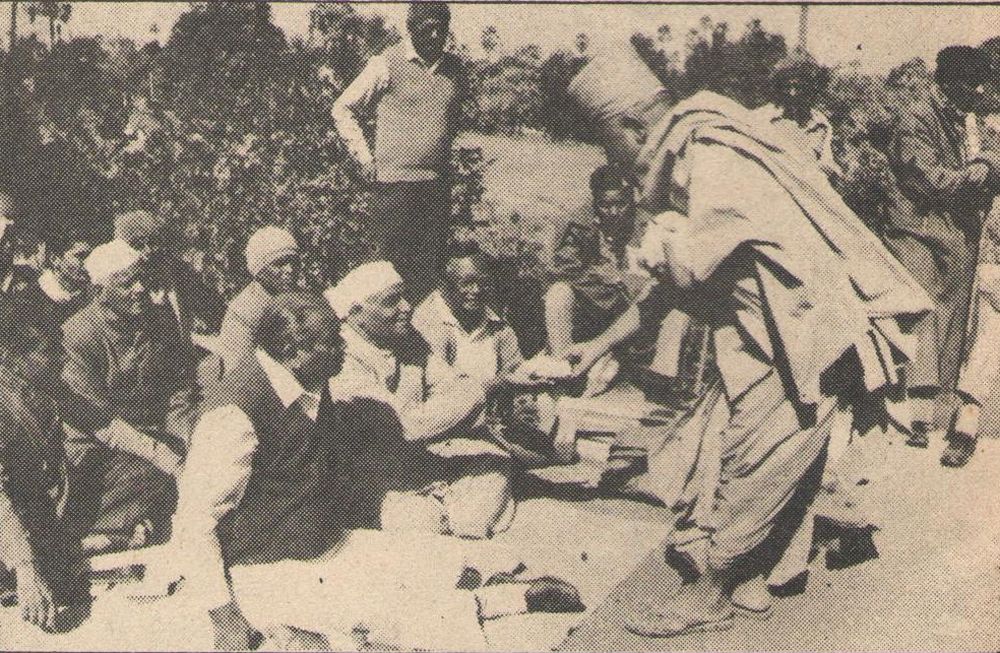
Section 144 was in force between Ferkuwa and the Madhya Pradesh border, prohibiting the assembly of more than four people. When Ashish Kothari and the Adivasis entered the prohibited area on the Gujarat side, the police stopped them. At that moment, Vadodara builder Suren Choksi violated the prohibitory orders and ran toward the Adivasis, shouting:
“We will not allow Gujarat’s interests to be harmed. If you wish to march to the Narmada dam, you will have to walk over our dead bodies.”
Yet that very night, at around 10 p.m., in temperatures of barely 5–6°C, Suren Choksi and his wife Arunaben abandoned their position opposite the Adivasis and left. Haribhai and Chunikaka retired to the Circuit House in Chhota Udepur. The college students went back to their homes.
The point I wish to make is this: a government-sponsored movement—or counter-movement—cannot succeed in any genuine sense. Chimanbhai Patel alone cannot safeguard Gujarat’s interests. Nor will those interests be protected simply because newspapers write in support of the dam.
Instead, we must understand who Medha Patkar is, what her strengths are, and how her movement functions. Gandhians, religious leaders, politicians, and journalists repeatedly write about her weaknesses. But precisely because she is portrayed as an adversary of Gujarat’s interests, it becomes all the more important to understand every aspect of her personality and her movement. Only then can one make a realistic assessment of her strategic abilities as a leader.
Medha Patkar was born in Mumbai and studied in an English-medium school. She graduated in Science from Ruia College. Her father, Vasant Khanolkar, and her mother, Indu Khanolkar, were socialists. Her father was a leader of the Hind Mazdoor Sabha. After graduating, Medha completed her postgraduate studies at the Tata Institute of Social Sciences, graduating at the top of her class.
From childhood, she had a strong desire to improve village life. At home, she had watched her parents lead groups of people in public causes. During her college years she wrote poetry, acted in plays, and even played the role of the Rani of Jhansi. Winning prizes in debating competitions interested her more than academic study.
She married a professor from the Tata Institute. After marriage she became a lecturer while simultaneously beginning social work in Mumbai’s slums. Her work gradually became so consuming that her husband felt she was devoting herself excessively to social service. The couple divorced. Her former husband remarried, while Medha renounced a conventional domestic life and dedicated herself entirely to social work.
She is well-versed in the social sciences and highly skilled in community leadership. She has the habit of studying every subject in depth. She possesses the ability to become completely absorbed in a cause, forgetting herself in total commitment to a chosen objective. She pays little attention to her appearance or physical comfort. At the age of thirty-six, she appears closer to forty-six.
For five years she headed a voluntary organization with a staff of about two hundred people, working in the Govandi slums of Mumbai. But she longed to work among Adivasi communities rather than in the city. Accordingly, in 1984 she moved to Ahmedabad and joined Setu, the organization led by Achyut Yagnik, which worked among Dalits and Adivasis.
She was also part of one of the earliest relief teams to reach Morbi after the disaster there, arriving soon after the Ramakrishna Mission. In this way she became familiar with Gujarat. On behalf of UNICEF she evaluated the state’s Anganwadi programme, travelling throughout Gujarat for six months and visiting places such as Dang and Junagadh. Through Setu she subsequently worked in Panchmahals, Sabarkantha and Dang districts, supporting Adivasi communities in their struggles and demands.
While she was with Setu, a lawyer from Delhi [Late Vasudha Dhagamwar] came to Ahmedabad. She wished to visit villages in Maharashtra near the Gujarat border. Since Medha spoke Marathi, she accompanied her as an interpreter. In three days they walked 125 kilometres. The journey exhausted them, but what Medha saw and learned during those three days transformed her life. In a sense, it also marked the beginning of a new chapter in the history of the Narmada project.
The villages they visited were all destined to be submerged by the Narmada project. Yet the Adivasis living there knew virtually nothing about this enormous development scheme. Medha concluded that people whose villages were to disappear beneath the reservoir had a fundamental right to know about their future. They deserved complete information about every aspect of the project. It was unacceptable that people directly affected by such a massive technological and development project should be ignored in this manner.
The struggle that began in 1985 as a campaign for the right to know had, by the time of this article, reached Ferkuwa.
In an interview with Abhiyan, Medha Patkar recalled:
“The villagers would help the survey teams by carrying their equipment. When a surveyor told someone, ‘Your village is going to be submerged,’ the villager would simply laugh. Later, when the authorities set up committees for the dam project, notices would be sent saying that a meeting would be held at such-and-such place on the full moon day. Which villager could walk sixty kilometres just to learn what was happening to his own village? Seeing this, I decided that I would devote my life to raising issues affecting the lives and culture of Adivasis.
In 1986 I studied the Narmada project, the report of the Narmada Water Disputes Tribunal, and every available survey. I went to Delhi and visited every relevant government department. I wanted to understand who had approved the project, how, and on what basis. I was not an environmentalist. My only concern was that the people whose villages were going to be submerged should receive their rightful entitlements.
In June 1987 the Ministry of Environment granted conditional clearance to the project. Eight different studies and surveys were required. My point is very simple. When natural wealth—water, forests, minerals—is used for development, should decisions about who gets what and in what measure be made only by people sitting in offices in Delhi? When you take away water, who receives the electricity generated from it? When forests are cut, whose homes receive the furniture made from that timber? Who decides how much right the original owners have over the natural resources taken from them? At the very least, show them both the benefits and the costs of the new project.
Saurashtra’s present condition is itself the result of unequal industrial development. The Sardar Sarovar project will also produce unequal development. After eighteen or twenty years, only twelve per cent of Kutch’s land and nine per cent of Saurashtra’s area will actually receive water.”
Medha’s formal training in social work proved invaluable. During 1989–90 she travelled from village to village, presented the Adivasis’ case before the World Bank, and even went to Japan to argue on their behalf.
It was reportedly claimed in a Gujarat Intelligence Bureau report submitted to the Chief Minister that Medha had received 50 lakhs to run the movement.
Medha rejected such allegations:
“Each of our workers receives only ₹400 a month for personal expenses. We have friends everywhere who contribute a small percentage of their income. How much money does a movement like this really require? Our workers go to Mumbai and tell their friends, ‘Skip one meal at a Chinese restaurant.’ Immediately we receive ₹200. There is no shortage of funds in India. One simply has to know how to mobilize them properly.”
There is much more that could be said about Medha. She conducts the movement with such determination that one feels her bones are made not of calcium but of iron.
She has received strong support from a wide network of individuals and organizations: Pritish Nandy of the Illustrated Weekly in Mumbai; Menaka Gandhi in Delhi; Sundarlal Bahuguna in the Himalayan foothills; activists such as Ramesh Billore in Madhya Pradesh; Dr. Siddharaj Solanki, Director of the Adivasi Research Institute at Gujarat Vidyapith in Ahmedabad; Vinod Raina and Rajesh Khindri of the Eklavya organization in Bhopal; the Parivartan Group of Vadodara; the Samaj Parivartan Sangh of Karnataka; the anti-missile movement activists of Baliapal in Odisha; the noted natural historian Bittu Sehgal; and nearly three hundred organizations across India.
The theatre group Nishan, which stages street plays, has also supported her movement. Rajni Kothari of the Indian Institute of Public Administration and both his sons are associated with Medha. Ashish Kothari is an exceptionally sharp-minded activist, while his brother documents people’s movements throughout India through the organization Lokayan. Rajni Kothari himself is originally from Palanpur.
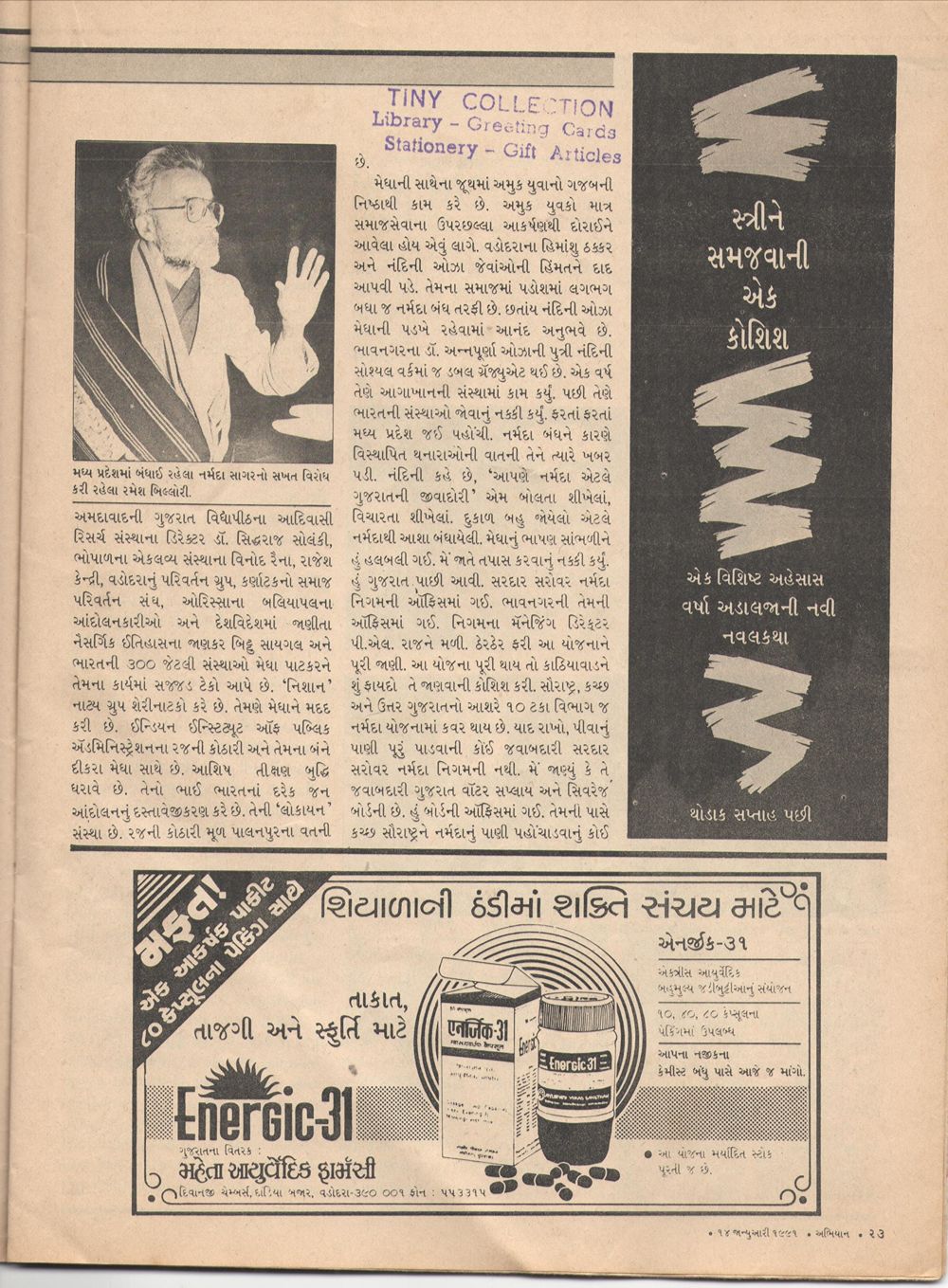
Among Medha Patkar’s colleagues are some young people who work with extraordinary dedication. Others appear to have been drawn into the movement merely by a superficial attraction to social service. People such as Himanshu Thakkar and Nandini Oza of Vadodara deserve admiration for their courage. In their own social circles and neighbourhoods, almost everyone supports the Narmada dam. Yet Nandini Oza finds satisfaction in standing beside Medha.
Nandini, the daughter of Dr. Annapurna Oza of Bhavnagar, holds two degrees in Social Work. She worked for a year with an Aga Khan organization before deciding to travel around India to learn about different voluntary organizations. During those travels she reached Madhya Pradesh, where she first became aware of the plight of the people who would be displaced by the Narmada dam.
Nandini says:
“We grew up believing and saying that the Narmada was the lifeline of Gujarat. We had witnessed repeated droughts, so naturally we placed our hopes in the Narmada. But after hearing Medha speak, I was deeply shaken. I decided to investigate the matter for myself.
I returned to Gujarat. I visited the offices of the Sardar Sarovar Narmada Corporation, including its office in Bhavnagar. I met the Corporation’s Managing Director, P. L. Raj. I travelled extensively and tried to understand the project in its entirety. I wanted to know what benefit Kathiawar would actually receive if the project were completed.
Only about ten per cent of Saurashtra, Kutch, and North Gujarat is covered by the project. Remember, the Sardar Sarovar Narmada Corporation has no responsibility for supplying drinking water. I discovered that this responsibility lies with the Gujarat Water Supply and Sewerage Board. I went to the Board’s office. They have no plan to take Narmada water to Kutch and Saurashtra. They have no budget, not even an estimate. Some estimates put the cost at as much as ₹ 1500 crores. The Board does not even have the money required to lay pipelines.
For many years to come, sixty-five per cent of Gujarat’s budget will be consumed by the Narmada dam. Groundwater levels in Kutch and Saurashtra have fallen drastically. I believe that problem requires immediate attention.”
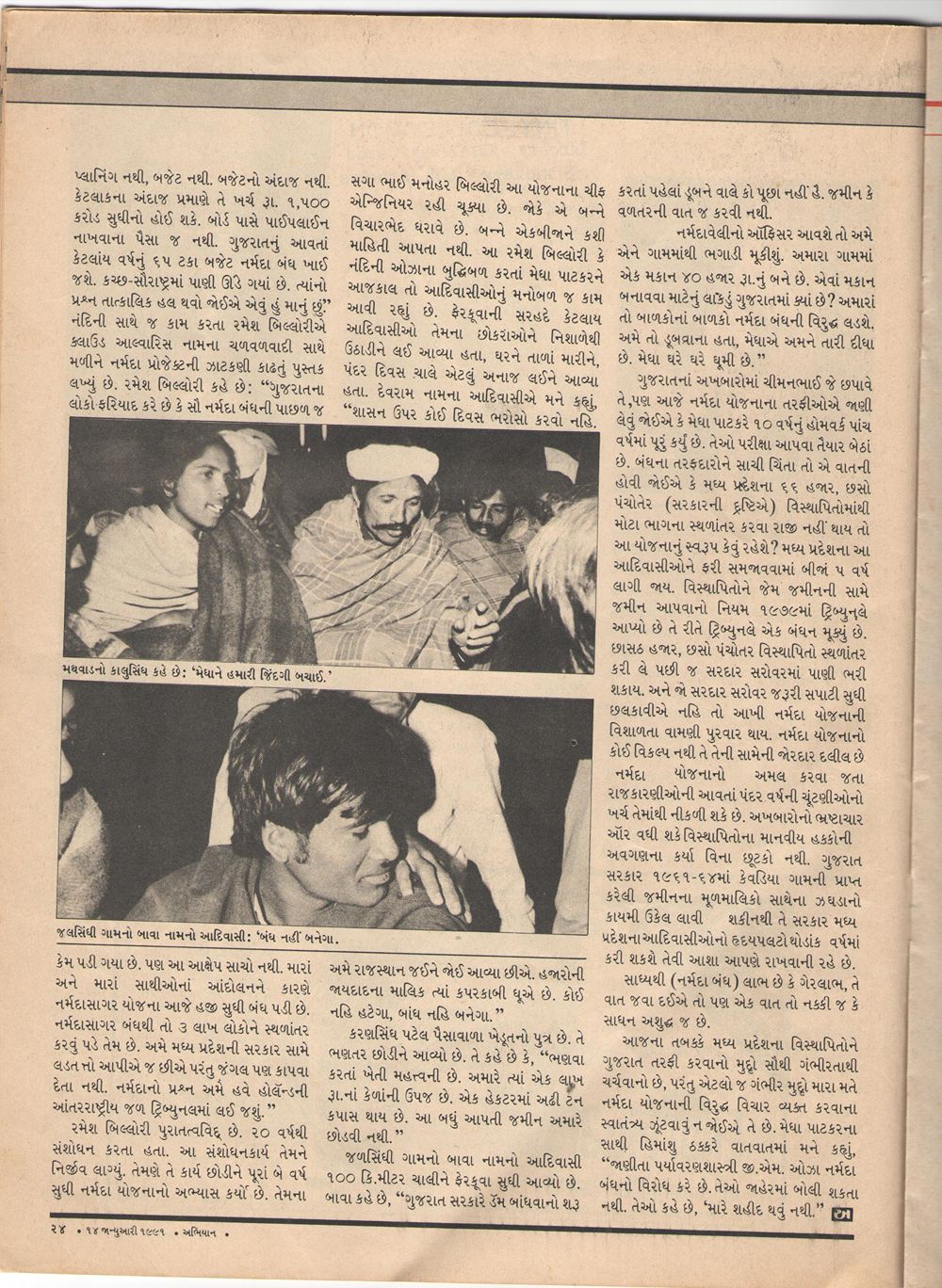
Working alongside Nandini was Ramesh Billore, who, together with activist Claude Alvares, wrote a book sharply critical of the Narmada project.
Ramesh Billore says: “People in Gujarat complain that everyone seems to be targeting the Narmada dam. But that accusation is false. Because of the movements led by my colleagues and me, the Narmada Sagar project has remained stalled until now. The Narmada Sagar dam alone would displace 300,000 people. We are certainly fighting the Madhya Pradesh government, but we are also preventing the destruction of forests. We now intend to take the Narmada issue before the International Water Tribunal in the Netherlands.”
Ramesh Billore is an archaeologist. He spent twenty years engaged in research, but eventually found that work lifeless. He abandoned it and devoted two full years to studying the Narmada project. His own brother, Manohar Billore, had served as the project’s Chief Engineer. Despite that, the two hold opposing views and do not exchange information with one another.
Today, however, Medha Patkar draws her greatest strength not from the intellectual abilities of people like Ramesh Billore or Nandini Oza, but from the determination of the Adivasis themselves.
At the Ferkuwa border, many Adivasi families had withdrawn their children from school, locked their homes, and brought enough grain to last fifteen days.
One Adivasi named Devaram told me: “Never trust the government. We have seen what happened in Rajasthan. People who once owned property worth thousands are now washing cups and saucers. No one will move. The dam will not be built.”
Karansingh Patel, the son of a prosperous farmer, had abandoned his studies to join the movement. He said:
“Farming is more important than education. Our banana crop is worth one lakh rupees. We harvest two and a half tonnes of cotton from a single hectare. We are not going to leave land that gives us all this.”
An Adivasi named Bawa from Jalsindhi village had walked one hundred kilometres to reach Ferkuwa. He said:
“Before beginning construction of the dam, the Gujarat government never asked those who were going to be submerged. They don’t even want to discuss compensation for our land. If an officer from the Narmada Valley Authority comes to our village, we will drive him away. A single house in our village costs forty thousand rupees to build. Where is the timber in Gujarat to build houses like ours? Even our children and grandchildren will continue fighting this dam. We were destined to drown, but Medha has saved us. She has gone from house to house.”
Whatever Chimanbhai Patel may publish in Gujarat’s newspapers, supporters of the Narmada project should recognize one fact: Medha Patkar has completed ten years’ worth of preparation in just five years. She is ready for the examination.
The real concern for supporters of the dam should be this: if the majority of the 66,675 displaced people in Madhya Pradesh (according to government figures) refuse to relocate, what will become of the project? It could take another five years merely to persuade them.
The Narmada Water Disputes Tribunal ruled in 1979 that displaced people must receive land in exchange for land. It also imposed another condition: the Sardar Sarovar reservoir cannot be filled until all 66,675 displaced persons have been resettled. And unless the reservoir is filled to its intended level, the project’s much-celebrated scale and benefits will be drastically diminished.
The strongest argument in favour of the Narmada project remains that there is no practical alternative to it.
The implementation of the project may well finance politicians’ election campaigns for the next fifteen years. Corruption within the press may increase still further. There appears to be no escaping the neglect of the human rights of the displaced.
The Gujarat government has still not permanently resolved its dispute with the original landowners whose land at Kevadia was acquired between 1961 and 1964. Can the same government really transform the hearts and minds of the Adivasis of Madhya Pradesh within a few years? That is what we are being asked to believe.
Whether the ultimate objective-the Narmada dam-proves beneficial or harmful is a separate question. One thing, however, seems certain to me: the means adopted are impure.
At this stage, the most serious issue is how to persuade the displaced people of Madhya Pradesh to accept Gujarat’s position. But equally serious, in my opinion, is the danger of suppressing the freedom to express views against the Narmada project.
In the course of conversation, Medha Patkar’s colleague Himanshu Thakkar remarked:
“The well-known environmental scientist G. M. Oza opposes the Narmada dam. But he cannot speak publicly. He says, ‘I do not want to become a martyr.'”
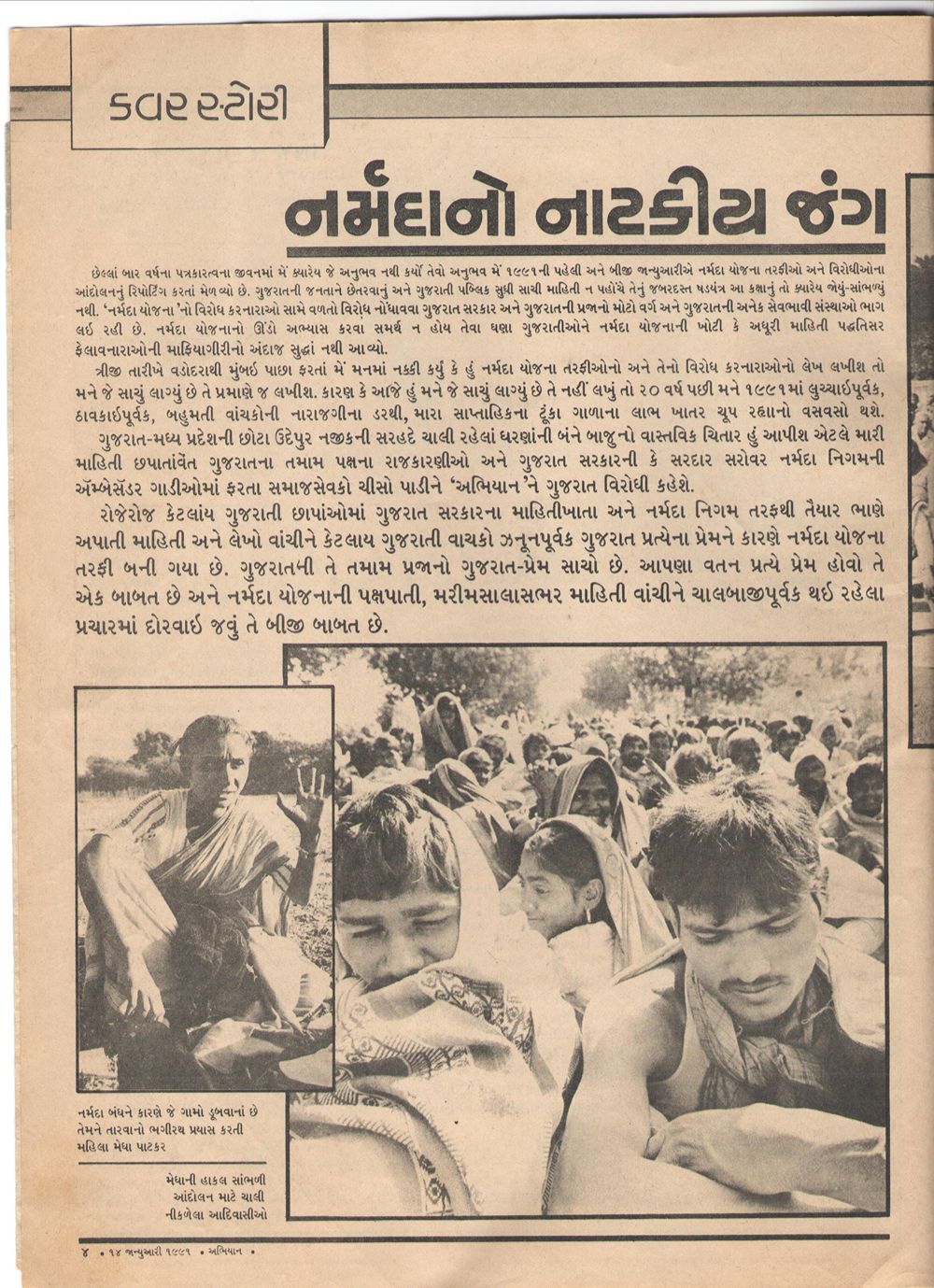
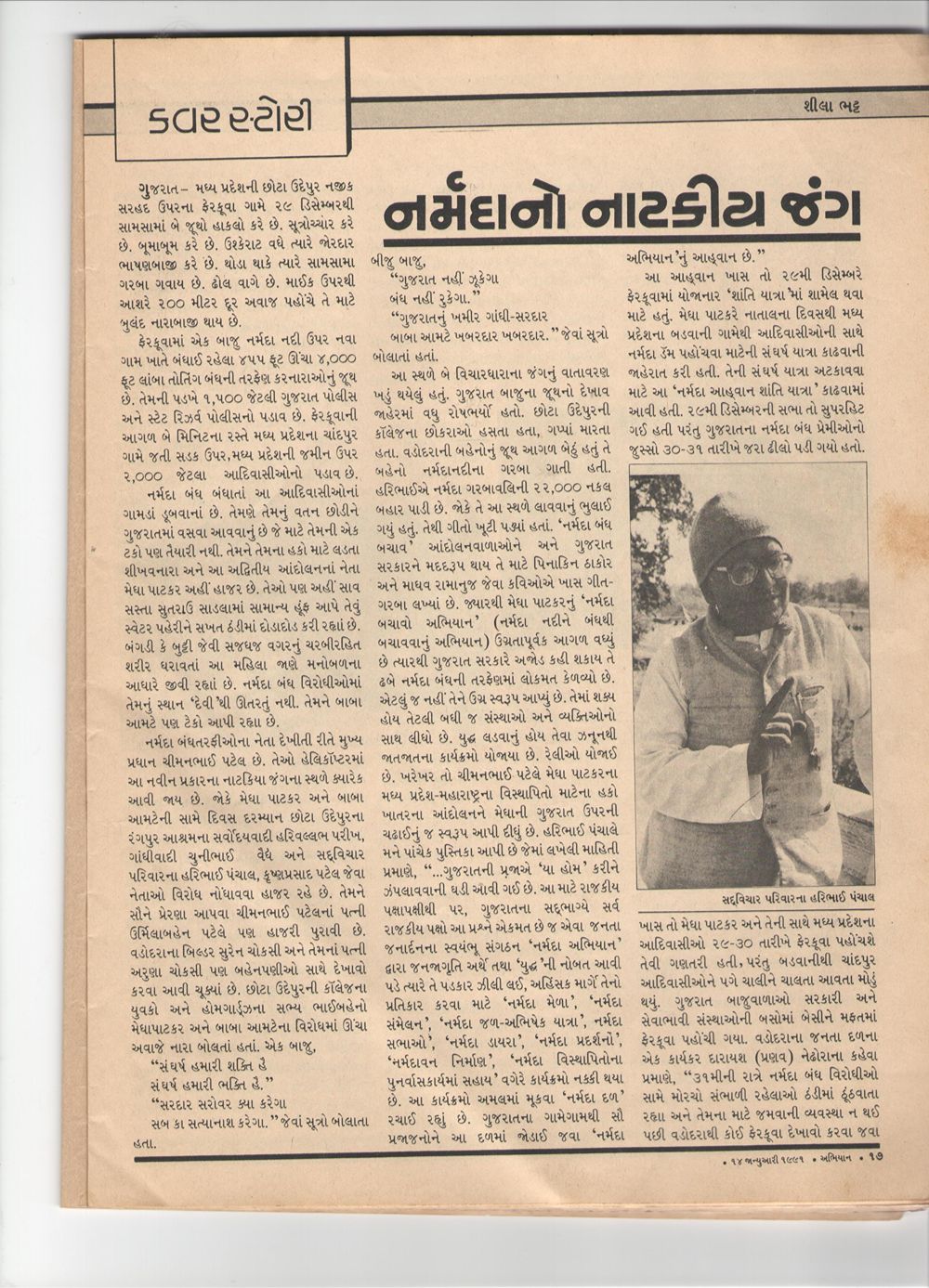
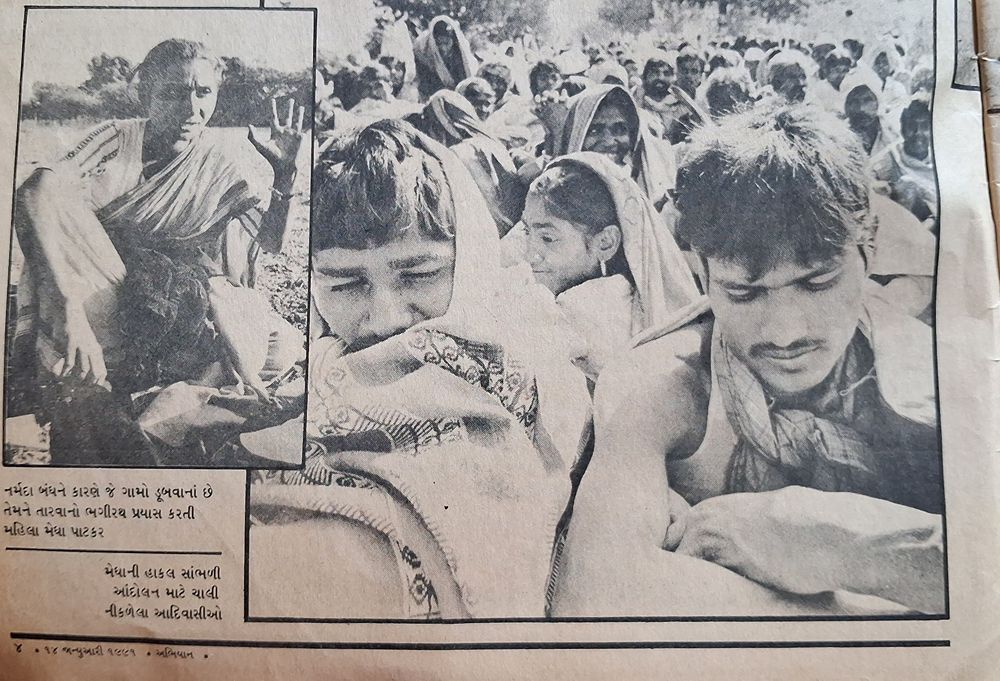
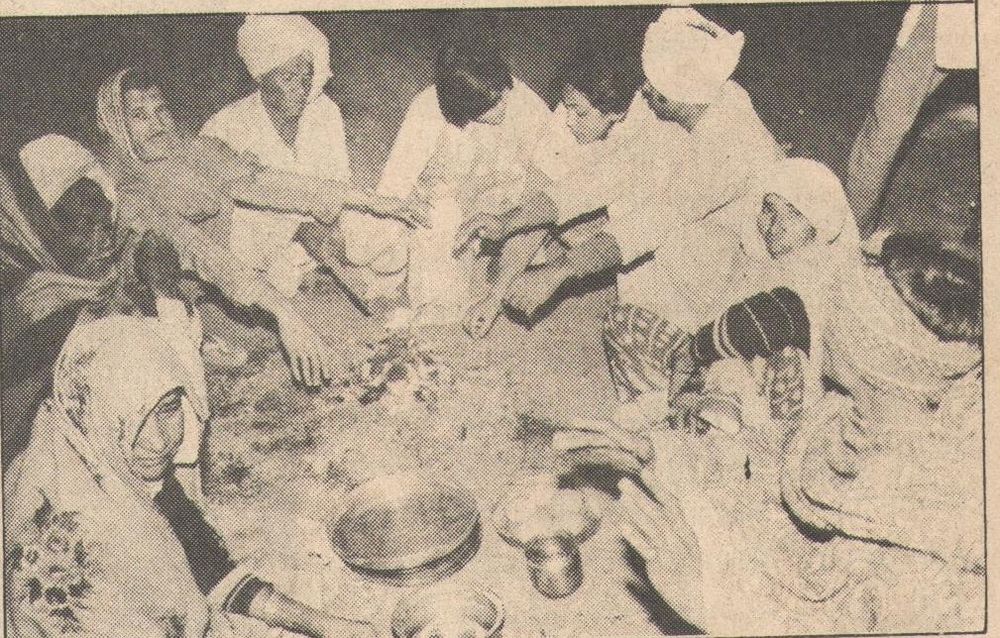
Adivasis marching after responding to Medha’s call for struggle.
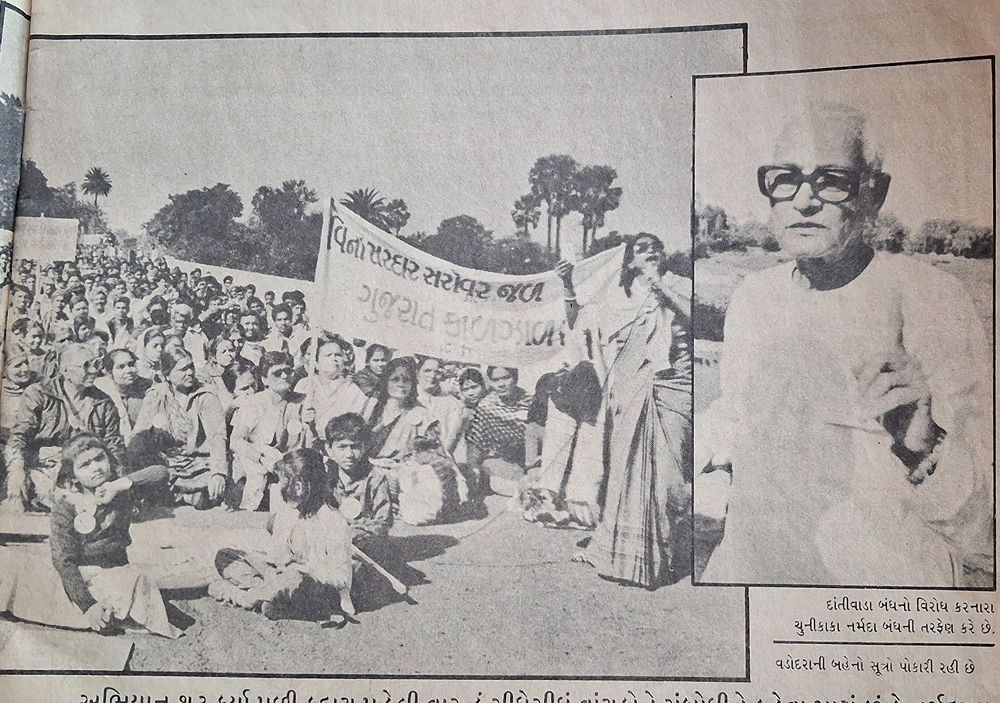
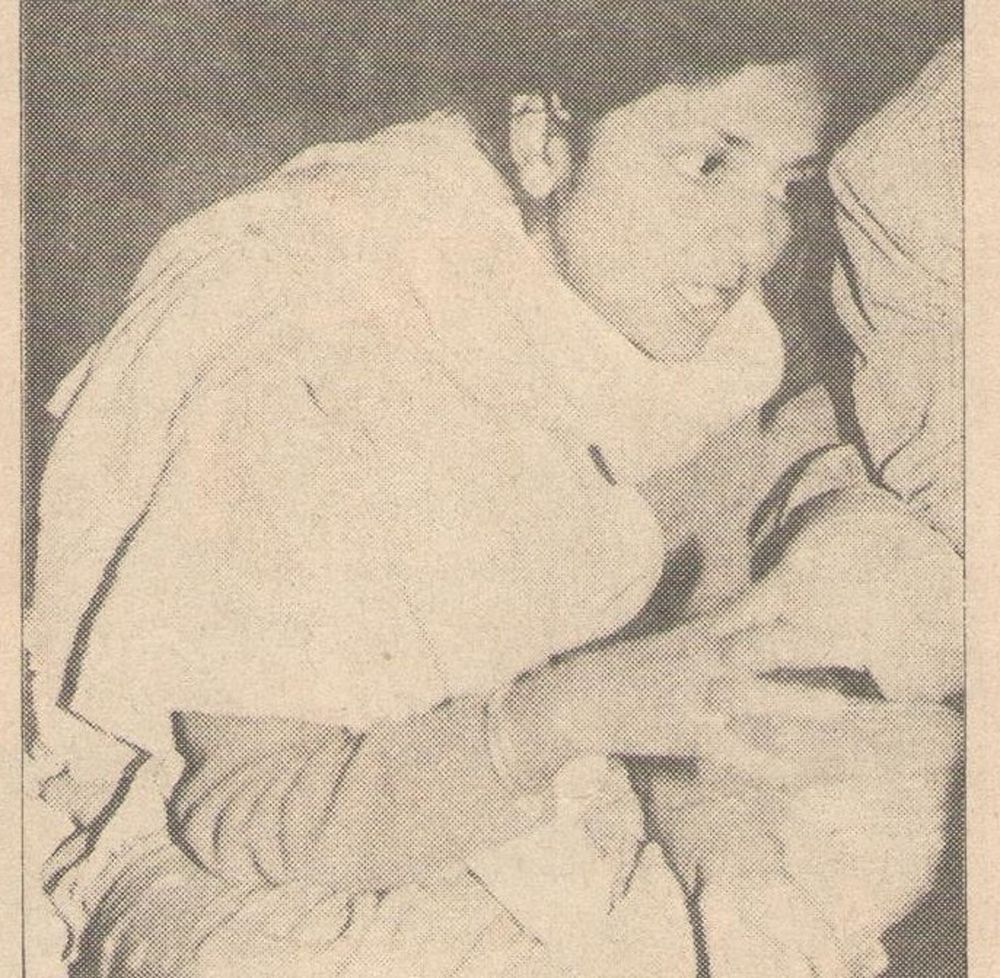
Women from Vadodara shouting slogans.
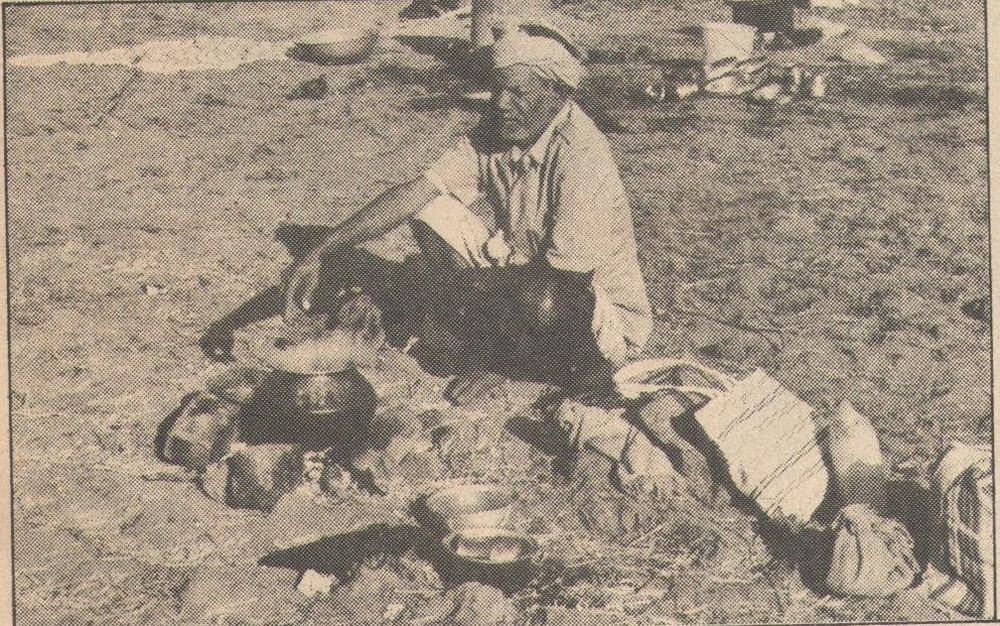
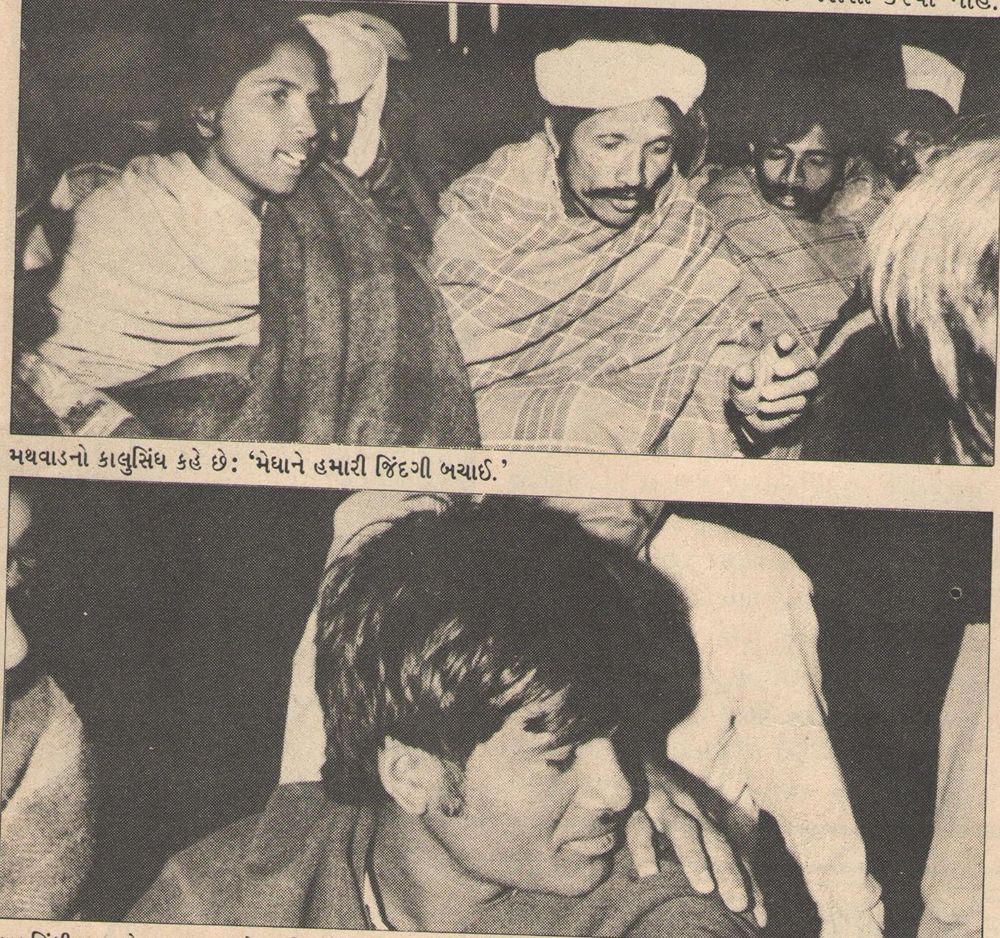
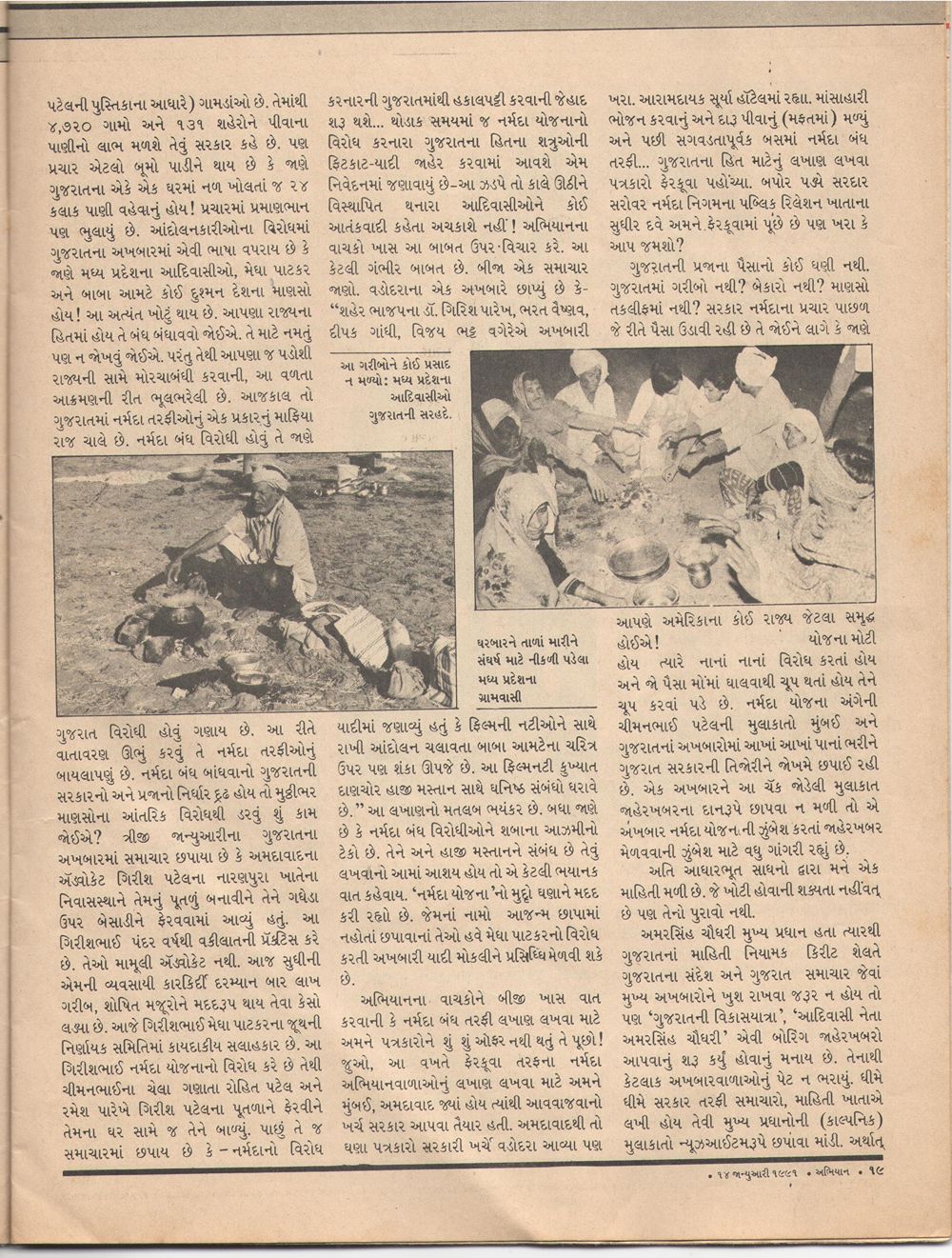
Bawa, an Adivasi from Jalsindhi village: “The dam will not be built.”
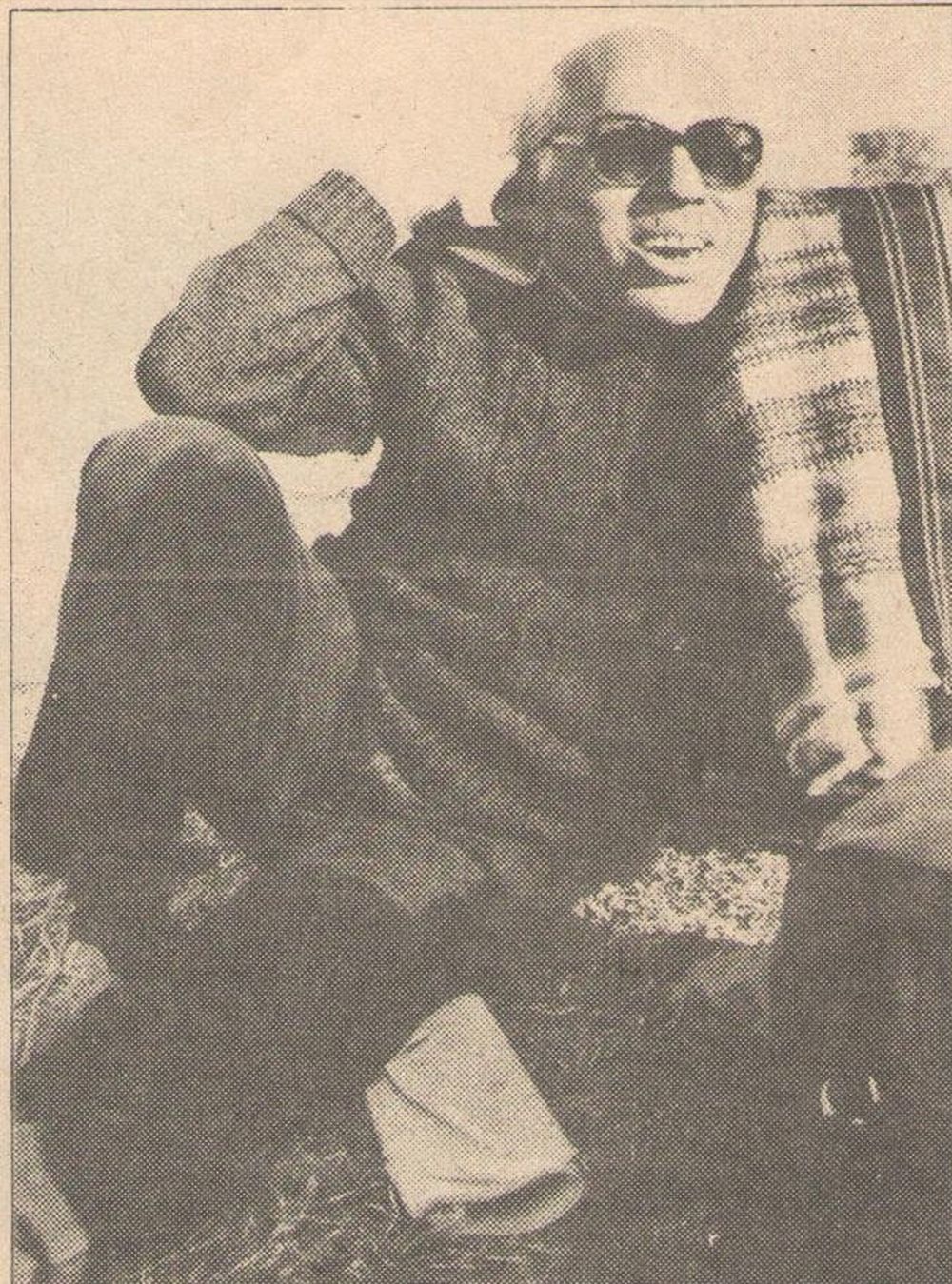
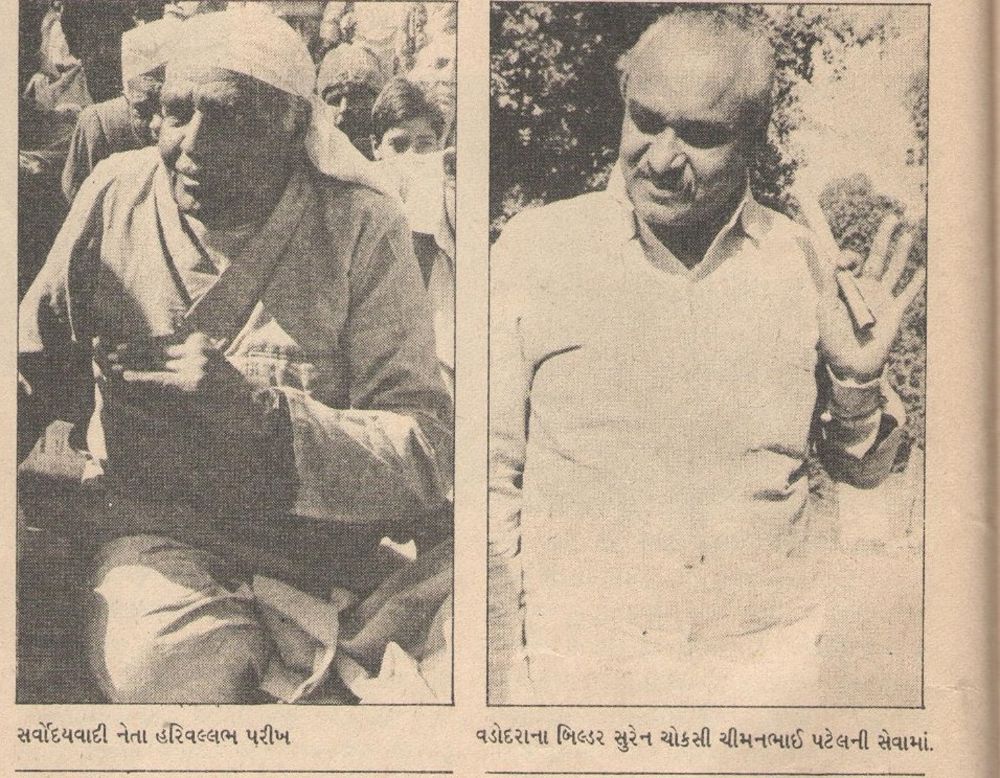
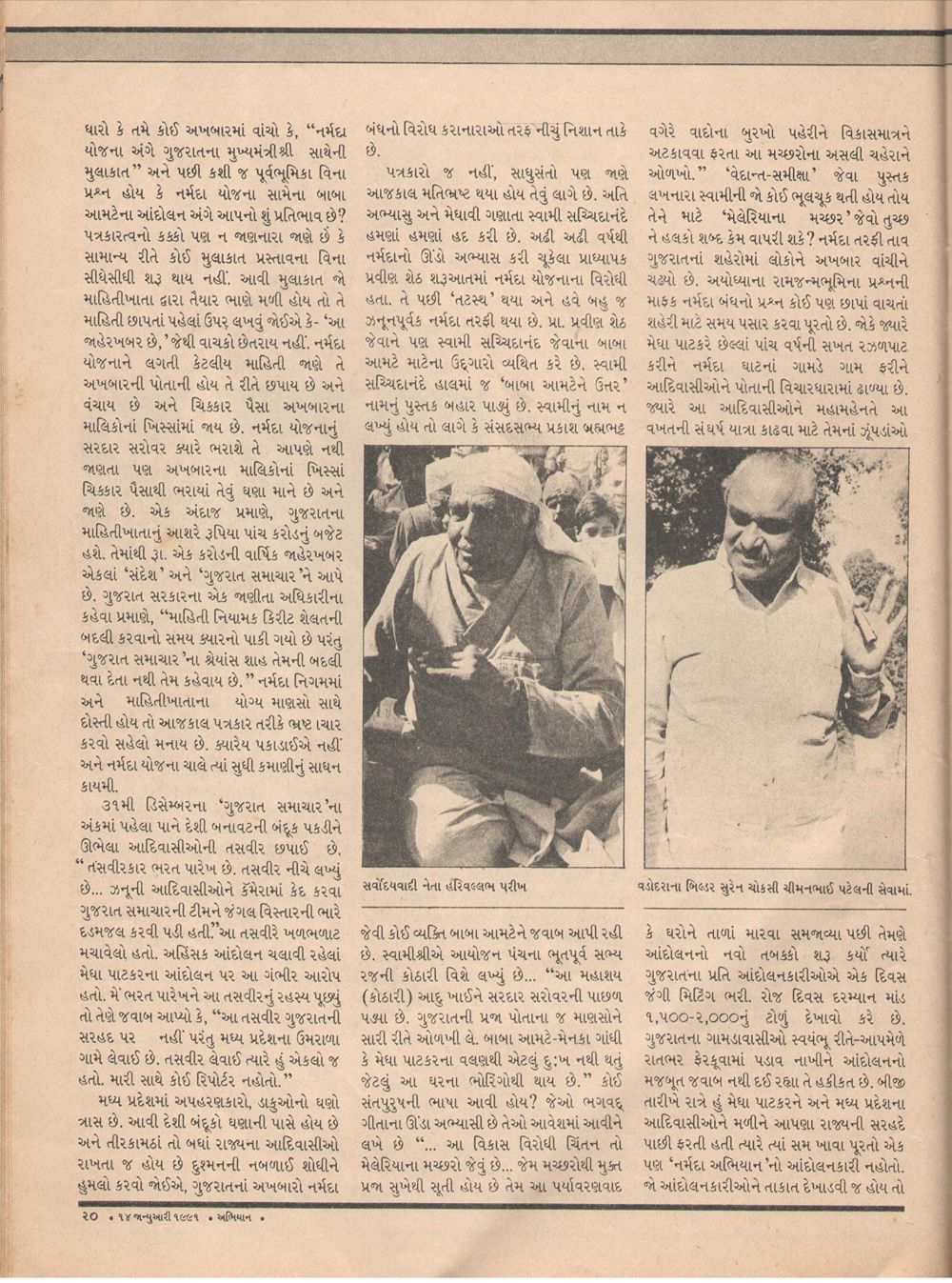
Vadodara builder Suren Choksi in the service of Chimanbhai Patel.