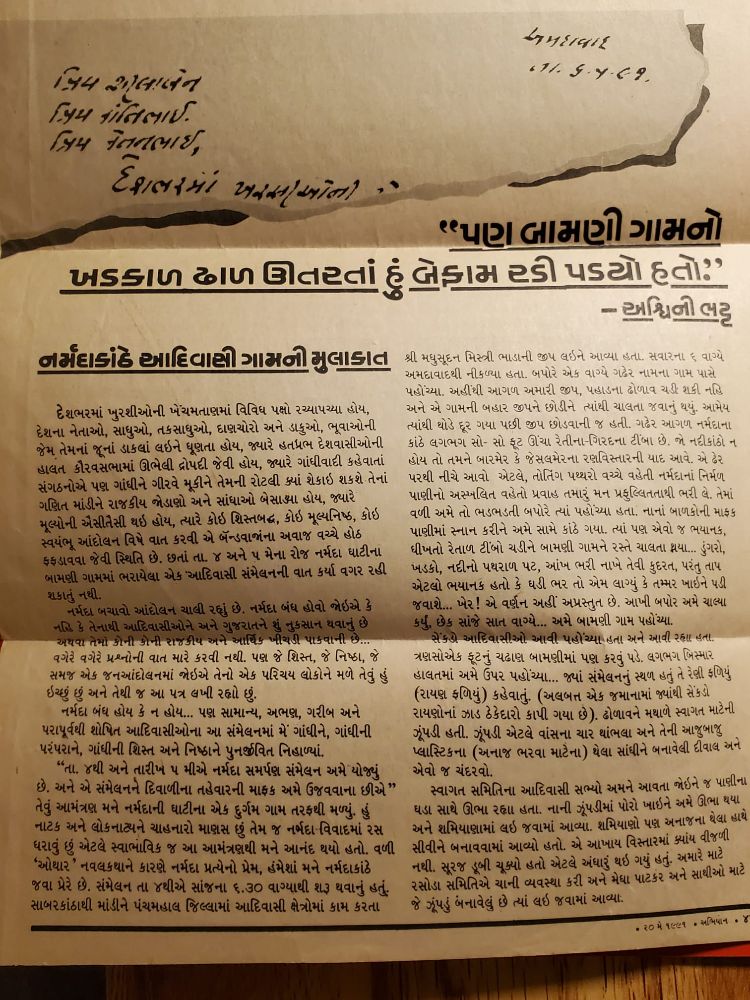
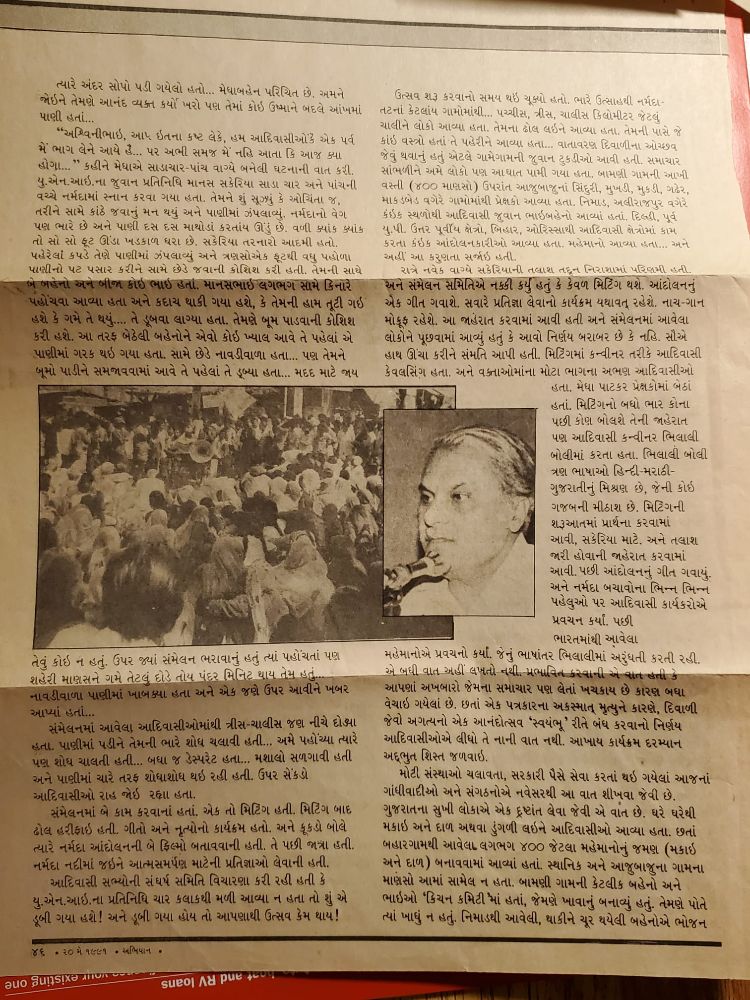
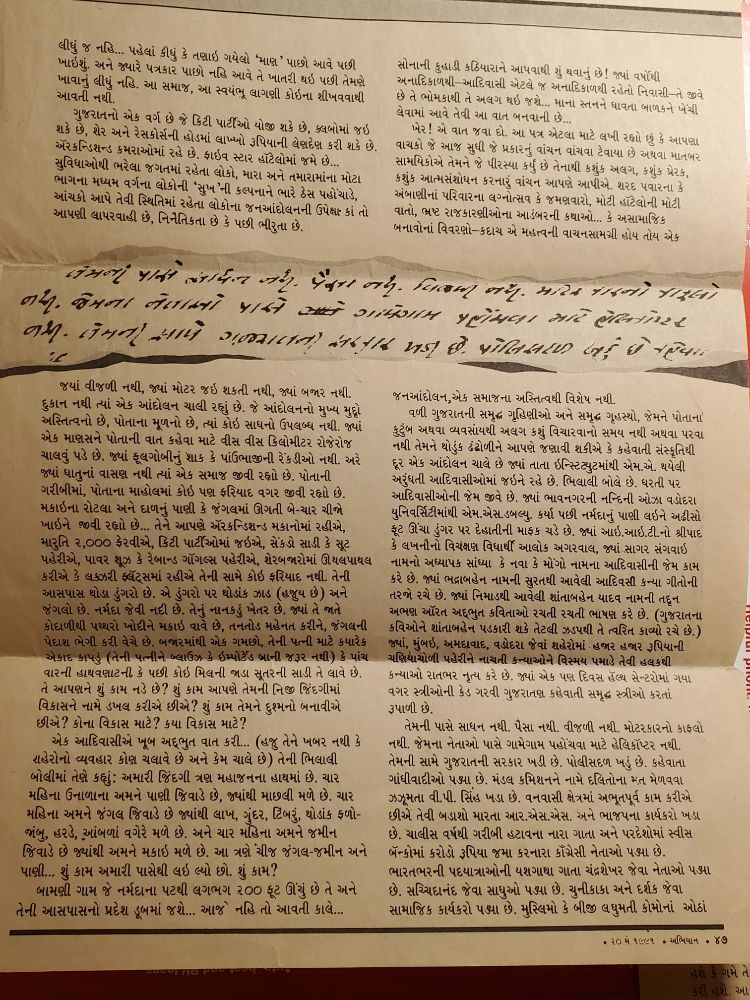
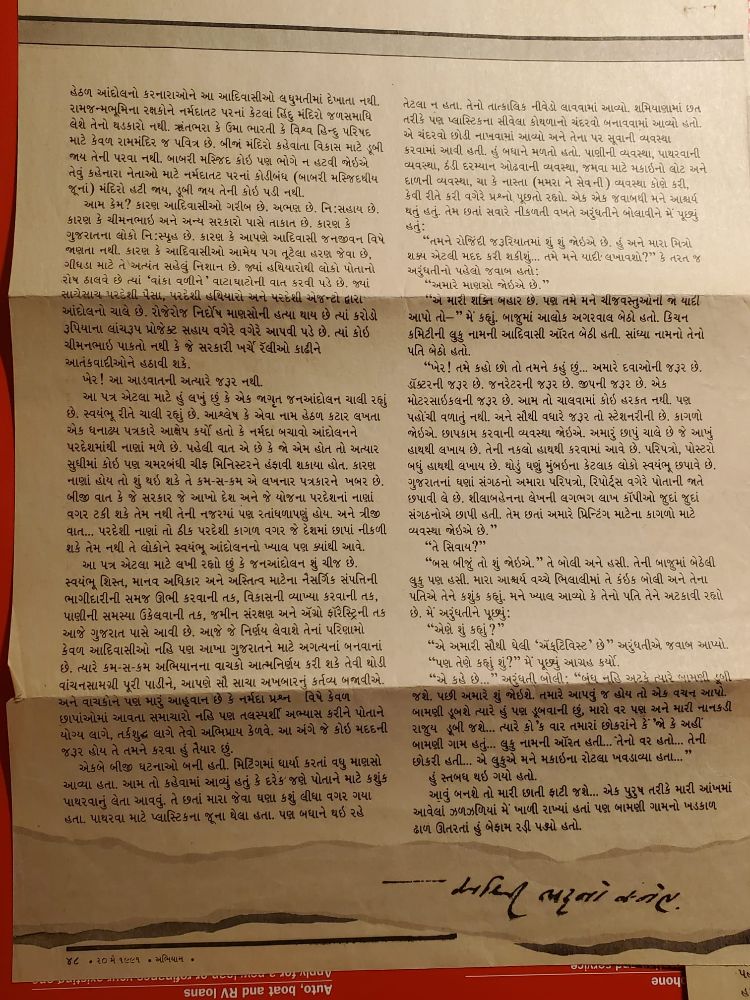
This profound letter in Gujarati by renowned Gujarati writer Late Ashwineebhai Bhatt, has been shared with me for wider readership by Ashwineebhai’s son Neel Bhatt under fair use principle for academic study and knowledge purpose. The images of this letter published in Abhiyan magazine in the year 1991 are reproduced here as shared by Neel Bhatt with due acknowledgement of the magazine.
Ashwineebhai was one of Gujarat’s most popular novelists, much loved and widely read columnists, and a prolific writer. He wrote this letter on the issue of the displacement of Adivasis caused by the Sardar Sarovar Project (SSP), a large dam on the river Narmada. The letter was addressed to the editors of Abhiyan, which was a widely read magazine at the time.
Swimming against the tide, Ashwineebhai challenged the dam, putting his popularity at stake in a state that was largely intolerant of anyone who so much as raised a finger against the project—one that had been declared the very lifeline of Gujarat. The sustained propaganda that the SSP alone would solve the state’s water crisis had so deeply influenced public opinion that even leading public figures of Gujarat—many of who, who did not believe in large dams— also did not dare to question it.
At such a time, this letter by Ashwineebhai— a much loved and respected author—was received with open hearts by the people of the Narmada valley and the Narmada Bachao Andolan. It proved to be much-needed oxygen, especially for members of the movement working in Gujarat.
It has now been 35 years since this letter was first published. It was only recently, Ashwineebhai’s son, Neel Bhatt, very kindly shared it with me. Neel also gave me the permission to translate the same in English and Hindi for wider readership. I once again acknowledge Abhiyan magazine for carrying this letter and I share it here for educational purpose only.
I am reproducing this priceless piece of writing by Ashwineebhai—an extraordinary human being whom I had the privilege of knowing closely—along with its translation of select excerpts from Gujarati to English, for a wider readership for understanding and knowledge purposes.
The translation in English is below and the images of Abhiyan magazine are at the bottom of the page.
Ahmedabad
Date: 6-5-1991
Dear Sheelaben,
Dear Kantibhai,
Dear Ketanbhai,
“As I descended the rocky slope of Bamni village, I broke down uncontrollably.”
— Ashwini Bhatt
Visit to an Adivasi village on the banks of the Narmada
At a time when across the country political parties are being formed and broken in the scramble for power; when leaders, saints, opportunists, smugglers and bandits roam about in frenzy; when the condition of stunned citizens resembles Draupadi standing helpless in the Kaurava court; when even organizations calling themselves Gandhian have mortgaged Gandhi and are calculating where their bread will be buttered through political alliances—when values are being trampled—speaking about any disciplined, value-based, spontaneous people’s movement feels like moving one’s lips amidst the blaring noise of a brass band.
Yet, I cannot refrain from writing about an Adivasi सम्मेलन [gathering] held on 4th and 5th May [1991] in Bamni village in the Narmada valley.
The Narmada Bachao Andolan [movement] is ongoing. Whether the dam should be built or not, what losses it may cause to Adivasis or Gujarat, or what political and economic interests are at play—these are not the questions I wish to discuss here. What I want is for people to understand the discipline, commitment, and awareness that a people’s movement requires. That is why I am writing this letter.
Whether the dam exists or not… among the ordinary, untutored, poor, and historically oppressed Adivasis gathered here, I witnessed Gandhi—his tradition, his discipline, and his commitment—reborn.
I received an invitation from a remote village in the Narmada valley:
“We are organizing a Narmada Samarpan gathering on the 4th and 5th, and we will celebrate it like Diwali.”
Being a lover of theatre and folk performance, and having an interest in the Narmada issue, I was naturally delighted. Also, because of my novel Othar, I have always felt drawn to the Narmada for my love of the river.
The conference was scheduled to begin on the 4th at 6:30 in the evening. Madhusudan Mistry, who worked in Adivasi regions from Sabarkantha to Panchmahal district, had arrived in a hired jeep.
We left Ahmedabad at 6 a.m. and reached a village called Gadher by 1 p.m. Beyond that, the jeep could not climb the mountain slopes. We had to continue on foot. There were massive sand dunes, nearly a hundred feet high, along the riverbank—reminding one of the deserts of Barmer or Jaisalmer. But as you descended, the sight of the pure, flowing waters of the Narmada between giant rocks filled the heart with joy.
We bathed like children in the scorching afternoon and crossed over to the other bank. Then began another steep climb through burning sand towards Bamni village. The landscape—mountains, rocks, riverbed—was breathtaking, but the heat was so intense that one felt one might collapse at any moment.
Well! That description is not relevant here. We kept walking the entire afternoon, and finally, we reached Bamni at around 7 in the evening.
Hundreds of Adivasis had already arrived, and more were still coming. There was also a climb of about three hundred feet to reach Bamni. We somehow made it to the top in an almost exhausted state…
The place where the gathering was to be held was called Rayaan Faliya (hamlet)—a place that, in earlier times, had hundreds of rayaan trees, most of which had been cut down by contractors.
At the top of the slope stood a hut meant for welcoming people. By “hut,” one means four bamboo poles, with walls made by stitching together plastic sacks (used for storing grain), and a similar makeshift covering for a roof.
Members of the Adivasi स्वागत समिति (welcome committee) were already standing with pots of water as soon as they saw us arriving. After having a simple meal in the small hut, we got up and were taken to the shamiana. The shamiana too had been stitched together by hand using grain sacks.
There was no electricity anywhere in the entire area. The sun had already set, and darkness had fallen. The kitchen committee arranged tea for us, and we were then taken to the hut that had been prepared for Medha Patkar and her colleagues. Inside, there was uncanny silence.
Medhaben recognized us. She expressed happiness, but instead of warmth, her eyes were filled with tears.
“Ashwineebhai, you have come all this way, taking so much trouble, to participate in a पर्व / festival of us Adivasis… but right now, we do not understand what is going to happen today…” — saying this, Medha Patkar recounted the incident that had taken place around 4:30–5:00 in the evening.
A young UNI reporter Manosh Skaria, had gone to bathe in the Narmada between 4:30 and 5:00. For reasons unknown, he suddenly felt like swimming across to the opposite bank and jumped into the water. The current of the Narmada was very strong, and the water was extremely deep—ten heads deep in many places, and in some stretches, there were a hundred feet wide rocky beds.
Skaria was a swimmer. Wearing his clothes, he leapt into the river and attempted to cross the stretch of water, more than three hundred feet wide, to reach the other side. Two women and one another man were with him. Manoshbhai had almost reached the opposite bank when perhaps he became exhausted, or lost strength… he began to drown… Before the women sitting on this side could even realize what was happening, he had disappeared beneath the water.
There were boatmen on the opposite bank… but before they could be alerted by shouts, he had already drowned. There was no one who could go to help in time. Even reaching the spot above, where the gathering was to be held, would have taken at least fifteen minutes… Some of the boatmen had jumped into the water, and one of them came up to inform the others…
Thirty to forty Adivasis from among those who had come for the gathering had run down to the river. They had plunged into the water and were searching intensely… Everyone was desperate. Torches had been lit, and the water was being searched in all directions. Hundreds of Adivasis were waiting…
There were two main things planned for the gathering. First, there was to be a meeting. After the meeting, there was to be a drum competition, followed by songs and dances. At cockcrow, two films on the Narmada movement were to be shown. After that, there was to be a jatra/ procession, and people were to go into the Narmada River to take pledges of self-sacrifice.
The Adivasi members of the struggle committee were deliberating: the UNI reporter had not been found for four hours—could it be that he had drowned? And if he had indeed drowned, how could the celebration go on?
The time to begin the festival had already passed. With great enthusiasm, people had walked from many villages along the Narmada—covering distances of twenty-five, thirty, even forty kilometres—to attend. They had brought their drums… the atmosphere was meant to be like a Diwali celebration, and groups of young people had come from village after village.
Hearing the news, we too were deeply shaken. Along with the entire population of Bamni village…, spectators had come from nearby villages such as Sindhuri, Mukhdi, Gadher, Makadkheda, and others. Adivasi youth had come from regions like Nimad and Alirajpur. Activists…had come from Delhi, eastern Uttar Pradesh, the northeastern regions, Bihar, and Odisha. Guests had arrived… and in the midst of all this, such a tragedy had unfolded.
By around nine at night, the search for Manosh Skaria had turned completely hopeless. The conference committee then decided that only the meeting would be held. One song of the movement would be sung, and the pledge-taking program in the morning would continue as planned. The dance and music performances would be postponed. This announcement was made, and the people gathered were asked whether they agreed with this decision. Everyone raised their hands in consent.
The meeting was convened by an Adivasi leader, Kevalsing1…Medha Patkar was seated among the audience. The entire responsibility of conducting the meeting—including announcing who would speak next—was handled by the Adivasi convenor in the Bhilali dialect. Bhilali… with a remarkable sweetness to it.
The meeting began with a prayer for Skaria and an announcement that the search was still ongoing. Then a song of the movement was sung, followed by speeches by Adivasi activists on various aspects of the Narmada Bachao movement. After that, guests from across India spoke, and Arundhati [Dhuru] translated their words into Bhilali. I will not go into all those details here.
What was truly moving was this: newspapers often hesitate even to report on such people, as most have been compromised. Yet, because of the accidental death of a journalist, the Adivasis took a spontaneous decision to call off a major celebration—one that was meant to be like Diwali. This was no small thing. Throughout the entire program, an extraordinary discipline was maintained.
This is something today’s large organizations, and many self-proclaimed Gandhians working with government funds, need to learn anew. It is also an example for the more privileged sections of Gujarat. Adivasis had brought maize and dal, or onions, from their own homes. Yet, food (maize and dal) was prepared for about 400 guests who had come from outside. The local villagers and those from nearby areas did not partake in this meal. Some women and men from Bamni village formed the “kitchen committee” and prepared the food—but they themselves did not eat there.
The sisters who had come from Nimad, exhausted from their journey, did not eat either… they first said, “We will eat only after the man who has been swept away returns.” And when it became certain that the journalist would not return, they chose not to eat at all. This kind of community, this spontaneous feeling, does not come from being taught—it arises from within.
There is a section in Gujarat that can organize kitty parties, go to clubs, deal in lakhs of rupees in shares and at racecourses, live in air-conditioned rooms, and dine in five-star hotels… People living in such comfort, and even many among our middle classes, often ignore people who live in conditions that would deeply unsettle our very idea of “comfort.” Is this neglect carelessness, moral failure, or simply fear?
Where there is no electricity, where vehicles cannot reach, where there is no market, no shops—there, a movement is taking place. A movement whose central question is one of existence, of roots. There are no resources. A person must walk twenty kilometres just to make their voice heard. There are no luxuries no street food stalls, not even metal utensils. And yet, a community lives there—without complaint—sustaining itself on maize rotis, dal, and whatever the forest provides.
They have no grievance against us—those of us living in air-conditioned homes, driving maruti cars, attending parties, wearing hundreds of clothes, using branded power shoes and Ray-Ban sunglasses, speculating in markets, or living in luxury apartments. Around them are a few hills, some remaining trees and forests, a river like the Narmada, and a small piece of land. There, with their own hands, they dig stones with a hoe and sow maize, labouring tirelessly. They gather forest produce and sell it. From the market, they might buy a gamchha, or occasionally a piece of cloth for their wife—who does not need expensive blouses or imported garments…
Why do they trouble us? Why do we interfere in their lives in the name of “development”? Why do we make them our adversaries? Development—for whom, and what kind of development?
One Adivasi expressed something profoundly insightful… in his Bhilali dialect, he said:
“Our life depends on three masters. For four months, water sustains us—it gives us fish. For four months, the forest sustains us—it gives us lac, gum, timber, fruits, jamun, harad, amla, etc. And for four months, the land sustains us—it gives us maize. These three—forest, land, and water—why are you taking them away from us? Why?”
Bamni village, which stands about 200 feet above the Narmada riverbed, along with the surrounding region, will be submerged—if not today, then tomorrow. What is the use of giving a golden axe to a woodcutter? A people who has lived on this land since time immemorial—Adivasi literally meaning original inhabitants—will be uprooted from their own soil. It will be like snatching a child away from its mother’s breast.
Well… let that be. I am writing this letter so that we may offer our readers something different from what they are used to reading—something inspiring, something that provokes self-reflection. Lavish wedding feasts of Sharad Pawar or the Mukesh Ambani family, grand stories of big hotels, tales of corrupt politicians’ excesses, or accounts of antisocial incidents—these may all be considered important reading. Yet, they are not more important than a people’s movement that concerns the very existence of a community.
And we might also gently shake the conscience of the affluent women and well-to-do men of Gujarat—those who have neither the time nor the inclination to think beyond their families or businesses—and let them know that far from what is called “mainstream culture,” a movement is unfolding.
A movement where Arundhati, with an M.A. from the Tata Institute of Social Sciences, lives among Adivasis, speaks Bhilali, and lives as they do. Where Nandini Oza from Bhavnagar, after completing her M.S.W. from Maharaja Sayajirao University of Baroda, climbs a 250-foot hill carrying Narmada water like a village woman.
Where Shripad from Indian Institute of Technology, and Alok Agarwal from Lucknow, where a teacher named Sagar [Sanjay] Sangavai, and Adivasis like Sandhya, Nava, or Mongo, all work and live like Adivasis. Where a young Adivasi woman from Surat, Bhadraben, composes tunes for songs2. Where Shantaben Yadav,3 an entirely unlettered woman from Nimad, composes astonishing poetry even as she speaks—creating spontaneous verses with a speed that could challenge poets of Gujarat.
Where young women dance through the night with an energy that would astonish those who perform in expensive embroidered attire in cities like Mumbai, Ahmedabad, and Vadodara. Where, without ever visiting health centres, the women’s vitality and beauty surpass that of the so-called affluent women of “Garvi Gujarat.”
They have no resources. No money. No electricity. No fleets of motorcars. Their leaders do not have helicopters to reach villages. Against them stands the government of Gujarat. The police force is arrayed before them. So-called Gandhians stand opposed [to them]. V. P. Singh who struggles to secure Dalit votes in the name of the Mandal Commission, stands [in opposition]. Workers of the Rashtriya Swayamsevak Sangh and Bharatiya Janata Party, who otherwise boast of their work in tribal areas, stand [in opposition]. Congress leaders, who for forty years have raised slogans of removing poverty while depositing crores in Swiss banks, stand (in opposition)…Sadhus like Sachchidanand stand [in opposition]. Social workers like Chunikaka [Chunibhai Vaidya] and Darshak [Manubhai Pancholi] stand [in opposition]. Muslim and other minority communities…Those who speak of minority struggles do not see these Adivasis as a minority. The self-proclaimed defenders of the Ram Janmabhoomi do not seem to care how many Hindu temples along the Narmada will be submerged. For Sadhvi Rithambara, Uma Bharti, or the Vishva Hindu Parishad, only the Ram temple appears sacred—other temples can drown in the name of “development,” it does not matter. And for leaders who insist that the Babri Masjid must not be removed at any cost, it does not seem to matter those countless temples along the Narmada—older even than Babri—may disappear beneath the waters.
Why is this so? Because Adivasis are poor… and powerless. Because leaders like Chimanbhai Patel and other governments hold power. Because people of Gujarat remain indifferent. Because we do not truly know Adivasi life. Because Adivasis are like wounded deer—easy prey for vultures. But where anger is expressed through weapons, negotiations are forced with compromise. And where movements are fuelled by foreign money, weapons, and agents, where innocents die daily, there, one has to offer crores of rupees in the form of bribes, project aid, and so on. There is no Chimanbhai Patel there—no one who can, at government expense, organize rallies and drive away the terrorists.
But let that pass for now.
I write this letter to say that a conscious people’s movement is unfolding—spontaneously. A columnist once alleged that the Narmada Bachao movement (NBA) receives foreign funding. If that were so, any number of chief ministers could have been easily overthrown by now—after all, the power of money is well known to such critics. Secondly, even the government—which cannot sustain the entire country and its plans without foreign funds—seems to suffer from a kind of blindness. And thirdly—those who cannot even imagine newspapers running without imported paper can hardly understand what a spontaneous movement looks like.
I write this so that we may understand what a people’s movement truly is: an opportunity to build spontaneous discipline, to assert human rights, to understand equitable sharing of natural resources, to redefine development, to address water issues, to protect land, and to explore agro-forestry. The decisions taken today will affect not just Adivasis but the whole of Gujarat. At the very least, we must provide readers of Abhiyan Magazine with material that enables informed, rational reflection. Let us adhere to responsible journalism. I urge readers: do not rely only on newspaper reports—study deeply, think critically, and form your own considered opinion on the issue of the Narmada [dam]. I am ready to help in any way needed.
A few other incidents occurred (at Bamni gathering). Far more people had come than expected. Though everyone had been asked to bring something to spread on the ground to sleep, many like me had brought nothing. There were some old plastic sacks to sit or sleep on—but not enough. A quick solution was found: even the plastic canopy stitched together as the roof of the shamiana was taken down and spread out for people to sleep on.
I went around asking: who had arranged the water, the bedding, the blankets for the cold, the maize flour and dal for food, the tea and snacks (puffed rice and sev)? Each answer filled me with astonishment.
Before leaving in the morning, I called Arundhati and asked:
“What do you need for your daily work? My friends and I can help as much as possible… will you give me a list?”
Her immediate reply was:
“We need people.”
“That is beyond my capacity,” I said, “but if you give me a list of things…”
Alok Agarwal was sitting nearby. So was Luku, an Adivasi woman from the kitchen committee, and her husband Sandhya.
“Well, since you insist… we need medicines. We need a doctor. We need a generator. We need a jeep. A motorcycle would help. We don’t mind walking—but we can’t reach everywhere. And most of all, we need stationery—paper, printing facilities. We run a newsletter, entirely handwritten. Copies are made by hand. Circulars, posters—everything is written by hand. Some people in Mumbai voluntarily print things. Many organizations in Gujarat print our materials on their own. About a lakh copy of Sheelaben’s (Bhatt) article were printed by different groups. Still, we need paper for printing.”
“Anything else?”
“No, what else do we need?” she said, smiling. Luku, sitting beside her, also smiled. She said something in Bhilali, and her husband seemed to stop her.
I asked Arundhati, “What did she say?”
Arundhati replied, “She is our most spirited activist.”
“But what did she say?” I insisted.
Arundhati said:
“She says… if the dam is not stopped, Bamni will drown. Then what will we need? If you really want to give something, give us a promise. When Bamni drowns, I too will drown. My husband will drown. My little Raju will drown… then someday, tell your children— ‘There was once a village called Bamni… there was a woman named Luku… she had a husband… a daughter… and she fed me maize rotis…’”.
I was stunned.
If this comes to pass, my heart will shatter. As a man, I had held back the tears that welled up in my eyes—but as I descended the rocky slope of Bamni village, I broke down and wept uncontrollably.
– Affectionately from Ashwinee Bhatt.
Note: Both Bamni village and Ashwineebhai are no longer with us. Bamni village submerged several years ago, and Ashwineebhai passed away in 2012. With his passing, the Narmada Bachao Andolan lost one of its tallest and most steadfast pillars.
- Kevalsingh Vasave’s oral history of the Narmada struggle has been published by Orient Blackswan in English, by Rajkamal Prakashan in Hindi and Rajhans in Marathi, along with that of another senior adivasi leader of the NBA, Keshavbhau Vasave. ↩︎
- For movement songs and its information click the link. ↩︎
- Shantaben’s oral history interview is accessible through the inserted links, which include both a full-length recording and a short excerpt. ↩︎