Articles by former Education Minister, M.P., Omprakash Rawal ji
Articles by Omprakash Rawal
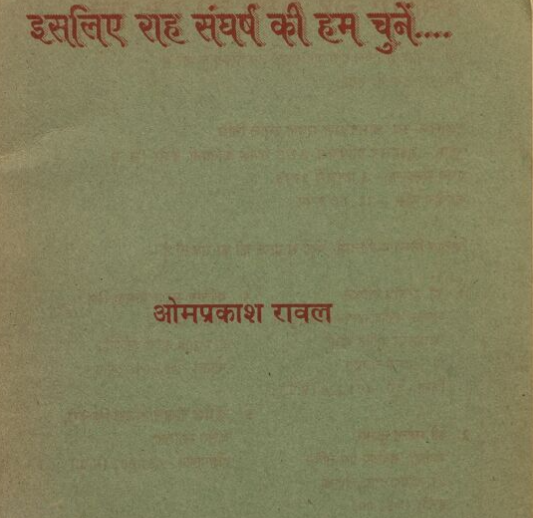
Late Shri Omprakash Rawal, popularly known as Rawalji, was the State Education Minister under the Janata Party rule in 1977 in Madhya Pradesh. He was an environmentalist who advocated decentralized water management programs as against large dams. He wrote extensively on these issues and some of his articles published in Hindi in leading newspapers were brought out in the form of a booklet after his passing in his memory in 1995. This booklet is now a part of the NCBS archives and some important articles with historical significance concerning dams are shared here with English translation for wider reach and only for educational purpose.
To read the original booklet in Hindi, please visit:
Translation: (In memory of the late Omprakash Rawal, who dedicated his life to the rights of workers and the common people.)
Published by: Late Omprakash Rawal Memorial Trust
Address: Mukesh – Ravindra Complex, 31/3 Ganesh Colony, Indore (M.P.)
First Edition: 3 October 1995
Table of Contents
1. The Drum Roll of Struggle against Large Dams…………………………………………………………………………. 2
2. Sankalp Mela in Harsud: A Thousand Hands rose in Resistance……………………………………………….. 6
3. A Roar from Singhbhum against Large Dams………………………………………………………………………….. 12
4. Ganga and Narmada: Both the Mother and the Daughter face a crisis……………………………………… 16
5. The sound of a non-violent struggle and ears covered with hands…………………………………………….. 21
6. Beautiful Manibeli, Preparing for the Impending Battle…………………………………………………………… 27
7. Panicked by Public Awakening, the Governments brings out the bogey of Naxalism………………. 32
8. One death would not end this struggle……………………………………………………………………………………… 38
Shri Om Prakash Rawal: A Short Biography………………………………………………………………………………… 42
1. The Drum Roll of Struggle against Large Dams
The struggle against Narmada Sagar dam on Narmada River in Madhya Pradesh, against Koyalkaro dam in Bihar, against Tehari dam in Uttarakhand, against Polavaram dam in Andhra and against Poyamkutti dam in Kerala would be intensified. This decision was arrived at in a Seminar held a few days back (first week of July) at Anandvan, in which over 80 environmentalists, grassroots activists and journalists from various states of India participated. In the keynote address to this Seminar held at Anandvan, which has become the work area for Baba Amte, he exclaimed that while serving leprosy patients for the last 40 years he had confined himself to a small area, so much so that he never attended a single seminar in all these years. Baba further said that his recent experiences are indications of the fact that the whole country today is mentally inflicted with leprosy and this mental leprosy is much more terrifying and lethal than physical leprosy. In the last few days, Baba had been traveling across the wound-inflicted areas of Punjab. Earlier, he undertook a march from the south towards the north of India as part of the ‘Bharat Jodo Abhiyan’ (Unite India Campaign) and now he would start on a march from East to the West of the country. While proposing that a strong movement should be built against large dams ‘today, right at this moment’, he said, ‘Natural resources are not just a heritage inherited from our ancestors, but a debt we owe to our future generations, which we have to pass on to them along with due interest.’
The Seminar passed a resolution and issued a Collective Pledge against Large Dams [Called the Anandwan Declaration Against Big Dams, in 1988], stating that these large dams are signs of destruction, not development, they are harbingers of devastation, not welfare. The resolution further states that there has been widespread criticism of large dams but the government has consigned it to the dustbin and stomped on the demands of the tribals. The government has given its approval to large dams, especially Sardar Sarovar, Narmada Sagar and Tehri dams, even before the publication of the reports of the official enquiry committees. The resolution also states that rare flora and fauna would become extinct if these dams are constructed. It expresses surprise at the fact that government committees start destroying the forests even before official approval, which is a blatant violation of the Forest Conservation Act.
The resolution states that these large dams have disrupted the water-cycle, which has destroyed the livelihoods of thousands of farmers and fishermen in the ‘Nimad region’; swamping and salinization have rendered lakhs of acres of land infertile. Not only have these dams increased the risks from earthquakes, the strategic location of some of the dams have created dangers for national security as well.
The Seminar unanimously demanded that all those projects where construction work has not commenced yet, should be canceled, and for projects where construction work has commenced, an analysis of the cost-benefit ratio and the environmental and social impacts should be carried out by an independent agency, which should include representatives of affected people in it. Additionally, those who have already been displaced, should be resettled with provisioning of all facilities.
The Seminar has dedicated its resolution, not to the government or any such institution, but to the nation as a whole. Many prominent personalities of the country took a collective pledge after holding discussions for three days; some of the issues raised in the pledge have been mentioned above. Apart from this pledge, the Seminar chalked out a plan for an intensive campaign against large dams. This campaign would especially include the dams mentioned in the beginning of the article. Village fairs would be used for spreading the message of the campaign. Copies of the pledge would be sent to Members of Legislative Assembly and Members of Parliament. Small booklets would be published; meetings, rallies and protests would be organized and finally, a mass protest would be organized at Hemalkasa in the third week of April. Hemalkasa is also part of Baba’s work area, where his second son, Mr. Prakash is working with his wife. Baba Amte announced that he would raise consciousness about the ill-effects of dams during his upcoming ‘Bharat Jodo Yatra’.
Mr. Sunderlal Bahuguna, while speaking at the Seminar, said that forests shouldn’t be treated as timber mines, they are repositories for water and soil; and development doesn’t mean abundance but happiness and peace. Leading environmentalist, Mr. Anil Aggrawal, after describing the ecological diversity of various geographical regions, exclaimed that the current models of development are destroying these diversities and giving birth to fresh problems. Prominent scientist, Mr. Anil Sadgopal, spoke of ‘the right to know’ and the control on labour of certain classes of society. Leading Gandhian, Ms. Kamla Chaudhary, suggested that the question of dams should be linked to the national question, along the lines of the Champaran struggle during the independence movement.
Medha Patkar and Ramesh Billore, who have been associated with movements against large dams, gave an account of the activities being carried out in opposition to Sardar Sarovar and Narmada Sagar dams, respectively. Mr. Meghnath from ‘Janchetana Samaj’ Bihar, Mr. Mohankumar from ‘Western Ghats Movement’ and Mr. Mohan Harilal from ‘Vrikshmitra’ spoke about the ongoing struggles against Koyalkaro, Poyamkutti and Inchampalli Bhopalpattnam dams, respectively. Ms. Siraj Balsara from Thane and Ms. Bela Bhatia described from their own experiences, the painful situation that the displaced are forced to live in. Mr. Ramesh Desai from the Navnirman Samiti gave an account of the struggle against the Ukai dams.
Apart from those mentioned above, some of key participants of the Seminar included Mr. Walter Fernandes from the Indian Social Institute, Delhi, Mr. N D Jayal from ‘Indian National Trust for Art and Cultural Heritage’ (INTACH), Mr. Smitu Kothari from Lokayan, Mr. Thomas Matthew from World Wide Fund, Mr. Bhratendu Prakash from Vigyan Shiksha Kendra, Mr. Brahmdev Sharma, the Commissioner for Scheduled Castes and Scheduled Tribes, Mr. Darryl D’monte from ‘Association of Environmental Journalism’, Mr. Bittu Sehagal from Century Magazine and Mr. Rahul Barpute from Nai Duniya, Indore.
Political parties are too busy to reflect on this basic issue that large dams have become now symbols of destruction instead of development. City residents are either ignorant of these facts or have become insensitive. Most of the experts, economists and engineers speak the language of the government and bureaucrats have become deaf. But a ray of hope is shown by those carefree youths who are joining grassroots movements along with some economists, experts, scientists and environmentalists. It is also encouraging that some young journalists are showing deep interest in these human disasters.
———————
With regards,
Sarvodaya Press Service
2. Sankalp Mela in Harsud: A Thousand Hands rose in Resistance
Harsud has also attained international fame, just like Bhopal did. Bhopal was asleep when the disaster took place there, but Harsud has woken up well before the impending disaster. Bhopal was an unparalleled man-made disaster, but a 20–25-year long genocide is staring at Harsud, and this massacre would not be a natural disaster, just like Bhopal wasn’t. The dust raised by the trucks, buses, railways, tractors and bullock-carts rolling into Harsud, has posed a question to all those who are hell bent on building the dams Sardar Sarovar and Narmada Sagar– Would Harsud still drown? Despite the warning given by a large mass of people, would the genocide and environmental destruction in Narmada Valley not stop?
A human ocean of lakhs of people had gathered at a small town called Harsud in Khandwa district of Madhya Pradesh on the 28th day of last September [1989]. Over 150 active groups of the country, who are fighting against various aspects of environmental destruction, displacement and social injustice in their own areas, were present for this ‘Sankalp Mela’ (Pledge Fair). These active groups along with a massive ocean of people took a pledge to fight against all destructive projects of developments.
Bhopal had taught us that we cannot separate the production of pesticides from our development policies and therefore, the fight against Union Carbide is in fact a fight against particular models of development. It had also taught us that all those committed to constructive change should work together. Harsud has gone one step further, and has signaled to us that a new political force is anxiously waiting to emerge in the country, as a challenge to all those political forces which have been taken over by vested interests. While it may be difficult to predict the rise of an alternative political force, at least this can be said with certainty that a ‘green force’ is taking birth in the womb of Harsud which would continuously fight for development models based on social justice and comprehensive protection of the environment.
Apart from 125 representatives of various Indian news agencies, national and regional newspapers and magazines, representatives from international media including BBC, Associated Press (AP), Voice of America and some European newspapers were also present to report on this Sankalp Mela in Harsud. It is important to understand the reasons behind the international attention that Harsud has received. The idea of development that India’s Prime Minister Mr. Rajiv Gandhi, the Chief Minister of Madhya Pradesh Mr. Motilal Vohra, the Chief Minister of Gujarat, Mr. Amarsingh Chaudhary and the Chairman of Narmada Valley Development Corporation, Mr. Sanat Mehta are talking about stands being exposed internationally. The current development model has led to America and Europe drowning in poisonous gases, and now they want to plunder the natural resources of the Third World. But the rising awareness in the Third World about protecting their own lives, has forcefully raised a question before the human race – what is considered development by the West, and which is now being parroted by the rulers of the Third World, is this really development or destruction? The world is turning a new page in its history. Brazil has decided that dams should not be constructed at the cost of the Amazon forests and Thailand has announced that not even an inch of forests would be cleared from now on. But in India, the land of Gandhi, the country which should have emerged as a beacon to show a new path to the world, its rulers are hell bent on participating in a blind race to the bottom. If the movement spreading through the Narmada Valley succeeds, it would not only have an impact on the Green Movement in India, the rest of the world would also not remain untouched by it. This is the reason behind the international attention on Harsud.
Not only is the capitalist and centralized model of development based on abundance, extravagance, luxury and comfort crumbling, the feudal system is also coming apart. By changing the ownership of means of production, the current system had provided a new spurt of energy to one part of the world, but because of the inability to change the capitalistic foundations of development, this system has also become problem-ridden. The patch of ‘perestroika’ did not last for very long. If we do not adopt a sustainable model of development based on minimum needs, which is possible only through decentralization and conservation of environment, it would threaten the very survival of the human race. Soon, the new generation would ask the purveyors of this so-called development, what right did you have to plunder and destroy the wealth of the future generations for your luxury and comfort? Like Emperor Nero, our rulers keep singing paeans to this so-called development, while turning blind and deaf to the chants of ‘Nobody would leave, the dam wouldn’t be built’. Those present at Harsud were reminded of the country’s independence struggle by the echoes of people singing ‘Here they come, with torches in their hands, the people of my village’ and ‘The Struggle in Narmada valley continues and will continue’. Everyone could hear the footsteps of a new revolution approaching.
Some newspapers published comments on this Sankalp Mela. A look at these commentaries shows that either they are completely ignorant of the role of the movement and the statistics and arguments put forth by it or they don’t want to speak the truth for some reason. The main import of these commentaries is that Gujarat would race ahead in development because of the spread of irrigation and electricity. And, as an afterthought, with some human sympathy, it is suggested that if there are shortcomings in rehabilitation, they can be rectified.
As far as development in Gujarat is concerned, it has been repeated with facts on numerous occasions, that Sardar Sarovar would provide water only to central Gujarat, which already has sufficient irrigation and water supply. Northern Gujarat, Saurashtra and Kutch would still remain thirsty. A report from ‘Indian National Trust for Art and Cultural Heritage’ (INTACH) shows that 56 of the 69 tehsils of Saurashtra would not get even a drop of water. Moreover, with a lot of difficulty, only 10 tehsils of Saurashtra would get water in adequate quantity. Two-thirds of the 62 tehsils which will receive water from Sardar Sarovar are not drought-prone and two-thirds of the 52 drought-prone tehsils in Saurashtra would get little or no water. Despite these facts, Mr. Sanat Mehta claims that Sardar Sarovar would permanently solve all the water problems of Gujarat.
Not just the ruling party, even the leaders of the opposition have been adopting opportunistic policies. Mr. Vishwanath Pratap Singh first expressed his opposition to large dams, but when he faced criticism in Gujarat, he said that Sardar Sarovar should be completed since large sums of money have already been spent on it. Mr. Rajiv Gandhi made a statement in Gujarat that Vishwanath Pratap Singh is creating obstacles to development in Gujarat. The famous Kannada writer and Jnanpeeth awardee, Mr. Shivaram Karanth, who is a leading light of the green movement in India, had also come to Harsud. While addressing the large crowd gathered there, he mentioned the Report of the World Commission on Environment and Development constituted by the United Nations under the Chairpersonship of Norway’s Prime Minister, Mrs. Brundtland. This is a very significant document, which informs us of the grave dangers that the human race is facing because of the current models of development.
The Commission has recommended that the current model of development be replaced by alternative models which are sustainable. The irony is that while writing a preface to the above report, Mr. Rajiv Gandhi says, “We have destroyed our forests to produce more grains and items of luxury. We have polluted our rivers and oceans in the name of industrial development. The global temperatures are rising and the ozone layer, which protects us from harmful sun rays, is thinning.” Mr. Gandhi writes further, “We Indians understand this very well. We can meet the basic needs of our growing population only when there are no further attacks on our ecology.” Mr. Gandhi has suggested the creation of a Planet Protection Fund in the recent meeting of the non-aligned countries held in Belgrade. Would our newspapers ask the Prime Minister why he talks about saving the environment outside the country while approving projects within the country which have proven to be faulty on all technological, environmental, social justice and cost-benefit parameters? Unfortunately, the influential class of our country has become hypocrites and liars because of their vested interests and the greed for a luxurious life.
Some people advocate for approving the dam on liberal terms and conditions. Who are they to decide which terms and conditions are liberal and which are not. This decision should be left to those who are affected by the dam. It is strange that the very people for whose happiness this dam is being constructed, are being denied the right to consent or not consent to its construction.
Are those arguing for approving the construction of the dam on liberal terms and conditions ignorant of the history of the project till now? It has been repeated many times that the government does not even have a rehabilitation map till now. The government neither has sufficient land for compensatory forests, nor for resettling the displaced, but despite this, the argument for approval on liberal terms is repeated ad nauseam.
As far as alternatives are concerned, it is not feasible to discuss them here, but one comment would suffice. When rivers catch only one-fifth of the total rainwater, are large dams the only option for management of this water? Why have we not thought about tanks and other alternatives? The argument of large-scale production of electricity is repeated again and again, but have any of these schemes proved efficient in cost-benefit terms? Cheap electricity is provided to the cities at heavy social and environmental costs, which is then spent wastefully. It is important to think about these questions.
The real question is much deeper. In the name of national interest and development, comfort and luxury are being provided to 15 percent or a maximum of 20 percent of the population. A large number of the poor are being sacrificed at the altar of this so-called development. It is important to ask – whose development, at whose cost?
After understanding this question, we would need to come up with alternative development policies which lead to permanence, protect the environment and establish social justice.
—————
Nai Duniya, Indore
Date: 16-10-1989
3. A Roar from Singhbhum against Large Dams
One person dances and the rest are either the crowd or bystanders, this is one culture. But there is another culture, which is being erased. In that other culture, there are no crowds or bystanders. Everyone dances, women and men, girls and boys, irrespective of gender. This other culture, which was part of our cultural mainstream before the invasion of foreign cultures, hasn’t disappeared completely, yet. When the Convention against Large Dams held on 10-11 September, 1988 came to a close at Chaibasa in Jharkhand’s heartland Singhbhum, the tribals who had come from far-off hamlets, decided to stay back at Chaibasa. At the signal of Ms. Amarjeet Kaur of ‘Mahila Sangharsh Vahini’ which draws inspiration from ideas of Jayaprakash, everyone started dancing without any invitation and the Vahini didn’t allow anyone to remain a spectator.
Singhbhum is also referred to as Kolhan region. This region fought historical battles against the British and kept its self-governance systems alive, which are known by the name ‘Munda-Manaki’. When these traditional systems came under attack even after independence, they revolted and managed to keep their democratic social systems alive. The decisions arrived at the Convention held in such a region have a special significance for the fight against large dams, because fighting for one’s rights is second nature to the people of this region. When Mr. Meghnad from Palamu was singing these lines during the Convention-
‘People have kept singing,
Even while standing at the altar of death’
the song didn’t appear out of place at all. It was clear as crystal that this song was just reiterating what the history of this region has been saying all these centuries or what people of this region like Gangaram Kaloujiya have been saying through their martyrdom.
Those gathered at the Convention decided that they would not allow the dams coming up in this region on the Swarnarekha and Khadkai rivers to be constructed at any cost. While drawing up a programme for this, it was decided mainly that those supporting these dams should not receive our votes. Meetings would be held in villages of the region to collect one lakh signatures and grain or cash donations worth one lakh rupees. Additionally, a one-month long protest would be held before the Irrigation Department office in Chandil, where the dam on the Swarnarekha river is being constructed. After this, a large demonstration would be held at the district headquarters at Chaibasa in January 1989, where demands related to not only large dams but changing the whole model of development would be placed.
It is noteworthy that well-known scientists, social scientists, journalists, grassroots activists and environmentalists of the country had gathered at Baba Amte’s work area, Anandvan in the first week of last July. Despite his uncertain health, Baba Amte has accepted the responsibility of opposing large dams. The Convention at Chaibasa was a step in this process. Mr. Mohankumar spoke about the ongoing struggle against large dams in Kerala, Mr. Chandrashekhar on the struggles in Andhra Pradesh, Mr. Vikas Amte on the struggles in Maharashtra and Ms. Medha Patkar and Satinath Shangadi gave an account of the ongoing struggles against Sardar Sarovar and Narmada Sagar dams. Medha, while exposing the hollow schemes of rehabilitation, mentioned that in their region a compensation of only 46 rupees has been paid for an acre of land. Activists who had come from various regions of Bihar gave an account of the ongoing struggles against various other large dams in their region.
The main thrust of the discussions at the Convention was that while these dams are being built in the name of irrigation, their main purpose is generation of electricity for urban and industrial needs. The examples of dams on Swarnarekha and Khadkai rivers were mentioned, along with statistics, to show how these dams would primarily fulfill the drinking water demands of Jamshedpur and TISCO industrial complex. Since a third of the total irrigation budget is spent on these large dam projects, other more appropriate and useful methods of meeting irrigation and drinking water needs remain consigned to cold storage. All the speakers emphasized in their speeches, that those who are sacrificed at the altar of ‘national interest’ and ‘development’ are forced to become paupers while the benefits are enjoyed by others. The self-governing civilization of the Kolhan region was mentioned again and again during the Convention and everyone had this fundamental question on their minds – how can a dam be built in such a region without the consent of the people?
The dams, the power generation plant etc. being built on Swarnarekha and Khadkai rivers have been given the name of Swarnarekha Multipurpose Project. It was initiated in 1974, when the estimated cost was 129 crores. In 1981-82, the cost estimates jumped to 480 crores and by 1994-95, when this project would be completed according to official claims, the total project cost would have touched 1005 crores! The government has claimed that the project would irrigate a total area of 2.5 lakh acres across Bihar, Odisha and West Bengal, and meet the water needs of the towns, cities and industries of Singhbhum region. It is also claimed that the project would control flooding in Odisha and West Bengal in the future. The dam on Swarnarekha river would displace people from 43,500 acres of land while the dam on Khadkai river would submerge 31,500 acres of land and the project would displace a total of 70,000 persons.
The Convention was organized jointly by ‘Jharkhand Mukti Andolan’, ‘Icha-Khadkai Visthapit Sangh’, ‘Kolhan Raksha Sangh’, ‘Mahila Sangharsh Vahini’ and ‘Lokjagruti Kendra’.
4. Ganga and Narmada: Both the Mother and the Daughter stare down a crisis
Bhagirathi, the main tributary of the Ganga, traverses a distance of 200 kilometers before reaching the mystical town Trihari or ‘Tehri’. At a distance of about 15 kms from this town, lies a village called Sirai, which is located atop a hill, Bhagirathi flows through the village and at the foothills are flat plains, which have been rendered picturesque and captivating by the hillocks on two sides and the murmuring sound of the flowing Bhagirathi. There must be numerous such delightful spots in the foothills of the Himalayas. The attraction of these places for the residents of this region is not just spiritual, but physical as well. Air, water, soil, trees, etc. are not only part of their natural scenery, but the very basis of their lives too. If you ask those coming down from Gangothri, “Where are you headed to?”, they would respond, “To Gangadhar (the basis of Ganga)”. Ganga is their mother and the houses along its banks are the abode of mothers of distant brothers.
Numerous such houses would get submerged, approximately a lakh persons would become refugees because of the U.P. government’s insistence on building the Tehri dam. The Union Energy Minister Mr. Arif Mohammed Khan and Environment Minister Mrs. Menaka Gandhi may hold opposing views on the Tehri Project, the scientific reports may have disproved official claims, the Planning Commission may have stayed any further expenditure on the Tehri project and the Environment Department may not have approved the project yet, but the wagons of development are engulfing Tehri at a breakneck speed, the motors of the machines are turning, the blasting goes on and the dam construction continues unfazed. Environmentalist Mr. Sunderlal Bahuguna has settled in Sirai village, along with his wife Vimala and son Pradeep. Discussions are being held on the dam in every village. These discussions are being organized by both the supporters and opponents of the dam. It was in such an environment that a meeting of friends took place on 30th and 31st of last May in the picturesque plains of Sirai village. Stones were arranged to create a platform, and a layer of sand was placed on it to create a comfortable stage. Instead of a pandal (temporary structure for shade), there was a large tree showering its shade as blessings on everyone sitting under it. Some people had to sit under the sun too, but nature extended its cooperation for the most part – the cover of clouds kept the area shaded. Wind and rains also marked their brief presence, but they left quickly after testing the patience of those gathered.
Around 75 journalists, writers, scientists, activists of voluntary organizations and university students were present for this meeting of friends. Apart from these, a few local persons also participated, of which a majority were women. From the north to the south and the east to the west, representatives from a total of 12 states participated in the meeting. Mr. Sunderlal Bahuguna while laying down the context of the meeting, urged everyone present to think of policies of sustainable development and from this perspective, also think about ways and means through which the construction of Tehri dam could be stopped. Ganga is not a commodity for sale, as modern engineers and contractors think. Ganaga is the mother of our people. Mr. Bahuguna said that by building eight large dams between Gangothri and Rishikesh, the government is hell bent on destroying a large part of the Himalayan ecosystem, but the Ganga and the Himalayas are both invaluable heritage of humanity at large.
The S K Rai Committee, in its report submitted around 1986, had come to the conclusion that Tehri dam is not appropriate and is in fact dangerous. It is surprising that the government has refused to make this report public citing the Official Secrets Act and this report now lies before the Supreme Court in a sealed envelope. Subsequently, the Bhumala Committee report submitted to the government in the 1990s was also not made public. The report was, in fact, not made available even to the members of the committee. One of the members was finally given a copy of the report when they threatened to go to court. A summary of the report has now been published in newspapers and people now know that the committee had unanimously decided against the construction of the dam. Some of the influential sections within the government were in a soup because of these recommendations, and therefore another review committee was constituted under the chairpersonship of Mr. Dhodiyal. It was stated in the meeting that a majority of those included in this five-member committee were those who have a vested interest in the construction of the Tehri dam. It was mentioned that Mr. Dhodiyal has been rewarded for his services with the position of the vice-chancellor of Garhwal University. So, it was natural that this committee would find in favor of the dam. But one of the members of this committee, Mr. Gaud has alleged that his signature was misused and that he had expressed an opinion against the construction of the dam.
When the above facts were discussed, it was natural for the gathering to then dwell on why these facts were being hidden by the government, why such undemocratic steps were taken and whose interest were these development policies serving? Another question which arose during the deliberations, was that if there were such strong logical arguments against the construction of the dam, then why do we not see a strong people’s movement against it?
Apart from Mr. Bahuguna, the president of the Tehri Dam Struggle Committee and prominent freedom fighter, Mr. Virendra Sakalani and other local activists, described in detail, that the movement had become very intense during 1978-80; there was no room left in jails to hold the protestors. Since many retired army personnel living in the villages of the region came forward and joined the non-violent struggle against the dam, the morale of the S.A.F. took a beating. But when the weapon of fear failed, the contractors joined hands and started using the weapons of greed and inducement. False promises and middlemen were deployed to trap people in the maze of rehabilitation. The contractors, engineers and politicians have formed an unholy alliance. They are so influential that they are successfully able to get popular consent for policies which benefit only a handful of people instead of those which serve the goal of people’s development. This coalition influences everything from the development block to the national capital, Delhi.
Dr. Vir Sigh and Dr. Prem Prakash, scientists from the Govind Ballabh Pant and Garhwal University respectively, spoke of earthquakes and other geological dangers posed by the dam. The Himalayas are the youngest of the mountain ranges in the world. The hills overlooking the plains where this meeting was being held, were witness to this fact. When these hills would get submerged in the waters of the 839 feet high Tehri dam, so much silt would get accumulated that the reservoir would get choked with it. Even a common man can look at these hills and understand this basic fact. Earthquake-related dangers would not remain limited to the dam; they would create havoc for the surrounding areas as well. Taking this argument forward, Mr. Bishnoi, a retired officer of the Indian Air Force, stated that when the report of the defense committee dismissively claims that there is no danger whatsoever, it indicates that there is some danger. Although the Air Force is quite competent, their blanket conclusion confirms that there is definitely some danger posed by the dam. Although the Air Force deserves our respect, a war is a war. Imagining the destruction that would be caused if the dam breaks is itself so terrifying.
Mr. Vidyasagar and Mr. Jayala, both renowned writers, mentioned the culture of the mountain region and its integral relationship with nature, and the destruction that the dam would cause, cannot be captured by any numerical statistic or figure. Swami Kamalanand explained that Tehri is the distorted form of Trihari. The puranic texts mention that Lord Brahma, Vishnu and Mahesh used to gather at this place to hold consultations whenever any grave difficulty arose, and that is why this place was called Trihari (Three Lords).
Social scientists Mr. Nagendradutt, David, Ramesh Billore, Pradeep, Karuna etc. said that this loss-making project would return only 56 paise on every 1 rupee spent, i.e. it would cause a loss of 44 paise for every rupee spent. They mentioned the example of Maneri dam, which has caused minimal displacement, and urged that alternatives should be explored. This is the only way to address the employment question. The money that has been distributed in the name of rehabilitation is being spent on alcohol and gambling, leading to a precipitous decline in moral values. This issue was also discussed and local participants resolved to go from village to village and organize people.
The songs of the girls from Lakshmi Ashram, the passionate verses of the poets, and the music of Chamanlal Chaman not only added some respite to the intense discussions over the two days, but infused energy and vigor to them. The echoes of the group song sung by the girls, “The struggle continues in the Bhagirathi valley, March forward, keep marching forward, we have to stop this destruction”, must have spread far and wide, I am sure. Some youths from Roorkee University and Jawaharlal Nehru University, Mr. Lapalikar and other journalists, and some local residents undertook a foot march to Rishikesh on this occasion with the aim of spreading awareness about these destructive development projects.
The gathering adopted a declaration that it stood against destruction of nature and this so-called development based on greed and avarice, and is committed to changing this model. For this, it is important to stop projects like Tehri, Narmada and atomic power plants. The ongoing struggle against the dams on Narmada came up again and again in the discussions held during the meeting, and it was expressed that both struggles should move synchronously. One of the speakers exclaimed that while Ganga is the mother, Narmada is her daughter. And today, both the mother and the daughter are staring down a crisis.
5. The sound of a non-violent struggle and ears covered with hands
“We are not against Gujarat; we are against destruction.” The visual of satyagrahis (non-violent protesters) crossing the Gujarat border with folded arms and this slogan on their lips, accompanied by passion-raising echoes of conches and drumbeats, is unparalleled. The zeal of the activists and the energy of the March for People’s Development, reminds one of the hoary days of the freedom struggle. This march illustrates that the dedication people had for ‘freedom’ remained alive in demands for ‘equity’ and ‘equality’. The march started on 24th December from Rajghat in Badwani. At the time of writing this article, five batches of the march, of which one comprises exclusively of women, have entered Gujarat and four thousand persons are assembled like troops at the Madhya Pradesh and Gujarat border seeking permission to cross over. Currently, the coordination committee is permitting only 30 to 40 persons at a time.
While writing this article, information has been received from some of the satyagrahis that they are being forcefully picked up and left in the forests. They neither have food nor bedding to survive the nights. When they protested, they were dropped at Dahod. A few more batches have been similarly detained, we have no information on how they are being treated. We don’t even know where they are.
We received information that the Gujarat police has physically assaulted the satyagrahis and that male policemen have beaten and misbehaved with some women protesters. Baba Amte has started a protest at the Gujarat border against these brutalities.
‘Satyagraha’, ‘Satyagrahi groups’, ‘movement’, ‘non-violent struggle’ are words which have lost their meaning. Therefore, those who are unaware of the incidents unfolding at the M.P and Gujarat border would find it difficult to believe that this march is an unparalleled example of non-violence, love and upholding people’s interests in an environment of widespread violence, hate and narrow vested interests.
The officials in Gujarat are telling the marching protesters that the people of Gujarat are raging in anger against the demand of stopping the construction of the dam. Therefore, the officials say, this popular anger can lead to violence, which the Gujarat police would be unable to stop. The satyagrahis know very well that those who have been assembled on the Gujarat side of the border do not really represent the interest of Gujarat. But on one hand, the satyagrahis do not want to clash with them because the Gujarat government would then use this clash to claim that ‘this is a conflict between two sections of the public’. On the other hand, the satyagrahis also don’t want to withdraw their protest. Does the non-violent power of Gandhi still have some spark left in it? This question would be decided by dedicated bands of protesters, in a state which gave birth to Gandhiji.
This March for People’s Development, which started from Rajghat, has been unique. At least 700 women joined the march at Rajghat, and their numbers swelled to over a thousand from Alirajpur. A large share of these women protesters are young girls, particularly tribal girls. Farmers, tribals and passionate youths have also joined in large numbers. They are carrying necessary rations and bedding with them. The youths of the support groups from outside the valley are not carrying these essentials with them, their arrangements have been made by the people of the valley. The march proceeds on foot – dancing, singing, playing drums. Wherever this march halts, it creates such a revolutionary environment that those who witness it, feel excited and exhilarated. The ‘Nishant Manch’ has come from Delhi. Their inspiring songs and street plays added even more fervour to this environment. The exemplary confluence of ‘vigor’ and ‘passion’ seen in this march has made it difficult to ascertain whether it’s the vigor or the passion that has kept people bound to it. Whatever it may be, it is a historic moment. Without being deterred even for a moment by the biting cold that gripped the region at the beginning of this month, children and elderly alike are spending shivering cold nights in open fields, prepared to spend several months at the border in protest, if they have to. Some are determined to sacrifice their lives for the struggle. Medha Patkar has become a goddess for the valley and a renowned social worker like Baba Amte has decided to dedicate his life to this struggle. People know that Baba is not a politician. He is known for his unshakable determination. The situation should be given serious thought before it goes out of hand.
But the leadership in Gujarat has taken a strange line. They have the right to campaign in favor of the construction of the dam. But is it democratic to gather some people and pit them against another set of people? It is quite surprising that Gandhians like Chunibhai Vaidya and Babubhai Jashbhai are supporting this. A lobby of industrialists and big contractors can easily whip up a large crowd on any issue, but what is the duty of Gandhians in such a situation? Shouldn’t they tell the police that the civil rights of the marching protesters should be protected? If the government senses any threat to the dam, the police should make appropriate arrangements, but aren’t they making a mockery of law and order by allowing one group to gather on public road while disallowing another group to walk through the same road?
Not just this, whatever has come to light about the efforts of the police, the government and some voluntary organizations is worrisome. A six-member observer team on behalf of the Commissioner for Scheduled Castes and Scheduled Tribes had visited the border to assess the possibility of clashes between the March for People’s Development and Gujarat’s Peace March. This team was led by Mr. Piyush Tirki (Member of Parliament) and its other members included Dr. Vinathan, Swami Muktanand, Lalshankar Pargi, Baba Pansare and Satya. This team had announced publicly before the marchers that most of the crowd which had been gathered on the other (Gujarat) side of the border had dispersed now, and the remaining 500-1000 persons largely comprised home guards in plain clothes. School children are being sent to increase the strength of the crowd. The newspapers have also revealed that while those in the march were carrying their rations and bedding with them, free transport, mattresses, blankets and food were arranged for those gathered for Gujarat’s Peace March. Lakhs of rupees are being spent on advertisements. We should at least thank Chimanbhai for juxtaposing the two rallies, one organized by the wealthy and the other organized by the poor, and helping us in clarifying for everyone the concept of People’s Development.
It is very unfortunate that some of the newspapers in Gujarat are also providing misleading information. The march has been projected as an army itching for a war. One of the newspapers in M.P. has, while berating the leadership of Gujarat, erroneously commented on Baba Amte that the tribals are walking with bows, arrows and slingshots in his march; this is completely untrue. It has been reported that Swami Agnivesh has secretly reached the dam site; there has been a fight between Medha Patkar and Baba Amte or Medha Patkar has withdrawn from the march. One newspaper crossed all limits when it reported that Baba Amte has allured people to the march by offering Rs 25 per day and alcohol. What is the intention behind such despicable acts?
It is natural for people to wonder whether this march would be successful. When a conducive environment for the alternative conception of development put forth by this movement does not exist yet, what could be the possible fate of the movement?
Firstly, no movement aiming at renaissance of ideas can ever be a failure. The close relations that have developed between farmers and tribals during this movement are unparalleled. Women in large numbers are marching, eating, dancing, singing revolutionary songs, going to jail with others. In Baba Amte’s words, “This is a women’s liberation movement”. Many orthodoxies have been shattered during the course of this movement. The spirit of the support group youths who have joined the movement is soaring high and their understanding and commitment has deepened.
The government keeps asking what self-interest do these outsiders have in supporting the movement? Politicians who consider occupying the chair as the only goal of politics, would never be able to understand that there are young people in this world who know how to dedicate themselves to ideas. You can only feel pity for such politicians who call youths of their own country as outsiders, but this also shows that they are worried by the increasing strength of the movement for people’s development.
Another example of the anxiety of the government and the system is the allegation that environmentalists get foreign assistance. A large board affixed at the Gujarat border says, “Environmentalists? Why these foreign friends? For money? Or for fame?”
Medha Patkar has on many occasions publicly challenged the government to prove the allegations of receiving foreign assistance. It is so ironic that the governments who cannot build Sardar Sarovar and Narmada Sagar without foreign assistance and have to repeatedly beg for it, are the ones making these baseless allegations. Have they become so weak that this is the only straw they can grasp at now?
A team of ‘Friends for the Earth, Japan’ has joined the march. Students from Holland, Belgium and USA have also joined it. The fact is that the question of environment and development has become an international issue now. Because this question is linked with the survival of the whole human race and because the Narmada Valley Project is the largest and the most destructive so far, environmentalists from across the world are showing the same interest in it, as in the case of large industrial accidents like the Bhopal Gas tragedy and Chernobyl. As the name of the march itself reveals, this movement is for an alternative model of development, a model which achieves progress while conserving natural resources. This doesn’t mean that the protesters are hopeless idealists and they lack practical perspective. The fight against Sardar Sarovar is one of the fronts of the larger fight for People’s Development. Even while fighting on this front, the movement has consistently maintained that it is asking for a rethink on Sardar Sarovar but the Chief Minister of Gujarat doesn’t want to engage in discussions. He says that the construction work on the dam would not stop even for a day. The leaders of the movement say that the construction work can continue, but those works which are irreversible should be suspended till the conclusion of discussions. The protesters want the process of erecting a wall at Khir-Bed, of displacing the evictees and of felling of the forests to be postponed. Unfortunately, the leadership of Gujarat is unable to adopt a holistic view.
All the thinking people and organizations of the country and the Parliament should reflect on the above issue. A historic non-violent movement is underway under the leadership of Baba Amte and Medha Patkar. The Gujarat government should not make this a prestige issue.
Today, when the attraction of Gandhian ideas of development is becoming stronger across the world and Narmada valley has emerged as its redoubtable symbol, if the Gandhians of Gujarat choose to remain silent or wedded to western economic models, history would never forgive them.
6. Beautiful Manibeli, Preparing for the Impending Battle
The moonlit night two days before the day of Holi would remain unforgettable for those who were present that day at Manibeli. Holi is always enjoyable, whenever and wherever it is celebrated. But when nature reveals itself in all its beauty and glory, celebrating Holi with nature and as part of nature, makes the occasion even more memorable. Manibeli is located in the upper reaches of Narmada valley, the river flows just below it in all its beauty. Such beautiful places were always at the center of the attention of our ancestors; therefore, there is an ancient temple here where it is said that “Swayambhu Shiv” himself resides. A large fair is held every May at this Shoolpaneshwar temple, attended by lakhs of devotees. Tribals are in a majority in the surrounding area.
A meeting organized by ‘Narmada Bachao Andolan’ under the trees of the plains of Manibeli (Maharashtra) had been going on since the afternoon. As evening started to fall, I noticed that small children, girls and boys, men and women and the elderly, dressed up in fine clothes, were walking towards us from both sides of the river. The children were carrying bows and arrows in their hands and the young boys had crowns over their heads with long peacock feathers jutting out from them. Those who couldn’t find peacock feathers had used tree branches instead. Their bodies were painted in different colours. Some even had beautiful drawings sketched over their bodies. Some of the more experienced members were holding drums in their hands. Following the strict discipline of the movement, I remained seated on the stage but my heart had already wandered over to these joy-filled guests who had just arrived, although, the meetings of the movement are no less engaging. When the soldiers of the movement sing passion-filled songs or when Bhadraben from Gujarat says, “We will beat the drum till we stop the dam,” it captivates everyone. And when Charu and Vinay from Ahmedabad-based “Loknad” sing their verses matching it with the rhythms of the ankle bells tied to their feet, even the eldest of the eldest get stirred up from within at least once. The organizers have ended the meeting, probably because a battle is about to begin on this land as soon as the rain stops. One doesn’t know the extent of sacrifice this battle would demand. Therefore, the desire to celebrate to one’s heart’s content, the last Holi under this beautiful moonlight night before the battle commences must have been there in some corner of everyone’s heart. Young girls and boys, women and men, and children danced throughout the night. The drum beats and the large ankle bells tied to their waists captivated the tribals and everyone else. Young men and women from Bombay, Delhi and other cities also got hooked to them. Since the meeting was being held two days before Holi, the tribals decided to celebrate the festival two days in advance. It is one of the miracles performed by the movement’s leader, Medhaben, that the Narmada movement is now becoming part of our culture. This is quite natural too. If Narmada is destroyed, a very special culture would become extinct. Therefore, the movement to save Narmada is not limited to material needs only. It is a movement to save a culture and civilization as well.
A march was taken out from Manibeli to all the villages falling under the submergence zone of Sardar Sarovar on the 30th day of last January, to ascertain if people are committed to their “we will drown but not relocate” pledge. A similar march was taken out from the other bank of Narmada, from Badgam in Gujarat. Both the marches culminated at Badwani (Madhya Pradesh) on 4th of March. Immediately after this, everyone congregated at Manibeli the next day (5th of March). During these marches people were encouraged to think deeply on whether they wanted to relocate or not. This was termed as ‘lok nivada’ (people’s decision). It was announced in Manibeli that out of 22,523 families, 21,961 families have refused to relocate. By the time the meeting came to a close, the numbers had increased by 300 and had touched 22,500 by the second day, and kept increasing further.
People’s movements have their limitations in terms of time and money. But the movement claims that the numbers would increase up to 1 lakh. Even if you keep aside claims made by the movement, it is beyond doubt that at least 60,000 people of the valley have announced that they are not ready to relocate. Then there are members of the dedicated squads who are prepared to drown. Moreover, those who had been resettled 2-3 years earlier, are also returning back. Twenty people in Badwani announced that they would be returning their pattas (titles).
When the rains resume, the battle of Manibeli would recommence. The government claims that the village has been vacated, but that is not true. More than half of the families, around 55 families, are still living there. Thousands of tribals, farmers and youths would gather here in June-July to express their solidarity with these and other families of nearby areas staring at submergence. This would pose a huge problem for the government. People would not move; there is a lot of determination and zeal in the valley. If the government is unable to convince people to relocate, then they would not be able to fill the dam and if they resort to sticks and bullets, then this would expose its false claims that people have given their consent to the construction of Sardar Sarovar dam. With what face would it then ask the World Bank or other countries for financial assistance? Anyone who knows about Sardar Sarovar is aware that the project is impossible without foreign funds. The above figure of sixty thousand is a minimum estimate of those who refuse to give their consent. Can any project be implemented by ignoring such large numbers? Even if a single person drowns, the government would be charged with murder by drowning and no government can survive under the weight of these allegations. Some people, mainly those from outside the valley argue that the work on the dam has progressed so far that it cannot be halted now. Firstly, if someone has made a demonic bomb through deceptive means, would you argue that since the bomb has already been made, it should be allowed to be used now? Secondly, even if the dam has been built, why should it be filled with water without people’s consent? The correct argument would be that all those who have been undemocratic and obstinate, should be held accountable for spending so much money on the dam. Even if the dam has been constructed, we would not allow it to be filled, so that it becomes a reminder to the future generations of the hollowness and hypocrisy of their ancestors. Erecting the walls of the dam is in the hands of the government, and offering resistance (satyagraha) by refusing to move from their lands is in the hands of the people. If people stand firm, how would the government fill the dam?
The government itself is very scared right now. This is the reason why it has to resort to falsehoods and cruelty. Baseless allegations have been leveled against a selfless patriot like Baba Amte that he has left the valley leaving the movement leaderless. Instead, the government should have been proud that he has set out to douse communal fires without caring for his failing health and old age. He has now returned back to his small hut “Nijbal” in Kasravad located, next to river Narmada.
In an incident a few days ago, the government resorted to firing for two days in Anjanwara village in Alirajpur tehsil, people’s huts were pulled down, women were harassed and even the flour mills were destroyed. Their crime was that the people of Anjanwara and of twelve adjoining villages, which are going to get submerged in the first phase of the project in Madhya Pradesh, had refused to leave. To justify this brutality, the government had to resort to a blatant lie that the protesters were Naxalites. If falsehoods and oppression are the only means left with the government to carry on the construction of the dam, then we should conclude that the government is afraid of the Narmada movement.
One more thing, the question is not limited to the dam alone. Many spontaneous movements are emerging across the country today on the questions of environment, development, displacement, pollution and natural resources. These are indications of the fundamental problems we are facing. The youths, by joining these movements, have put forth an example for us to emulate. Understanding these matters is beyond the capacity of the “system” but would those who are not yet slaves of the “system”, at least make an attempt to understand these issues? These people could be those in the government and those among the politicians as well.
7. Panicked by Public Awakening, the Governments brings out the bogey of Naxalism
When incidents become news, they are only read. But incidents are capable of speaking to us too. Incidents can be spiced up so that they can be projected as important news. But no matter how much spice one adds, by evening the news is forgotten. But if you are able to capture the spirit behind the news, it has the power to change your fate.
This incident is from last February, when a conflict arose between forest officers and tribals in Kiti village in Alirajpur (Jhabua). The conflict centered around common lands which the tribals had been using for years to graze their livestock. The Forest Department wants to establish its control over the land. The Department is claiming the land for public purpose, i.e. planting forests. Historically, enclosure of common lands, whether forests or hills or pastures, began during the British period. Those whose lives depended on common lands or forests, were evicted or deprived of access to natural resources, and the forests were then destroyed.
The British of course, saw the forests as timber mines and exploited them as a source of revenue, but the approach of our own governments wasn’t any different. The Forest Department was seen as a commercial department. While the slogan said ‘social forestry’, the perspective was trade-centric. And this was dubbed as development. For forty years after independence, people remained in the illusion that development would arrive at their doorstep also someday. But the last few decades deepened the feeling that a large section of society is not even considered as citizens. Forget about improving the standards of living of people, they were being deprived of the resources which formed the very basis of their survival. People are being evicted and excluded in such a cruel manner that the metaphor of fish being pulled out from water and thrown away won’t be an exaggeration.
The pastures are the basis of their survival for the residents of Kiti village, which is now being snatched away from them. So, naturally, they protested. The tribals claim that the forest officials opened fire on them. The forest officials claim that they were attacked with slingshots. After sifting through these conflicting statements, one fact is enough to help us understand what really happened. An organization called ‘Khedut Mazdoor Chetana Sangathan’ is working in that region. A day before the protest, the leaders of this organization were arrested without any reason. The matter went before the High Court, which termed the arrest illegal and condemned it in strong words. The matter would have stopped with the February incident if the administration had undertaken development programs in accordance with their own announced policies.
But this is never the case because their vested interests clash with those of the tribals. Then stories like “terrorists have taken over”, “Naxalism is spreading”, etc. are spun. Unfortunately, the victims of these irresponsible statements are those young women and men who are working in far-flung villages and forests with a sense of dedication. To spice up the headlines, many journalists also write, ‘Naxalite-type of activities’. Is this being done in our country to dissuade people and the youths from joining non-violent struggles? Is the real agenda of those who raise the bogey of Naxalism, to actually promote it?
Not everyone may be aware of smaller incidents, so let us take the example of some prominent ones. It is well-known that the people of Narmada valley are fighting a long-drawn battle. It is also public knowledge that dedicated groups of youth are part of this struggle in the valley. But the ministers and bureaucrats have left no stone unturned in their attempts to discredit the movement by using terms like “foreign”, “outsider”, etc. It is being claimed now that Naxalites are infiltrating the Narmada movement.
We need to, in fact, understand how obstinate, insensitive and unlawful the system is. The struggle over common land is a prominent example of this. In Karnataka, 75,000 hectares of common lands, on which people depend for fuelwood, fodder, timber, leaves and eatables, have been handed over to a private company. Half of the shares in the company are owned by the Birlas and half by the state government. Debt was raised by the company from financial institutions based on a 100 percent guarantee from the government. The government was entitled to only 12.5 percent of the produce, while 87.5 percent would go to the Birla company.
The scheme was brought in under the Congress Chief Minister Mr. Gundu Rao and was approved by Janata Dal Chief Minister, Mr. Hegde. A non-violent struggle against this has been going on for the last seven years. The High Court had issued a stay order but the Forest Department violated this order. 72 MLAs along with the Forest Minister and the Deputy Conservator of Forests have already recommended that the agreement for leasing common lands to the company, which is called ‘Karnataka Pulpwood Limited’ should be terminated. But the Karnataka Cabinet has been sitting on this proposal for several months now. This is one example of how sensitive our governments are.
Spontaneous movements are taking root in various regions from Uttarakhand to Kanyakumari and from Saurashtra or Kutch to Baliyapal in Odisha and even the north-eastern states. These movements have arisen because land, forest and water, which are the basis of people’s survival, are being snatched away from them in the name of development and progress. The profits from these are being cornered by the 10 crore European Indians while its price is being paid by the 75 crores indigenous residents of Bharat or Hindustan. The battle for control over natural sources is very deep and intense, and attempts are made to malign these struggles with shallow labels like ‘outsider’, ‘foreign’, ‘Naxalite’, etc.
This is happening in Alirajpur too. People are fighting for the very basis of their survival. This fight has created a public awakening. The evidence for this can be seen in Sondwa block, where ‘Khedut Mazdoor Chetana Sangathan’ is active. When a forest official asked Rojali, a woman from Mathwad village, for a chicken in return for firewood, she flatly refused saying that she was now aware of what the law says. “We are allowed to take one headload of wood,” she said. When Kunji from Kakarana village was asked to remove grass under begar (unpaid labour), he refused to work without pay. When Avalsingh, wearing a pant and shirt and sitting in the front row of the bus, was pulled by his arm by the conductor to remove him from his seat, he refused and protested against the use of the derogatory word ‘Bhilada’. The elected presidents (sarpanch) of Keladi, Wakner and Mathwad had colluded with the panchayat secretaries to divert Rs 50,000 from a drinking water scheme; the villagers protested and made them return the public funds.
Many people like Rojali, Kunji and Avalsingh are rising up in this region now. The tribals who were considered chicken and goat till yesterday have become conscious of their identity and dignity, and are standing up against the atrocities committed by the police, patwari (revenue officials) and foresters. Those who were considered as fodder and prey by these officials, are now rising to protect ‘the basis of their existence’ and speaking the language of law. This has thrown the government into a state of panic, because of which they have started raising the bogey of ‘white collar’ naxalism.
The tribals are fighting not only for their individual rights, but for collective efforts for improving their lives as well. The farm soil was getting washed away for years in Atta village. With motivation from the organization, Roopsingh came forward to take the lead. No individual farmer could have erected embankments on their fields. Villagers came together to make a plan; everyone worked on each other’s fields and around 500 embankments were built. Residents from 25 villages took the responsibility of saving nearby forests and planted numerous trees. To escape the usury of moneylenders, people collected contributions from everyone and a collective ‘piggy bank’ was started. These are mere illustrations. Many such processes are afoot, which are being led by a young tribal man, with the name Shankar.
How did this public awakening come about in the Sondwa region? In answer to this question, Amit and Jayashri working in the organization tell us, “The tribals who used to run away at the sight of a ‘pant-coat wearing person’ or a ‘dhogadiya’ (the police) and would be beaten up for not greeting them, are now raising their voices for their rights and self-respect and are coming forward to change their futures on their own.” Amit adds further, “But this journey was very painful and marked by state oppression.”
Some youths came to Atta in 1982. These youths were dissatisfied with the armchair research being carried out by the universities, and decided to carry out research centered on the needs of the people. They took the assistance of the famous organization in Tilonia, ‘Social work and Research Centre’ and came and settled in a faraway village called Atta. Unlike white-collar professionals, they not only lived, worked, sang and danced with the locals, they also adopted their food habits and dressing culture. People joined their efforts of building an organization and fighting for their rights. How could the oppressor class digest this, especially those forest officials who had till then shown no interest in encroached lands because this allowed them to extract rents from the tribals. So, over 40 false cases were foisted on these youths, attempts were made to extern them from the district and allegations of being Naxalites were leveled against them. The tribals were brutally assaulted on many occasions, they were fired at and several different means were adopted to spread fear among them.
Mr. Nayar and Nafisa also bid goodbyes to their ‘careers’ and started living in a hut amidst the hills in Navpada-Yuvagram of Jhabhua and have been working among the tribals. This area is known as Machaliya Ghat and is also known as a crime-prone area. These youths started doing exemplary constructive work in this region. Mr. Ravi, who used to help them in their work, is traveling through the Sondwa region these days and he says, “Any scheme in our village should be implemented with our approval.” Where does Naxalism figure in all this? The National Forest Policy 1988 itself talks about increasing public participation.
Rahul, a young engineer working in this region, while discussing the history of this organization, stated that they have learnt two things through their experience so far. Firstly, the tribals are dependent on the forest for all their needs ranging from brushing their teeth, cultivating their lands, grazing their animals to worshiping their gods, therefore their lives are held hostage by the forest officials. Secondly, they fall victim to the exploitation of the government official and the moneylender because of lack of awareness about relevant laws. Those who have been custodians of the forests, are now being termed as encroachers. While talking about this history, Chitarupa, who also works in this region, says, “Revolution comes with change of mindsets, that is what we are trying to do here.”
On one hand, self-interest and corruption is ruling the roost in society, violence and narrow-mindedness is spreading unabated, all the major political and social organizations have either become mute spectators or have been taken over by vested interests, but even in these terrifying and despondent times, young women and men have set out to work amidst the voiceless, the helpless and the oppressed. This is the only ray of hope for the country. If we fail to recognize this and if these emerging movements are suppressed, no power on earth would be able to stop the country from being engulfed by the fire of violence.
8. One death would not end this struggle
The Swarnarekha Multipurpose Project was started in Bihar in 1974. Two large dams on Swarnarekha and Khadkai rivers and other schemes were proposed under the project. These dams are being built in the Singhbhum region of Chotanagpur, which is considered to be the richest in terms of forest and mining resources. These dams would submerge 75,000 acres of land and displace an equal number of persons. The opposition to the project began as soon as it was announced in 1974. The dam on the Swarnarekha is being built in a town called Chandil. This block office situated in the town was gheraoed in 1975 itself, but the construction work went ahead subsequently because of the promulgation of the Emergency. In 1978, over a lakh persons expressed their strong opposition to the dam by taking out a massive rally. Subsequently, a fast unto death was undertaken in April of that year. Police committed extreme brutalities. When over 8,000 persons assembled to observe a fast against these excesses, the police first used teargas shells on them and then opened fire, killing four protesters.
A similar struggle was waged against the dam on the Khadkai river being built at a place called Icha. The main demand of this struggle was provision of land for land, appropriate compensation and employment for the displaced. On 22nd March 1982, eleven trucks filled with police personnel entered several villages at 4 am in the morning and crushed them brutally. The house of Sidhy Tiyu, the leader of this movement, was completely destroyed. Women were also physically assaulted, in which the mother of one Sura lost consciousness. In a chain of events started by these incidents, Gangaram Kalundiya was murdered on 4th July 1982.
The movement remained dormant for some years because of these atrocities and oppression, but a few select individuals who had gathered at Anandvan last July under the leadership of Baba Amte, had taken a pledge to oppose the construction of large dams. This is one of the reasons, among others, behind renewed vigor among the grassroots activists in Singhbhum region. Therefore, a Convention was organized on 10th and 11th September at Chaibasa in Singhbhum (Bihar) to rejuvenate the struggle against the Swarnarekha Multipurpose Project.
This Convention was organized by Lok Jagruti Kendra, Jharkhand Mukti Andolan, Icha Khadkai Bandh Visthapit Sangh and Mahila Sangharsh Vahini under the leadership of Ghanshyam, Kumarchandra Mardi, Shankarkundi and Mrs. Amarjit Kaur. As decided in the Convention, along with one lakh signatures against the dam, a sum of one lakh rupees would be collected, village-level meetings would be organized and protests would be held. A large demonstration would be organized in January. Mainly, an environment would be created where the supporters of the dam would not be given any votes. The history of the Kolhan region came up during discussions with the people of Chaibasa. I had some knowledge of the self-governance system of this region. I also recalled that a 17-year girl was termed a separatist and anti-national by the government. When I inquired further, people very respectfully shared information about that girl. Newspapers had reported about this girl Josana, about three-four years back.
After some time, a girl came up to me and struck up a conversation. She was none other than Josana herself. I felt as if I was talking to a close friend. The decline of the ‘Munda-Manaki’ social system of the Kolhan region from its ideal form also came up in discussions. Josana then accompanied us to the annual conference of Jharkhand Coordination Committee held at Kharagpur (Bengal). Sitaram Shastri, who has been the lifeline of the Jharkhand movement, was also traveling with us. Josana sold books during the conference. She was lifting and arranging heavy bundles of books with unusual ease. I kept wondering this whole time, why would the government call this simple and committed girl anti-national? Anyways, let us come to some special features of ‘Kolhan’.
The Kolhan region of Singhbhum is of course famous for its iron ore mines and abundant natural resources, but it has a distinct culture and social traditions which are based on communitarian ways of living. The ‘Nikus’, the name by which tribals of this region are known, have a long history of protecting these cultural traditions. Every village has a head referred to as a ‘Munda’. A few villages come together to form a larger unit, whose head is referred to as the ‘Manaki’. There is no individual ownership over land and natural resources. The benefits from these resources are enjoyed collectively.
Such systems existed in almost all forest areas before the arrival of the British. To strengthen their grip over India, the British brought forests under state control and introduced individual rights in land. They were called ‘Diku’ by the tribal society. Tribal revolts erupted at many places against these impositions. In the Kolhan region, the battle against the British continued for 15 long years. The most prominent tribe of this region are the ‘Ho’. Because of their fighting spirit, they were given the moniker ‘Ladka Kol’. The Kol Rebellion of 1831-32 is widely known to have brought the British to their knees. Although the British managed to establish control over the region in 1837, the area was given autonomous status as the ‘Kolhan Government Estate’ under the famous Wilkinson Rule. Under this Rule, ordinary laws are not applied to the region and decisions are taken as per their traditional social systems. Several revenue, judicial and police powers are exercised by the Munda-Manki system. The important part is that no development activities can be carried on without the consent of the people of the region.
The ‘Niku’ (indigenous people) of the Kolhan region view the ‘Dikus’ with a lot of suspicion. Earlier, Britishers were the ‘Dikus’ but now those who are depriving them of their lands and natural resources have become the ‘Dikus’. Although their panchayat system and lifestyles have become fragmented to a large extent, whatever has survived has kept their fighting spirits alive. Although many Mundas and Manakis have become corrupt now, there is an initiative now to replace these hereditary positions with elected ones. When the Congress had imposed its panchayat system on them, it had led to a revolt and the Congress was then forced to bring the Wilkinson Rule back.
The struggle against the Swarnarekha Multipurpose Project, which is being implemented without the consent of the people of such an autonomous civilization, can become very intense. This struggle will play a key role in the wider campaign against large dams.
Singhbhum is a significant base for the Jharkhand movement also. In a way, the Jharkhand movement is attracting those who have been or are being deprived of their natural resources. This is also the character of the struggle against large dams. From this point of view as well, the struggle against the Swarnarekha Multipurpose Project would have wide ramifications for the whole Jharkhand area.
Nai Duniya, Indore, 28-09-1988
Shri Om Prakash Rawal: A Short Biography
Born on 4th January, 1928 in Badnagar, Ujjain district.
Education in Ujjain till High School. Later, M.A. and L.L.B. from Holkar and Christian University, Indore. M.D. from Allahabad in 1956.
Active participation in the Freedom Struggle from 1942 onwards. Studied thoughts of Marx and Gandhi. Influenced by Jayprakash and Lohia.
Teaching in Government Schools from 1949 onwards. Resignation from government service in 1957.
Served as Principal of Parasarampuriya School, Indore from 1957 to 1970. Went to jail during this period, for offering civil disobedience.
Marriage to Krishna Verma on 1st May 1959, the International Labour Day.
Involvement in political work with Socialist Party and detention under MISA in 1975. Underground for three months, arrested and jailed for 16 months.
State Education Minister under the Janata Party rule in 1977. Resignation after not being allowed to reform education and the conditions of teachers because of lack of cooperation from colleagues.
After 1978-79, maintained distance from party politics and became associated with people’s organizations and movements (PUCL, Narmada Bachao Andolan, Jan Vikas Andolan, Bandhua Mukti Morcha, Ekta Parishad). Participation in grassroots struggles and continued writing for raising public consciousness. Special affection for people’s organizations and groups, especially younger colleagues.
Death – 3rd February 1994.