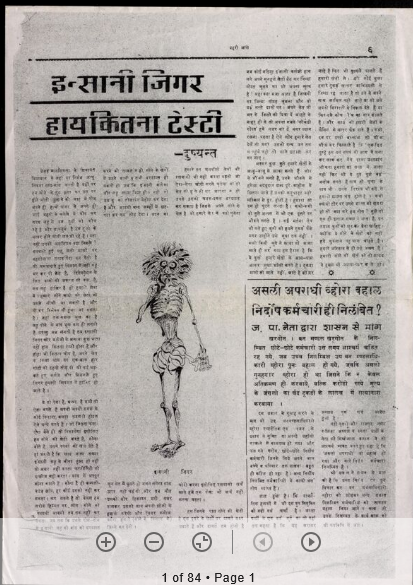
A powerful movement in the years 1978-79 called the Nimad Bachao Andolan took place in Madhya Pradesh demanding the height reduction of the Sardar Sarovar Dam soon after the Narmada Water Dispute Tribunal was declared. Very little is known of this movement today. However, there was a newspaper in Hindi called, Prahari Aankhein that extensively covered the movement. Some Photocopies of this newspaper are archived at the NCBS archives, as explained by the archives as, “9 sets of the Hindi newspaper that covered the movement in 1978-79 called the Nimad Bachao Andolan demanding height reduction of the Sardar Sarovar Dam. There are annotations in the newspaper.”
For wider reach, some relevant articles from the newspaper are translated to English here.
The nine copies at the NCBS archives can be reached through this link
The following article is from the 16th September 1978 edition (Year 1, Issue 11) of Prahari Ankhein (Watchful Eyes), a Hindi Weekly published out of Indore, Madhya Pradesh under the editorship of Jawarchand Dassani. This was the fifth in a series of special issues on the subject of ‘Struggle for Fair Distribution of Narmada Waters’. These special issues were published in the aftermath of the initial award of the Narmada Water Disputes Tribunal delivered on August 16, 1978.
Have our politicians ever followed the Gandhian perspective?
A movement is gaining momentum in the region on the issue of the height of the Navgam dam. A Tribunal has arrived at the figure of 455 feet for the height of the dam, and as a result, a large number of villages would get submerged either partially or wholly.
But, is the issue limited to just the reduction of the height of the dam? Every initiative in our country is accompanied by a lot of ‘noise’. Although Sanjay Gandhi’s family planning and tree plantation initiatives were appropriate national issues, when family planning was forced on people and when planting of trees was reduced to a photo opportunity, they turned into futile exercises succumbing to the ‘noise’ around them. Construction of mammoth dams is also a product of the ‘noise’ about their grand size, devoid of any inquiry into their suitability.
Irrigation is an integral part of agriculture. But attention must also be paid to the type of irrigation needed. It is important to evaluate the benefits and the costs of the dams which have been built so far.
A large dam was constructed on Bhakhra-Nangal in Punjab. This ‘temple of modern India’ is now harming those very people for whom it was constructed. Increase in salinity has become a significant problem for agriculture in Punjab-Haryana. A dam built for the benefit of agriculture by providing irrigation, has now become a bane for cultivable lands in the area. Around 60 percent of the cultivable area in the state of Haryana is turning into a wet desert because of increasing salinity, and consequently, crop productivity is coming down. The only achievement of the dam appears to be the supply of electricity to the cities. Similarly, the huge Tawa dam in Madhya Pradesh was built under the Tawa Ayacut scheme. We can already see a glimpse of how beneficial or harmful the irrigation facilities from the dam would be for the farmers.
The over-recharge of water in Chambal has also pushed the farmers of the region away from farming and into other occupations. People of the region are fleeing agriculture and taking to weaving carpets. There are many such examples before us.
The politicians who have used Gandhi for their political ends in the last 31 years, never thought or did anything based on Gandhi’s principles. Gandhi had appropriate solutions to all these myriad problems. In response to a question about the suitability of large-scale centralized projects for addressing the poverty, inequality and unemployment in the country, he had answered that the solution to poverty was not more production but production by more and more people.
Looking at the geopolitical and economic situation of the country, the idea of undertaking smaller irrigation schemes instead of construction of large dams, is aligned with this Gandhian thinking.
We basically derive two kinds of benefits from dams – electricity and irrigation. If we are able to free ourselves, at the level of both thought and action, from the spell of ‘largeness’ which is a product of western industrialization, we can clearly see that small irrigation schemes are as beneficial as the large ones. If we look at the downsides, the larger schemes are likely to prove more harmful. Smaller schemes can be implemented by construction of small dams on smaller rivers. People of 2-4 neighboring villages can derive benefits from such schemes as per their needs. Small scale industries like fisheries can also be supported through these smaller dams.
Electricity is an important product derived from the use of water. This can be generated from small dams as well. Local-level powerhouses can be constructed for the benefit of 10-20 villages for electricity purposes. By generating surplus electricity, they can help nearby villages and towns as well. Electricity generation is a business in Canada, and electricity is generated there at such small-scale power generation centers. Surplus electricity remaining after fulfillment of local requirements is then sold to others.
The issue of Navgam [Sardar Sarovar Project] is thus, not just a question of the height of the dam or the quantity of electricity generated, but it is a question of the appropriateness of large dams. Are we going to fall prey to the ‘noise’ of the technical advancement of European nations and chase large-scale projects or are we going to look back and heed the advice of our own Gandhi?
Second Assassination of Gandhi!
History would never forget Murderers Morarji Desai and Virendra Kumar Sakhlecha
All the Janata (Party) leaders under the leadership of Shri Jayprakash Narayan and Shri Morarji Desai had announced from public platforms during the Lok Sabha elections that “in accordance with the principles of Mahatma Gandhi, large projects and large factories won’t be built in this country from here on.” Instead, small projects and employment-oriented small industries would be initiated. But in a betrayal of these promises, these leaders after having killed Gandhi, are now hell bent on blowing up into pieces, those very Gandhian principles, which had brought them to power. What else is this, if not the second assassination of Gandhi?
Sakhlecha summoned to Delhi
As soon as the assembly session ended here, Sakhlecha was immediately summoned to Delhi. It is being reported that Morarajibhai had asked Sakhlecha in this meeting, if the provocative actions during the assembly session and the intensifying protests have unsettled him?
[Virendra Kumar Saklecha was the Chief Minister of Madhya Pradesh from January 1978 to January 1980]
Sakhlecha under Pressure
Sakhlecha had no answer to this question. Then, Deoras and Advaniji were contacted immediately, and Sakhlecha was pressured to immediately issue a statement to the press to the effect that the state government would accept the Award of the Tribunal, if the height of the dam can be reduced by 5-10 feet.
Eating the hand that fed them
It is being said that when Virendra Kumar Sakhlecha remained undecided, he was pressured by senior leaders of Jan Sangh and told in clear terms that even a small misstep by him can put Jan Sangh out of power. In response to this, Sakhlecha is reported to have said that Badwani is the one of the few assembly seats in Madhya Pradesh where Jan Sangh has won consistently in the previous elections, and therefore if we make the mistake of drowning the anchor which is keeping us afloat, the consequences would be terrifying.
The Threat of Imprisonment?
He then reminded them of the Janata Party’s promise of not implementing large-scale projects. But it is being said that Sakhlecha was warned that he should fall in line if he wanted to continue as the Chief Minister, else he may be looking at a long jail term in the Nepal trafficking scandal.
And this way, Sakhlecha agreed to become a co-murderer along with Morarji in this assassination of Gandhi’s principles. He announced Madhya Pradesh’s acceptance of the Award of the Navagam Tribunal in a press conference in Delhi, with the rider that the height of the dam should be reduced by 5 feet. In this manner, he agreed to drown the region which had kept Jan Sangh afloat all these years. Morarji and Sakhlecha have shown their true colors now.
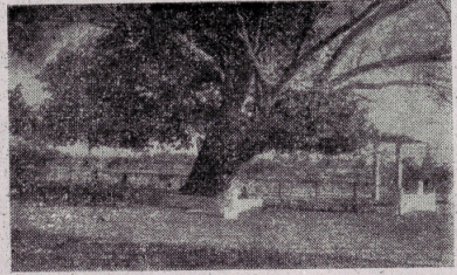
[Mahatma Gandhi’s Samadhi along with that of Kasturba and Mahadevbhai Desai at Rajghat was dug up and removed before submergence in 2017, for details see
https://www.counterview.net/2017/07/demolition-of-gandhi-samadhi-in-badwani.html
https://sabrangindia.in/gandhi-samadhi-demolished-mp-govts-bid-stop-medha-patkars-fast/
Question – Are you worried about your chair or Madhya Pradesh?
In pursuance of their greed for power, Morarji and Sakhlecha are ready to murder Gandhi’s principles, symbolized by submergence of Gandhi’s mausoleum in Badwani under the waters of the Navgam project. The people of this country would never forgive such power-hungry murderers.
When we can change the Constitution, why not the award of a Tribunal?
Shri Raghu Thakur
The lion of Badwani, Madhya Pradesh, Shri Raghu Thakur commenced the struggle against the large Navgam Dam by lighting a lamp at Gandhi’s mausoleum, and said that when we are allowed to change the Constitution, no hell would break loose if we change the award of a Tribunal. He stated that the interests of Madhya Pradesh would never be allowed to be sacrificed and that the large Navgam dam would never be accepted.
A large gathering extended a historical and grand welcome to Shri Raghu Thakur, the General Secretary of Madhya Pradesh Janata Party and the Lion of Madhya Pradesh on his arrival at Badwani. The arrival of Shri Raghu Thakur has lifted the spirits of the people of Nimad.
A large crowd of over 10 thousand people had gathered to listen to the Lion of Madhya Pradesh.
Shri Raghu Thakur lit a lamp at Gandhi’s mausoleum and announced the commencement of the Navagam struggle. Thousands of young people joined him in taking a pledge that they would not allow Bapu’s mausoleum to be submerged.
While addressing the largest rally in the history of Badwani, Shri Raghu Thakur announced that he would never accept the construction of a large dam at Navagam. At this announcement, a 10-15 thousand strong crowd clapped and shouted slogans of ‘Long Live Raghu Thakur’ in unison.
Shri Raghu Thakur stated that the Manifesto of the Janata Party is Gandhian in character, and there is no place for large-scale schemes like construction of big dams in it. We had announced the construction of smaller dams and irrigation projects and a government that supports construction of large dams can never be a people’s (janata) government. He said that if we can change India’s constitution, then no hell will break loose if we change the award of a tribunal.
He continued by saying that if the Chief Minister of the state has not entered into a secret agreement, he should, in the interest of the state, reject the award of the Tribunal. If the government doesn’t reject the award, then the party would compel it to reject the award, and we would not allow the interest of the state to be sacrificed at any cost. He announced that he would always stand with any peaceful movement led by the Struggle Committee.
On this occasion, Members of Legislative Assembly from Janata Party, Shri Babulal Soni and Shri Bankim Joshi said that Janata Party has and will always defend the interests of the people and those who betray the people, can never be part of the Janata Party. Earlier, the General Secretary of the Committee, Shri Madanlal Sharma, Vice President Shri Vyas and Shri Babu Sen called on all the political parties to rise above sectarian interests and come together to defend the interests of the region. The event was presided over by Shri Narmada Prasad [Tiwari].
Why such helplessness over the Tribunal Award?
Shri Bankim Joshi, MLA
The Narmada Tribunal finally announced its decision to raise the height of the Navagam dam to 460 feet. This has lit a fire across the whole Nimad region, because a large portion of Nimad’s fertile lands would go under submergence. There can be no doubt that the Tribunal’s Award is against the interest of Madhya Pradesh. Madhya Pradesh has come out as a loser because of the award. If you have to put a monetary value to the loss, then the market value of the lands that would be submerged would alone be at least one billion rupees; and if the cost of rehabilitation is taken into account, including the cost of land required for it, then the total expenditure on rehabilitation would be another 1.5 to 2 billion rupees.
The Chief Minister of Madhya Pradesh, Mr. Sakhlecha and the President of Madhya Pradesh Janata Party, Mr. Thackeray has declared that the award is in the interest of the state. They have resorted to the biggest lie possible to avoid facing the fury of the people and to protect their self-interest. But the Janata Party would like to ask Mr. Sakhlecha and Mr. Thackeray and former Jan Sangh leaders, that if the height of 460 feet for the Navagam dam is in the interest of Madhya Pradesh today, then why did Madhya Pradesh Jan Sangh ask for the dam height to be reduced to 210 feet when they were in the opposition?
Was it for the reason that they were in opposition then and considered it their bounden duty to create trouble for the ruling Congress party or was it because their demand truly reflected people’s interest? Mr. Sakhlecha’s old speeches made in the assembly would themselves pose this question to him – why did he lie in previous assembly sessions and why did he use the sacred portals of the assembly to further narrow party interests? While the leader of Congress (I), the opposition party, Mr. Arjun Singh has not opposed the Tribunal Award in clear terms, but whatever has been said by him so far, indicates that eventually he would also come around to opposing the Award. Let us examine some of his statements more closely: –
- The Chief Minister of Madhya Pradesh has stated in the All-party meeting that Madhya Pradesh has not accepted this Award.
- A Committee should be formed to suggest ways of utilizing the water more efficiently while keeping the height of the dam low.
- The Chief Minister of Madhya Pradesh should meet the Prime Minister as the representative of the state and if the Prime Minister doesn’t accept the interests of Madhya Pradesh, then the Chief Minister should resign from his post, and lead Madhya Pradesh in this fight.
These excerpts make it clear that Mr. Arjun Singh is also unsatisfied with the Award, but he is choosing his words carefully and there can be several reasons behind his cautious approach.
Because he has been a minister in the Congress government, he probably remembers his earlier role in the issue. Or, having been in the government for so long, he understands the implications of going against the government, and hence he doesn’t want to oppose the government directly knowing very well that Mr. Sakhlecha is trying to defend the Tribunal Award out of compulsion. The Chief Minister is also unable to muster the courage to state the truth. Even in the all-party meeting he could not show the courage of acknowledging that his government has accepted the Tribunal Award, instead he lied that his government hasn’t accepted the Award yet. If the Chief Minister agreed with the Award, then why did he state in a statement issued on 17th August that Madhya Pradesh government would seek clarifications from the Tribunal. It is widely known that a Tribunal Award cannot be appealed, but clarifications can be sought, which is almost like a reconsideration of the award. A second option could be filing a petition before the Supreme Court. Madhya Pradesh government has decided to pursue the first option and ask for reconsideration of the Award. This clearly shows that Mr. Sakhlecha is supporting the Award out of compulsion. Following could be the reasons behind his helplessness in the matter: –
- He is unable to find a legal way out of the problem.
- Being the representative of the government, it doesn’t appear appropriate for him to speak against the Award of a Tribunal.
- It is rumored that the Prime Minister had backed him for the post of Chief Minister on the pre-condition that he would accept 460 feet as the height of the Navagam dam. Some politicians have made statements to this effect before he became the Chief Minister and some newspapers had also published reports hinting at such an arrangement. Although, a few journalists have expressed doubts at this, and have termed these allegations scurrilous and baseless. If this allegation is false, it is undoubtedly scurrilous, but if it is true, then there could be nothing more scurrilous than to enter into a secret agreement to trade the interests of Madhya Pradesh in exchange for keeping oneself in power.
The question that arises is, what assistance can the Chief Minister offer for the benefit of the Prime Minister? If there indeed was a secret agreement, then a Chief Minister can oblige the Prime Minister in two ways: –
- Not presenting the state’s case and related documents before the Tribunal necessary for protecting the state’s interest or directing the concerned officials not to do so.
- Making the people swallow the poison of the award gradually without ever rejecting the Award.
The Chief Minister of Madhya Pradesh has entered into both these compromises and a deal to keep him in the chair has been struck.
It becomes necessary now to examine the issues which have been presented in the support of the Tribunal Award.
- Madhya Pradesh would not be at a disadvantage because of this Award.
- Instead of creating a controversy over the Award, we should think about how we would use the water allocated to us in the next 50 years.
- Instead of creating a controversy over the Award, we should think about rehabilitation.
- The same extent of land would have come under submergence, if the Haranfaal dam had been constructed.
- Madhya Pradesh would benefit from the electricity and water that it would receive.
- The Award should be seen from the point of view of national interest and not state interest.
- The people’s movement against the dam is losing steam.
Mainly, these are the only arguments which can be advanced in the favor of the Award. We should examine these issues one by one.
Narmada flows for about 700 miles in Madhya Pradesh, and hardly 100 miles in Gujarat and some 25 miles in Maharashtra. The damage caused by flooding in the Narmada is largely borne by Madhya Pradesh. From Amarkantak to Navagam, Narmada flows through the lands of Madhya Pradesh. But under the Award, Madhya Pradesh has been granted only two-thirds of the water and Gujarat has been awarded one-third. Is this appropriate? The rulers and political leaders of Madhya Pradesh should think about why not a single river of Madhya Pradesh has been sufficiently used to serve the state’s interests. The earlier governments are all guilty of this crime. This is a fact. The waters of Chambal are being used mainly by Rajasthan. The waters of the Bagh River are being used by Maharashtra. Similarly, Mahanadi is being used largely for the benefit of Odisha state. As a result, the lands of Madhya Pradesh are dry despite the state being abundant in water. Is it not a fact that Madhya Pradesh is the least irrigated state of the country? Only 12 percent of the agricultural lands are irrigated in Madhya Pradesh while in a small state like Haryana, which has no major river at all, 78 percent of the agricultural lands are under irrigation. Then, the lands which are going to get submerged are also largely in Madhya Pradesh. Gujarat and Maharashtra would have to sacrifice very little on this count. Is it not a loss for the state that when the river is flowing through our lands, when we are the ones facing the flooding, when hundreds of our villages and homes would get destroyed in the submergence, yet we are asked to bear the 1.5-to-2-billion-rupee expenditure on rehabilitation all by ourselves? Those who argue that such a large-scale project is required for the development of Madhya Pradesh, should tell us whether Madhya Pradesh would receive less water if the height of the dam is reduced?
Experts are of the opinion that if the height of the dam was kept at 360 feet, then Madhya Pradesh’s share of water would have reduced by hardly 30 lakh feet, i.e. instead of 1.80 crore feet water, Madhya Pradesh would have received 1.50 lakh feet water and Gujarat would have received 75 lakh feet of water instead of 90 lakh feet, but thousands of acres of lands and lakhs of people in Madhya Pradesh would have been saved from submergence. Madhya Pradesh had earlier proposed 360 feet as the height of the dam, which clearly shows that a 360 feet high dam was more beneficial for Madhya Pradesh, and therefore, the Tribunal Award is clearly against the interests of Madhya Pradesh.
Those who advise us to think in national interest should know that national interest is not inconsistent with the interest of Madhya Pradesh. National interest requires efficient and appropriate use of the waters of Narmada.
Concerned states, i.e. Gujarat and Madhya Pradesh should definitely not face shortage of water. In reality, Gujarat’s requirement, as it had declared earlier, is only 40 lakh feet of water, but as per the Tribunal’s Award, Gujarat would receive 90 lakh feet water now, which is more than double of what Gujarat requires. The question that arises is why does Gujarat want such a high dam which would give it more benefits than it actually requires? The reason is clear. Gujarat wants to use this water to irrigate Rann of Kutch. The higher the water level in the dam, the further it can easily irrigate lands in the Rann of Kutch. If the water levels of the dam are lower, Gujarat would have to make special efforts to irrigate the lands in Rann of Kutch, which would increase the cost of water made available for that region. This means that Gujarat wants a high dam so that the Rann of Kutch gets water for irrigation, and that too cheaply. If we think of national interest, then Gujarat is ahead of Madhya Pradesh in all aspects. Irrigation in Gujarat stands at 34 percent, while it is at 12 percent in Madhya Pradesh. Gujarat has several large rivers whose water it can utilize. The per capita income of Gujarat is also higher than that of Madhya Pradesh. In these circumstances, it would be in national interest that both Gujarat and Madhya Pradesh get water in adequate quantity, while lands in Madhya Pradesh are not submerged even if it means that Kutch gets water at a slightly higher cost. In this context, we should also ponder over whether projects like Navagam are appropriate for poor countries like India. Large projects, especially large irrigation projects are not suitable for our poor country because the cost escalations for these projects are so high, that it takes a long time for the projects to be completed and therefore, no benefits flow from them for several years. While vast areas fall victim to submergence, the availability of water in comparison is much lesser. A poor country doesn’t have adequate resources to undertake such projects in one go or to complete them quickly. The example of the Tawanagar project implemented in Madhya Pradesh earlier would suffice as an example, although the original cost estimate of Tawanagar project was one-third of that for Navagam dam. In the beginning, the total cost of the project was estimated as 25 crore rupees; 25 years have lapsed since then, and the project still remains incomplete, although over a billion rupees have been spent on the project in these 25 years. More money would have to be spent to complete the project, and who knows how many more years it would take to complete it? Moreover, the land area that would eventually come under irrigation, is a lot less than the projected figures. So, there has been a long tradition of projecting imaginary numbers while designing such projects. These facts show clearly that while these large projects may be beneficial to the bureaucracy, they are a loss-making deal for the country and its people. Therefore, smaller projects which require lesser capital, lesser time, and which submerge smaller land areas, are more beneficial.
The other argument which is usually made is that instead of creating a controversy over the Tribunal Award, we should think about how we are going to use our share of the water during the next 50 years. Before this question is asked, technicians and experts should be asked to examine the impact of construction of a large dam like Navagam on the older projects like Bargi, especially on the water levels in their reservoirs, which are still under construction. The origin point of Narmada is at an elevation of 3700 feet while the point where it lands is at a height of 300 feet. Thus, Narmada is a mountain river, flowing rapidly down a steep slope. Now coming back to the original question regarding the use of the available water, the responsibility of building the capacity to utilize the natural water resources of a state falls on the leaders in power. If the water of the rivers of Madhya Pradesh could not be utilized for Madhya Pradesh or if other states have been more successful in exploiting the water of the rivers of Madhya Pradesh, then the blame for this should fall on the previous governments of Madhya Pradesh, who failed to discharge their responsibilities in this regard. In a small state like Haryana, which is not blessed with any major river, 74 percent of the agricultural land is under irrigation. Punjab has also utilized its natural resources to the fullest extent and many other states have also exploited their water resources in a similar manner.
Therefore, the extent to which a state is able to utilize the water of its natural rivers depends entirely on the will and determination of those ruling it. I can state this with complete confidence, without any political bipartisanship, that if the previous governments of Madhya Pradesh had given priority to irrigation, if they had considered this as the most significant developmental work, then the water of our natural rivers would not have gone to waste in this manner. While granting 1 crore 8 lakh feet water to Madhya Pradesh, the Tribunal has not made any concessions to it because Madhya Pradesh is entitled to an even larger volume of water. If the water was allocated in proportion to the length of the river, then Madhya Pradesh would have received more than 2.5 crore feet of water. So, to say that we would not be able to use even the allocated volume of water in the next 50 years (it would be good if we are able to) shows our own incompetence. If we don’t have the will power to reach 100 percent irrigation in the state, we would keep making this excuse for the next 100 years. But if we are determined, then we can achieve this in a shorter time period, with much less water, as demonstrated by several other states. It would not be appropriate to determine the volume of water Madhya Pradesh needs based on today’s requirements, instead we should consider what would be the population of the state after 200 years, how much water and electricity it would need. Do we have a vision for our future? If we make plans for our long future, we would succeed in reaching our goals and realizing our dreams.
Another argument being made is that instead of indulging in controversy over the Award, Madhya Pradesh should focus on rehabilitation, to ensure that all those evicted are resettled properly. Mr. Thackeray, the President of Madhya Pradesh Janata Party has emphasized this on several occasions. I feel that making rehabilitation the central and sole focus of our discussions would take us away from the fundamental question. This shows that they (Janata Party) are accepting 460 feet as the height of the dam, but they don’t want to say this clearly and directly to protect their political standing from the obvious anger of the people, and therefore they are trying to divert the attention of the people on to other issues. The question of rehabilitation is undoubtedly very important, but what is the intention of people like Mr. Thackeray in focusing on the question of rehabilitation to the exclusion of others? This is beyond my comprehension. If he is requesting the cooperation of the people of the entire state then he should know that people of the state already contribute towards its functioning by paying taxes. Therefore, there is no question of any other form of cooperation. If he is preparing the ground for imposing any additional taxes to meet the expenditure on rehabilitation, then he should have the courage to say so clearly. However, people of the state are never going to accept any such additional taxes, because after all, those very people and their lands are being submerged by building an unnecessarily large dam. These are not normal or natural measures taken by any government. If the state was facing a natural calamity, the people would have accepted such an appeal for cooperation, but a disaster of the government’s own making should be remedied by the government itself. Therefore, calling on people of the state to discuss the question of rehabilitation could only serve the purpose of distracting them from the more fundamental question. The question of rehabilitation would arise only after the final decision on the height of the dam has been taken, after the administration would have acquired the lands needed for the dam through due process of law, and when the construction of the dam would be complete, ready to be filled with water, submerging people’s lands and properties. Discussing the question of rehabilitation at this juncture is akin to making arrangements for the funeral of a patient instead of giving him the required treatment. Those who think that rehabilitation would be an easy task, should keep in mind Madhya Pradesh’s fiscal situation and the expenditure that would have to be made for rehabilitation. We have been unable to resettle even those who have been displaced by smaller dams which have been built in the last few years. Many of the evictees of those dams have not received any compensation while they have been rendered unemployed. Those who have been compensated, have also received meager amounts. Ideally, those who have lost cultivable lands should have been compensated with land near the reservoirs, and those who have lost their homes to submergence, should have been provided built houses by the administration close to their villages; and all these steps should be completed before the acquisition of land by the administration. Till these steps are completed, the administration should allow the evictees to continue cultivating their lands. But this is what one would accept from an ideal administration. For now, please give serious attention to the expenditure we would need to make on rehabilitation.
The lands of Nimad are very fertile. Usually, they are used to grow cotton. The market value of just the lands which would come under submergence would be 1.5 to 2 billion rupees and then the cost of houses would come up to several more crores of rupees. Is the Madhya Pradesh government in a position to compensate for this loss? The administration has made provisions for an expenditure of 1600 crore rupees on this project over the next 10 years. In fact, at this point, it is not even a provision, it is a mere announcement. It would be impossible for the Madhya Pradesh government to spend so much on a single project. If this announcement is taken seriously, then the entire irrigation budget of the state would have to be reserved for only the Navagam project, which exposes the true reality of this announcement. The total budget of Madhya Pradesh government is 400 crore rupees and no government can spend half of this budget on the rehabilitation of the evictees from a single project, because 41 percent of the total budget is spent on salaries of government employees and if 50 percent is spent on the rehabilitation of the evictees of a single project, then it would become impossible to accomplish anything else in the state with the remaining 9 percent of the budget. Therefore, it is foolish to think that rehabilitation would be an easy task. One should also consider that the rehabilitation-related responsibilities assigned to Gujarat under the Tribunal Award are wholly insufficient. It has been stated in the Award that the government of Gujarat would provide compensation of Rs 1250 to every family along with a 20×30 plot. Any common man can understand that a compensation of Rs 1250 for a family is as insignificant as a drop in an ocean. And who would want to leave their settled livelihood and houses for a 20×30 plot on the Gujarat border? Eventually, this would all prove to be a fraud. This clearly demonstrates that Gujarat would contribute almost nothing to the rehabilitation effort. The entire responsibility and expenditure of rehabilitating the evictees would, more or less, be borne by Madhya Pradesh. In keeping with the principles of common or natural justice, Gujarat should have been made responsible for contributing one-third of the expenditure on rehabilitation of evictees in Madhya Pradesh, amounting to 60-70 crore rupees, but the Tribunal failed to do this, can you call this unbiased? An argument has also been made that we would request the Union government for their assistance in rehabilitation. But the Tribunal Award is silent on this aspect. The implication is clear. We would destroy hapless people; we would evict them and then we would keep running to Delhi and Gujarat with a begging bowl in our hands. Sharing of the rehabilitation expenses would not be our right then; it would be a mercy or a pity shown to us. Is this decision in the interest of the state?
Therefore, we should first focus on getting the height of the dam reduced from 460 feet to 360 feet and also demand that each beneficiary state has to bear the expenses of rehabilitation in proportion of their share in water. By this yardstick, Gujarat would have to share one-third of the rehabilitation expenses. The budget-related statistics of Madhya Pradesh quoted above clearly show that the Madhya Pradesh government would not, on its own, have the capacity to implement such a large scheme and use such a large amount of water in a short period of time. Thus, we should also ask the Union government to constitute a Narmada Valley Development Authority which would discharge the responsibility of implementing all the irrigation and electricity generation schemes on Narmada in the next 5-10 years, and 60 percent of the expenditure on this should be borne by the Union government while the remaining should come from the concerned state governments on a proportionate basis.
Another argument made is that if the Haranafal project (which is now falling under the submergence zone of Navagam dam because of the increase in height to 460 feet) would have been implemented, the same extent of land area would have come under submergence since the same height was proposed for Haranafal dam as well. This sounds valid on paper but we need to understand its reality. When Gujarat had knocked on Delhi’s doors with a claim over Narmada waters, to bolster its claim it had argued that Madhya Pradesh is unable to utilize the water of the Narmada, which is therefore going to waste. Hence, that water should be used in national interest and Gujarat should be given the permission to raise the height of the dam, so that the water could be utilized fully. The previous governments were unable to provide any firm and logical response to this argument because of their failure to make any arrangements or to take up any significant irrigation scheme between independence and the birth of this controversy. The argument made by Gujarat exposed the inactivity of successive governments of Madhya Pradesh. Therefore, in the anxiety to answer this allegation, at the behest of the politicians, some cunning and clever officials prepared a map of 29 projects across the Narmada valley and placed them before the Union government and the Authority. Those who had prepared these projects and those at whose behest these projects were prepared, knew very well that these were imaginary projects, which had nothing to do with reality, because these projects were proposed not for irrigating lands in Madhya Pradesh but to counter Gujarat’s arguments. These projects were counter-arguments against the argument for another project. In their anxiety and incompetence, they didn’t even bother to think that if they propose the height of the imaginary dam at Haranafal at 400 feet then the argument for lowering the height of the Navagam dam from 400 feet to 210 feet also falls like a heap of sand. In this way, Madhya Pradesh scored a self-goal against its own interests and those of its people by presenting a map of these imaginary projects. Therefore, it is meaningless and wrong to argue that the same land area would have submerged if Haranafal dam was built, since Haranafal was never meant to be built. Instead, the reduction in the volume of available water after lowering the height of the dam by 100 feet (which would come to about 45,00,000 feet of water presently allocated to Gujarat and Madhya Pradesh) could be made up by implementation of additional smaller projects on Narmada. One or two smaller projects would be sufficient to meet the shortfall of 45 lakh feet water, and on the positive side, they won’t submerge any lands, no expenditure would be needed for rehabilitation, they could be completed quickly and given the current fiscal situation of Madhya Pradesh, it would be able to complete these smaller projects on its own, without much delays.
Another argument being made is that the water and the electricity that Madhya Pradesh would receive because of the Tribunal Award would make the state prosperous, and this has an element of truth. But the question is that if the height of the Navagam dam is reduced from 460 feet to 360 feet, would it make a big difference to the availability of water and electricity and would Madhya Pradesh become less prosperous? The figures and arguments provided above prove that even if the height of the dam is reduced to 360 feet, the dam still remains beneficial in terms of both water and electricity. Firstly, the state would still be able to become prosperous and secondly, it would be spared large-scale submergence and burdensome expenditure on rehabilitation, so this alternative is actually superior.
Mr. Thackeray, the President of Madhya Pradesh Janata Party has told the press that the people’s movement against the dam is gradually fading away. Everyone is entitled to their opinion. In general, people’s movements do wane for a period after a surge of intensity. This is a natural phenomenon. But a decrease in the intensity of the people’s movement, doesn’t justify in any way, the acceptance of the Tribunal Award and raising the height of the Navagam dam to 460 feet. If loss of intensity of people’s movement is accepted as a justification, then Emergency should be considered as justified, since people’s movements were very muted during the Emergency. Such an argument can never be made by a wise satyagrahi, it can only be made by a ruler and an egotist at that. This is not just an argument; it is a ploy being used to throw cold water at people’s anger and rage. The Chief Minister and the President of Madhya Pradesh Janata Party are laying down a well-planned trap for the people of Madhya Pradesh. On one hand, they are not saying clearly in public that they have in fact accepted the Award of the Tribunal, and on the other hand they are trying to manage the anger of the people, to indirectly create a situation where the Award becomes a fait accompli for the people. This is the reason why the Chief Minister, Mr. Sakhlecha, the party President, Mr. Thackeray and the General Secretary, Mr. Khandelwal who had called the support extended by their MLAs to the demand for creation of a separate district of Katani as indiscipline, are now silently watching the protests and satyagrahas started by their own MLAs from the Nimad region. In fact, in public they even pretend to support these protests, although behind closed doors, they urge the same MLAs to withdraw their support to these protests.
The above discussion makes it clear that reducing the height of the Navagam dam to 360 feet would be appropriate, just and practical and this demand should be raised by all the political parties, the people and the government in unison. Madhya Pradesh should make its stand clear before both the Tribunal and the Union Government, that it does not accept 460 feet as the height of Navagam dam and it would not accept any height over and above 360 feet. Secondly, a Narmada Valley Development Authority should be constituted, 60 percent of whose expenditure should be borne by the Union government and the remaining should be borne by the respective states in proportion to the benefits derived by them. Thirdly, the responsibility of rehabilitation should be shared by all the states in proportion to their share in water allocation. Fourthly, the government is a representative of the people and a symbol of their emotions. Therefore, the government should act as per the wishes of the people.