The translation of a letter by Kashinath ji Trivedi
Kashinathji Trivedi, a Gandhian freedom fighter and pioneer in questioning large dams on the Narmada, was known as the “Gandhi of Nimad.” The fertile plains of Nimad in Madhya Pradesh lie within the submergence zones of several large dams on the Narmada, particularly the Sardar Sarovar Dam in Gujarat and the Indira Sagar Dam in Madhya Pradesh—two of the largest projects in the Narmada Valley Development Plan.
Soon after Independence, Kashinathji became a minister in Madhya Pradesh, but he soon realized that political office was not where his work lay. He returned to the grassroots, working closely with people and taking up issues affecting their lives and livelihoods. Among the most important of these was the impact of large dams on the people, ecology and culture of the Narmada valley.
Kashinathji challenged the dominant development paradigm based on large dams and centralized planning. He was a founding member of the Narmada Ghati Navnirman Samiti, which worked to create awareness about the social and environmental consequences of large dams and the need for sustainable, decentralized alternatives.
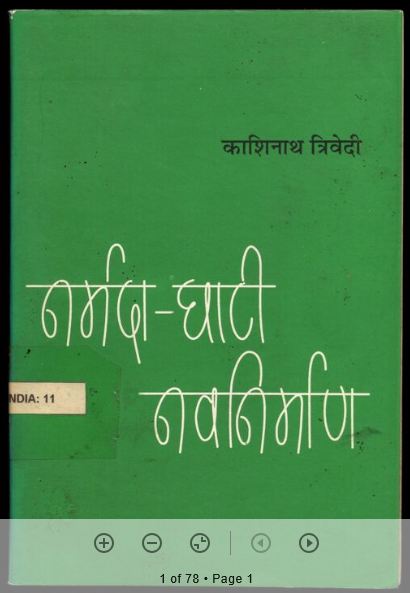
His writings on the Narmada during the 1980s are therefore of considerable historical significance. Some of these writings were published in a booklet titled Narmada Ghati Navnirman in Shatabdi Sandesh, and portions relating to dams are reproduced here in English for a wider readership.
Among these is an extraordinary Open Letter to Motilal Vohra, then Chief Minister of Madhya Pradesh, written by Kashinathji in 1987. The letter questions the construction of dams on the Narmada from ecological, social, economic, political and ethical perspectives. It challenges the belief that large dams necessarily represent progress and asks fundamental questions about who has the right to make decisions whose consequences will extend across generations.
Written several years before many of these concerns became central to public debates on displacement, environmental destruction, centralized development and people’s rights, the letter provides an important window into the early history of resistance to large dams on the Narmada.
The original Hindi booklet, Narmada-Ghati Navnirman, is now archived in the NCBS Archives and can be accessed [here].
The translation that follows is intended to make Kashinathji Trivedi’s voice and ideas accessible to a wider readership and to place his pioneering intervention within the longer history of the Narmada struggle.
Narmada-Ghati Navnirman
(Rebuilding the Narmada Valley)
Kashinath Trivedi
These articles written by the late Shri Kashinath Trivedi, the pioneer of the movement opposing construction of dams on Narmada and known as the ‘Gandhi of Nimad’, were serialized in ‘Shatabdi Sandesh’ during 1988-89.
A destructive form of governance and development has raised its head in India after independence. These articles reflect the internal pain and despair of a freedom fighter at the common man being reduced to a dwarf and robbed of his sovereignty. But this is accompanied by acceptance of this challenge and a call for waging a second struggle for independence which would beckon true swaraj (self-rule) to each and every village, and realize the sweet dream of ‘our country, our rule’.
Narmada Valley Development Seminar, Koteshwar, Dhar
Date: 15-17 April 1986
The gathering is of the opinion that the planners who are behind the project of building small and large dams on the Narmada river have not carried out any studies and analysis of the grave problems related to environment and pollution arising out of the projects. Therefore in the humble opinion of the seminar, these plans are isolated, incomplete and improper. Only irrigation and electricity related aspects have been given primacy, which is worrisome. While preparing these plans, the ecological balance of the region, its cultural and social traditions and the basic needs of the people of the area have not been given correct and appropriate consideration. Therefore, in the opinion of the seminar, keeping in mind the changed context today and in the background of the massive worldwide problems of environment and pollution, a thorough reconsideration of the entire scheme of construction of dams has become not just necessary but unavoidable too.
One of the strong beliefs of the gathering is that in a vast country like India, all development schemes and projects being implemented for the benefit and progress of common people should be decentralized, and not centralized…..
An Open Letter to the Chief Minister of Madhya Pradesh from Shri Kashinath Trivedi on the Dams being constructed on the Narmada
Letter No. 1339, Date 20-11-1987
To,
Shri Motilal Vohra,
The Chief Minister, Government of Madhya Pradesh,
Vallabh Secretariat, Bhopal
Subject: The Dams being built on Narmada.
Dear Brother Motilalji,
Greeting with warm regards and affection
The onerous responsibility of getting small, medium and large dams on the Narmada, the lifeline of Nimad region and people’s mother, has fallen on your shoulders now, as the sitting Chief Minister of Madhya Pradesh. The Chief Ministers who came before you, shouldered this responsibility, to the extent they could, given the circumstances during their respective tenures. This grave responsibility, received in inheritance from them, has fallen on your shoulders now. You have also begun discharging this responsibility in your own way. Numerous obstacles to this mammoth and arduous task of our times, have all disappeared one-by-one, and the heavyweights of Indian administration have also given you the green light to proceed with this godly task. You have also dug in your heels to take this task to its logical conclusion, and have given the green signal from your side to your colleagues in the administration tasked with completing this herculean task. The construction work would now keep progressing at its own sweet pace, and the scheme would reach its full working potential in the coming 15, 20 or 25 years. When this godly work had been completed, one of your successor Chief Ministers would be ruling Madhya Pradesh. The inauguration rituals would be carried out one-by-one, for all small, medium and large dams, as and when they are completed, and then they would get down to their work. The canals of the dam would get busy taking its water to far away fields. The electricity from the dam would also start creating new waves in villages, towns and cities of near and far. Everyone would witness their golden dreams descending on to earth, and the hearts of those benefiting from the dam would be filled with a sense of bliss and gratitude.
2. A chimerical deer would have accomplished its task by then with a lot of dexterity and skill. Ravana would come and kidnap Sita again. Rama would be left grieving over his separation from Sita, again. Then Rama would have to assail Ravana’s Lanka and to wage a great war to rescue Sita from the claws of Ravana. And, history would keep repeating itself in this manner.
3. I am writing this Open Letter to you on a beautiful morning from a quiet and solitary place in the lap of Narmada. This letter of mine is addressed to both Shri Motilal Vohra, the present Chief Minister of Madhya Pradesh, as well as Shri Motilal Vohra, a sovereign citizen and my well-known brother. Your tenure as a Chief Minister is time-bound, but you would remain a sovereign citizen till the last breath of your life. Please oblige me by reading this open letter from beginning to end in a calm, healthy, neutral, tranquil, open and pleasant moment, keeping in mind both your status as the Chief Minister of Madhya Pradesh and a sovereign citizen of this nation.
In your current political role, you are discharging your duties and responsibilities as the first citizen of Madhya Pradesh. The God of Time has given you a golden opportunity to carry out virtuous tasks befitting your strength. Any number of congratulations extended to you for this would be insufficient. May you continue to remain worthy of many more such congratulations, for our own good fortune and glory.
4. I am placing this open request before your good self regarding all kinds of dams being built on Narmada, out of only a sense of duty as an ordinary citizen of Madhya Pradesh. I would be much obliged for your inclination and indulgence if you would read this rather long request from beginning to end with all possible attention and neutrality amidst your myriad engagements.
5. Brother Motilalji, among the sundry tricks that the richest and the most developed countries of the west have deployed to exploit the nature and human-society of their countries based on new knowledge, science and technology, one of the tricks has been the construction of mammoth dams on large rivers; which have been promoted across the world with much fanfare. Extremely enticing and attractive images of such dams have been placed very influentially before the governments of the developed and the underdeveloped countries of the world.
Voluminous praises of a range of their benefits have been sung, and a clever campaign to entice, deceive and defraud backward countries is already underway with much fanfare. A lot of song and dance is made of the unique accomplishments of large dams before the people and the governments of underdeveloped and semi-developed countries like India. A lot of tempting promises of providing all kinds of assistance have also been made to them. Dazzled by the western style of development and the immense prosperity of the West, the rulers of backward countries have also declared that large dams are supreme boons, and have paved the way for construction of such dams in their own countries as well. The illusionary propaganda of the developed countries, the World Bank and large multinational corporations has influenced and motivated leaders of backward countries who have gained independence only recently, so much so that they have, with gratitude and folded hands, fallen prey to this web of deceit. The propagandists have been clever in highlighting only the brighter side of things before us, and the darker aspects have been kept hidden from everyone. These brighter aspects have created such a strong attraction towards a mirage of rapid progress and prosperity in the country that it has blunted our ability to think through and beyond this propaganda. Our eyes have contracted blindness. Prosperous and poor, large and small, all kinds of countries are in the grip of an unstoppable wave of construction of large dams on rivers. And our country, India, is also caught in the same whirlwind.
6. The first Prime Minister of independent India, late Shri Jawaharlal Nehru, began the process of building large dams during his tenure, calling them the temples of modern India. Bhakra-Nangal, Hirakund and Gandhi Sagar dam built on Chambal river in Madhya Pradesh were constructed as part of this temple tradition. Praises were heaped on them in the initial years. Despite being poor, India borrowed millions of rupees and erected several coffin-like dam structures on its land. And this trend continues unabated in our country. All the dams being constructed on Narmada are also part of this chain reaction.
7. The direct experiences of the last 30-35 years have clearly shown to the awakened public of India, the extent to which these large dams constructed on river streams are a boon and how later they become a curse playing havoc on their lives. The innocent masses of the country and the future generations would be forced to deal with the numerous unimagined, unwanted and unknown curses born out of these dams. Nobody would be left with any means to get rid of these ill-effects.
8. In India, our wise and farsighted forefathers had taught us that we should never borrow to undertake any small or big task. They gave us the sagacious advice of keeping away from the intense and scorching flame of debt. Take up only as much as you can pay for, through the wages of your sweat and blood, they told us, through their words and through their deeds as well.
9. We forgot this wise advice of our forefathers in the last forty years after independence; and falling prey to delusions, we adopted the faulty ways of borrowing for running everything, from our homes to running our governments. Now, everyone in our unfortunate country, from children to elders, are drowning in so much debt that it would become a burden and a source of tears for many generations to come.
10. Those from the World Bank and multinational corporations would keep draining, plundering and destroying indebted countries like India with the shamelessness and mercilessness of an average moneylender. For them this is a religion, but for us this religion of theirs has remained a cause of destruction. Therefore, if we have to be sensible and watchful, we should entertain only those dreams which can be realized on our own strength.
11. This golden rule acts like an infallible armour for everything ranging from family life to national life and by ignoring it, we have inflicted irreparable damage to ourselves. If we have to escape such total destruction in future, then we have to solemnly resolve to avoid all kinds of domestic and foreign debt in our public affairs. This resolve would give us the power to keep our present and future in our own hands. It would prevent us from becoming beggars, and we can avoid the insult, disgrace and shame faced by an average beggar.
12. In our present-day administrative, economic and social system, we have very foolishly closed almost all the paths of independent action by a sovereign citizen of our country. The insatiable hunger of centralization has gobbled up all the impulses of self-initiative among our citizenry. This has subjected the invaluable and scarce sovereignty of our citizens to a grave crisis. Their self-independence has become jaded today, and an average citizen of an India which is nominally considered to be independent, a citizen to whom we have granted liberty and freedom in our constitution, is trapped in the web of myriad compulsions. Freedom and independence have lost all their meanings for the citizens of India today.
13. In the context of the ambitious scheme of building some three thousand one hundred and sixty-five large, medium and small dams on Narmada, that our Madhya Pradesh government has undertaken with the blessings and cooperation of the Government of India, we don’t know how the people of the Narmada region would withstand the short and long term impacts and results of all these dams once they are completed, and what and how much destruction would they be forced to bear in silence centuries later. The world knows, and you and me also know from our experience, that none of the large dams constructed on large rivers in the world has ever been able to reach their declared and stated capacity, and those dams, about which it was claimed that they would be supplying abundant water to agricultural fields and electricity to villages and towns for at least 100 years, have failed to meet these expectations for even half of their declared life-span. Their capacity has been declining continuously. The water storage levels in the reservoirs have been falling. In the absence of sufficient flow of water, electricity generation has also been falling. The research that has been carried out in and outside India, has clearly shown that almost every claim made about the working capacity of large dams has turned out to be hollow. It is suspected, and not without a firm basis, that by the time they reach 100 years of age, large dams from those in Tennessee Valley in America to the Aswan dam on the Nile in Egypt and the Bhakra-Nangal dam in India, would turn into live ruins standing on earth’s surface, laughing out loud on the foolish claims of those who had been singing praises about their power and benefits! These dams which have the aura of pilgrim sites today, would turn into ugly-faced advertisements of their futility and their cursed impacts. The coming generations would curse them, and cry their eyes out over the unparalleled destruction they would have caused. Neither I or you nor your government would be around then, but the hearts of our descendants would keep writhing in pain caused by the memory of our black actions today. Their pain-stricken cries, their long wails and their anguish-filled curses would keep raining down on us and the memories we would leave behind.
14. The carnage that these big dams have inflicted on the animate and inanimate world around us has completely thrown the balance of nature out of gear. The treasonous behaviour that today’s wise and insightful scientists, experts, technicians, administrators, politicians, and planners are displaying towards the natural world around us—having forgotten the basic tenet that we must always enrich nature in every way possible—is progressively pushing not only our present but also our future into darkness.
15. The all-out preparations for destruction being made in India, as in the rest of the world, in the name of all-round development, are terrifying and deeply worrying. What is an even greater cause for concern than the impending catastrophe is the self-destruction of the common man. After this self-destruction, nothing resembling humanity survives in a person. Once humanity is erased from a human being, his development becomes devoid of any meaning. In the name of development, we are hell-bent on making him forever dependent, disabled, and needy. The value accorded to a human being today is even less than that of a small cog in a large machine. What could be a greater crisis and misfortune for us?
16. Large dams are completely unnatural in themselves, and impractical too. Their anti-nature character oozes out from every pore. The problems of environmental degradation and pollution attain monstrous proportions because of these dams. These dams cause continuous harm to the air, water, soil, weather, flora, and fauna in and around them. They transform fertile lands into marshy swamps. Because of these dams, the cropping cycle in the dam areas becomes completely distorted. Farmers are robbed of their autonomy. Nothing remains within the control of the farmer, be it water, electricity, seeds, crops, or the price of their produce. Farmers in the dam areas are entirely subdued. The average farmer of independent India is losing his autonomy today, and the process of constraining him through chains of all kinds of dependencies is gathering pace.
17. We know from long experience that water stored in the reservoirs of large dams loses its natural properties and begins to spread many unforeseen, unfamiliar, and uncontrollable diseases. These emerging diseases increasingly affect human beings, animals, birds, trees, plants, and even crocodiles. Neither governments nor human society has the capacity to deal with such diseases effectively.
18. The water stored in the earth’s abdomen is brought to the surface by large dams, increasing the moisture content of the soil. As a result, crops that require less moisture fail to flourish in these fields. Science, development, and technology have spread a vast network of hybrid seeds across the country. Hybrid seeds are products of chemical processes and require the compulsory use of chemical fertilizers. Crops grown with chemical fertilizers become increasingly vulnerable to harmful pest attacks. To protect them from these pests, the use of highly poisonous pesticides becomes inevitable. Crops grown with chemical fertilizers lose their natural taste and substance. Their life-force is depleted, and their nutritional value declines sharply. A variety of poisons continue to contaminate the air, water, soil, grains, flowers, and fruits. These poisons cause incalculable harm not only to human society but to the entire living world. Thus, a terrifying cycle of poisoning is created, from which it becomes increasingly difficult for anyone to escape its effects. The incidence of fatal diseases such as tuberculosis, hypertension, diabetes, and cancer continues to rise. Despite every effort, governments and societies find themselves unable to stop or eradicate them.
19. Can we ever estimate, in terms of money, the true cost of the valuable lands which drown under these dams, the houses, villages, towns and cities which get submerged under it, the forests that are cleared, the shrubs and the herbs which get destroyed, the places of religious and historical significance that are submerged, the cultural loss that it causes; the social instability and the distortions that it results in, the difficulties that evictees are forced to live with for the remaining part of their lives? Can we ever justly compensate for all these harms and calamities?
20. When did we get the license to cause such extensive and thorough destruction in the name of development and opulence? Can we place our hands on our hearts and honestly say that we will be able to successfully face the extensive destruction and distortions in human as well as natural life that would be caused by these large dams, and that we would keep compensating for these harms as our foremost priority? Have we really inculcated this power, this capacity, and this fierce commitment to justice within ourselves? We need to stop and ponder over this with a calm heart and serious attention.
21. Brother Motilalji, you are quite aware that we have accepted the discipline of democracy as a form of government for our independent India. Democracy, as a system, provides for periodic change of government. This system is very different from a monarchy. In this system, the rule of any person or party is not eternal like the sun or the moon. In such a system, what right do you or I have to implement projects, to take decisions and to undertake such construction works, which will expose our country-men to the poisonous cycle of calamities and destruction for several coming generations or shall we say till eternity?
22. Our Bharat is one of the oldest nations in the world, and today we are regarded as a subcontinent. We have a written history spanning ten thousand years. Our country gained independence some forty years ago, after having been subjugated for nearly 1,000–1,200 years. After attaining our invaluable independence, however, the system of governance we adopted, the economic and social structures we created, and the development policies we pursued for the all-round advancement of our people have gradually alienated us from our own country. We have become so divided and fragmented; so weakened in our sense of duty and conviction; so small and diminished in our vision; so fallen in our conduct; and so cunning in our ways. We have made the lives of our citizens—who are the true sovereigns of this nation—so arduous and unbearable. We have played with their lives with such shamelessness and heartlessness that we ourselves, with our own hands, have written their stories of suffering and despair. Would the Almighty ever inspire us to pause, even for a few moments of peace, and look within ourselves at this unbearable and tragic situation of our own making? Will we ever awaken and pray to God for such an inspiration? Come, let us reflect upon these questions of life and death that threaten the very fabric of our national life today—with humility, openness, and equanimity.
23. Let us all come together and, with a collective roar, put an end to this false imitation of the so-called ‘rich’ countries of the West that we have pursued during the forty years since independence. Let us put a stop to the destruction and calamities we have brought upon ourselves and to the slippery slopes down which we have chosen to descend. Let us turn back from the chimerical path towards which we have been rushing for the past forty years. Let us take a sacred pledge to place our nation’s traditions, nature, culture, civilization, and legacy before us; to keep our feet firmly rooted in our own soil; and to rebuild the present and shape the future of our country in our own way.
24. We should abandon the treacherous path of concentrating power and wealth in the hands of a few, and embark instead on the fruitful journey of sharing power and wealth with crores and crores of Indians, awakening in them the will and confidence to shape their own future. This is the only direction that can lead crores and crores of Indians towards genuine, people-centred, and welfare-oriented development. Only then will the ordinary Indian truly become a sovereign citizen of the country.
25. The only way self-freedom, self-rule, self-realization, self-sufficiency and self-respect can be achieved is when every thoughtful citizen of contemporary India starts preparing himself, with complete mindfulness and willingness to realize these values, within and without. Those controlling the reins of power and wealth should also understand the essence and significance of these values and bring about radical change in their ways of functioning. The government and the society should also give thoughtful consideration to rearranging their priorities. Keeping our own interest and our future in mind, we should all turn away from the present madness of elevating the gods of wealth to the status of super gods. Destructive means of accumulation of wealth have always proven to be a curse for family, society, nation and humanity. Keeping in mind this fundamental truth of human-life, and keeping before us the goal of strengthening the greatness and independence of our country, we should bring about fundamental changes in our political, economic, social, educational, moral and religious functioning. We should embark on the sacred journey of realizing in our public life, the revolutionary thought of sarvodaya (rise of all) which we have received as inheritance from Mahatma Gandhi, the father of our nation. There can be no greater and impenetrable shield for us. By ignoring this thought and this fundamental philosophy of life till now, we have only invited poverty, unemployment, hunger, helplessness, slavery, drought and famines for ourselves and for crores of our brothers and sisters. Our country finds itself in a very explosive, serious and unmanageable situation today. Despite this, I believe that if we all collectively refuse, with a roar, to walk down the path we had been walking on in the last forty years since independence, and if we decide on total revolution as our supreme goal, and dedicate massive people’s power to its achievement, if we provide employment to our able country-men within their homes and villages, if we don’t interfere with the nature around us, if we take a vow not to hurt any living being, if we hold the burning torch of restraint and morality and under its bright light, adopt a collective path to our goals, then not only would we be able to overcome the dangers circling over our country, we can even lend a helping hand to the whole humanity in overcoming these challenges.
26. My humble prayer to the Supremely Benevolent God would be that He may reside inside your innermost self as the Chief Minister of Madhya Pradesh, and give you all the direction, vision, inspiration, consciousness, emotion and strength so that you and your colleagues are able to find the self-power to free yourself from the web of illusions of large dams and concentrated wealth.
27. I am confident that keeping in mind the essence and significance of the sense of kinship with which I have written this letter to you for your serious thought and consideration, you would accept the trouble of examining all the planned projects of all kinds of dams on Narmada in this new context and new light and utilize all your energy to save Narmada region and its helpless people from the clutches of supreme destruction.
28. I seek your pardon in advance for the trouble and inconvenience you would have to undergo in reading this rather long open letter.
29. I would be much obliged if you can place your thoughts on this open letter, openly before the people of Madhya Pradesh and the country.
I am sure that this letter will find you in good health and happiness. Greetings to everyone with love and blessings.
Yours Respectfully,
Kashinath Trivedi
Village, Peepalyarav Indore-1
P.S.: Brother Motilalji, before I could dispatch this Open letter to you, yesterday, on 19th November, 1987, a Thursday, you laid the foundation stone for Indirasagar dam on the birth-day of late Indira Gandhi. You have the reins of power in your hands today; and the sources of wealth as well; and you have the support of some fellow citizens of our state who have become equally eager and frenzied because of the greed for this power and wealth. Despite this, I would again request you with all humility and firmness to discharge the sacred duty of looking inward and thinking over your decision a thousand times with all seriousness, keeping in mind the changed natural, social, economic and political context and listening to the voice of your innermost self with a sense of openness, before you move forward with the construction of these dams. My humble prayer at the feet of the Benevolent God would be that may He give you all His assistance in this task.
Yours respectfully,
Kashinath Trivedi
Published by Narmada Valley Navnirman Samiti; Talwai (Dhar)
The Receipt of the Open Letter
While acknowledging the receipt of the letter written on 20th November, 1987 to the Chief Minister of Madhya Pradesh, Shri Motilal Vohra on the dams being constructed on Narmada river, his Secretary, Shri N.B. Lohani wrote in his Letter dated 22nd December, 1987 that:
“Please refer to your Letter No. 1414 dated 7th December 1987 addressed to the Hon’ble Chief Minister. The Letter that you had sent to the Hon’ble Chief Minister on ‘The Dams being built on Narmada’ has also been received by him. The Hon’ble Chief Minister has been keeping extremely busy in the last few weeks, and therefore, naturally, he has not been able to give the serious and deep consideration to the points highlighted in your 12-page letter on the construction of dams on Narmada, with which you had requested him to reflect on in ‘quiet, healthy and pleasant moment’. He has directed me to assure you that he would give the matter due consideration as per your request.”
The Blessings of Dada
Revered Dada Kashinath Trivedi was the greatest mass educator of the Gandhian period. He deployed his talents to give voice to the voiceless. In this small booklet, he has attempted to raise the consciousness of the masses against the large dams which are being built risking the death of the voiceless Narmada and her human progeny, and the flora and fauna that has thrived in her lap since eternity.
Dada is no longer amidst us, but he has left this blessing, for us and the future generations. After reading this book people would rise up against the large dams which are being constructed on the back of threats, force and violence and the masses would feel inspired to fight against the destructive schemes being proposed or being implemented in the name of development, in our country and the world at large.
Sunderlal Bahuguna
03-12-1999