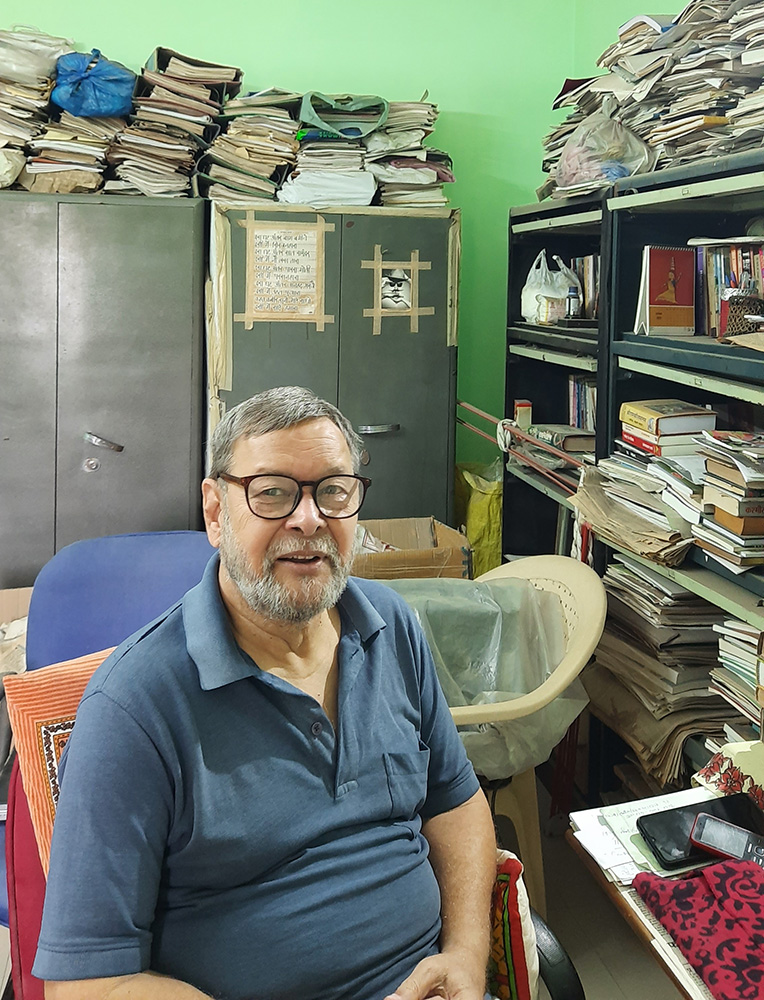
Senior journalist and founding member of the Narmada Bachao Andolan
Bhopal, Madhya Pradesh
Rakesh Dewan reflects on his relationship with the Narmada River
Many rivers in India are worshipped by different communities, especially by Hindus, and some of the largest Hindu religious gatherings take place along riverbanks across the country. Similarly, people living on the banks of the Narmada share a deep relationship with the river. Some communities worship her as a goddess and consider her divine, while others revere her as a mother and a provider. Hindus believe that a person is cleansed of all sins by bathing in the Ganges River, but merely the sight of the Narmada is believed to absolve one of all sins.
There are rituals, prayers, hymns, and scriptural texts dedicated specifically to the Narmada. Every stone found on the banks of the river is believed to be a Shiva linga, and therefore both banks are dotted with Shiva temples, many of them of great historical significance. The Narmada Purana tells us that anyone who recites the fifteen names of the Narmada—such as Reva, Mandakini, Sursa, Shoon, Mahati, Maharnav, Vipapa, Vipasha, Vimala, Karabha, Krupa, Dakshin Ganga, Trikuti and Para—each morning will be blessed. Even hearing these auspicious names is considered a blessing in itself.
Such a significant river is honoured every year during Narmada Jayanti, which is joyously celebrated along her banks to acknowledge the river as jeevan dayani—the giver of life. Namami Devi Narmade (I bow to the goddess Narmada) is a common chant among devotees, especially among those who live along the river.
What is particularly fascinating is that the Narmada is perhaps the only river in the world around which thousands of people undertake the Narmada Parikrama—a circumambulation of the river on foot. Pilgrims walk nearly 2,600 kilometres along both banks, carrying very few worldly belongings. Those living along the river consider hosting these pilgrims an act of piety that brings religious merit. Both the Narmada Purana and the Narmada Ashtakam explain the spiritual, ecological, and religious significance of the river and help us understand why many consider the Narmada divine—as a mother or a goddess.
Against this backdrop, it is important to hear what Rakesh Dewan, a senior journalist and founding member of the Narmada Bachao Andolan, has to say about the river. This is especially significant because he grew up on the banks of the Narmada and reflects on how his relationship with the river developed over time.
From describing his home on the banks of the Narmada in Hoshangabad to recalling his grandmother’s and father’s relationship with the river, he reflects on his own emotional connection with the Narmada.
This short clip from a longer interview with Rakesh Dewan helps us understand why people opposed the many dams built on the Narmada and the deep scars that the damming of the river has left on lakhs of people living along her banks.
Interview Duration:
0:08:32
Language:
Hindi, Subtitles in English
Subtitles can be switched on and off by clicking ‘CC’ button at the bottom right of the video